
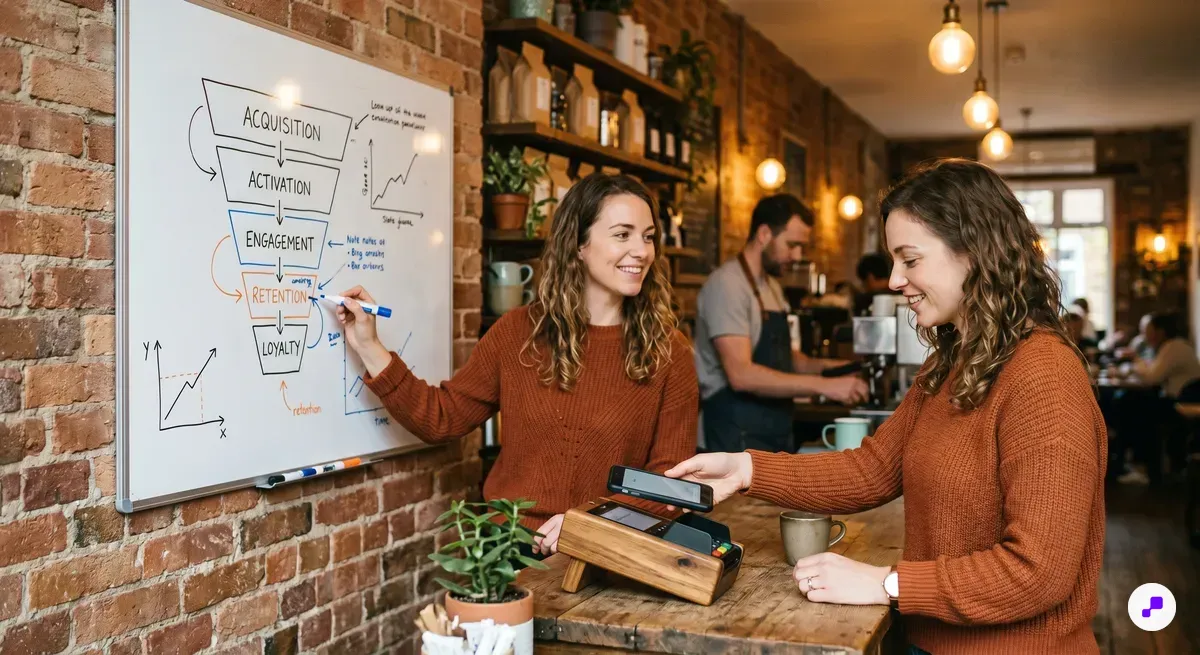
Every coffee shop owner knows that regulars are the backbone of the business. But few have put actual numbers to it. A daily customer spending $5 per visit is worth $1,300 per year. Lose them after three months, and you've captured only $325 of that potential value — a 75% revenue leak from a single customer relationship.
The math gets even more compelling when you factor in word-of-mouth. Loyal coffee customers don't just buy — they recruit. They bring friends, post Instagram stories, and recommend your shop when someone asks for a café suggestion. Research from Bain & Company shows that a 5% increase in customer retention can boost profits by 25-95%. For a coffee shop with thin margins on individual drinks, that retention-driven profitability is the difference between surviving and thriving.
Retention also reduces your dependency on paid acquisition. If you're spending $3-$5 per new customer through social ads and only 30% come back for a second visit, your effective cost per retained customer is $10-$17. But a customer who stays for a year through a loyalty program costs you the reward margin (a free drink every 10 visits, roughly $0.50 per visit) — a fraction of the acquisition cost.
The key metric to track is your repeat purchase rate. For coffee shops, a healthy benchmark is 40-50% of first-time customers making a second purchase within 30 days. If you're below 30%, you have a retention problem that no amount of advertising can solve. Check your numbers against industry benchmarks in our coffee retention strategies guide.
Start measuring retention today by segmenting your Shopify customer data into cohorts: customers acquired this month, last month, and three months ago. Track what percentage of each cohort made a repeat purchase. This simple analysis will show you exactly where customers are dropping off.
A daily coffee customer is worth $1,300+ per year — retention is the highest-ROI activity for any coffee or tea business.
Pull your Shopify customer data today and calculate your 30-day repeat purchase rate. If it's below 40%, retention should be your top priority over acquisition.
Shopify's customer segments let you create cohort analyses to track repeat purchase rates across different time periods without any external tools.
Subscriptions are the most powerful retention tool for coffee and tea businesses because they convert an active decision ("Should I buy beans this week?") into a passive default ("My beans arrive automatically"). Once a customer subscribes, the switching cost jumps from zero to the effort of canceling — and inertia is a powerful retention force.
Design your subscription tiers around consumption patterns. A single-origin enthusiast might want one 12oz bag every two weeks. A household of coffee drinkers might need two bags per week. A tea lover might prefer a curated monthly selection of four different varieties. Offer 2-3 frequency options and let customers adjust anytime — flexibility reduces cancellation anxiety.
The pricing strategy matters more than most shop owners realize. A 10-15% discount on subscription orders versus one-time purchases creates enough incentive to subscribe without training customers to devalue your product. Pair the discount with a loyalty bonus: subscription orders earn double points, accelerating the customer's path to free rewards.
Add a surprise element to prevent subscription fatigue. Include a free sample of a new roast or tea variety in every third delivery. This costs you $1-2 per shipment but creates an unboxing moment that customers look forward to and share on social media. It also introduces customers to products they wouldn't have ordered on their own, potentially driving upgrades to higher-value items.
For in-store customers who aren't ready for a full subscription, offer a prepaid coffee pass: buy 20 drinks upfront at a slight discount. This functions like a subscription in that the money is already committed, and it drives 20 guaranteed visits. Prepaid passes also work beautifully with wallet passes — the customer taps their phone, a drink is deducted from their pass, and the remaining balance updates in real time.
Track your subscription churn rate monthly. A healthy benchmark is below 8% monthly churn. If you're higher, survey canceling customers to find out why — common reasons include too much coffee accumulating, desire for more variety, or price sensitivity. Each reason has a specific fix.
Subscriptions convert active buying decisions into passive defaults — the single most effective way to lock in recurring coffee and tea revenue.
Launch a simple two-tier subscription this week: one bag every two weeks or one bag weekly. Add a free sample to every third delivery as a surprise retention hook.
Shopify's subscription APIs support recurring orders with flexible frequency, skip/pause options, and automatic payment — all managed from your existing admin.
Coffee and tea businesses have a natural advantage that most retailers envy: built-in seasonality. Pumpkin spice, holiday blends, iced tea season, cherry blossom matcha — these seasonal moments create urgency, novelty, and emotional connection that keep customers engaged throughout the year.
Build a seasonal loyalty calendar with four quarterly campaigns. Each campaign should include a limited-edition product, a loyalty bonus, and a social sharing hook. For example, your fall campaign might feature a seasonal spice blend, triple loyalty points on all seasonal drinks, and a "Share your fall cup" social contest where customers post photos for bonus points. The combination of scarcity, rewards, and community creates a retention engine that resets excitement every quarter.
Community events are underutilized retention goldmines for coffee and tea shops. A monthly cupping session where loyal customers taste new roasts before they hit the menu makes members feel like insiders. A latte art workshop on Saturday mornings turns customers into brand advocates. A tea ceremony class connects your brand to a deeper cultural experience. These events don't need to be elaborate — 10-15 people, 60 minutes, genuine hospitality.
Partner with complementary local businesses for cross-promotional retention. A bookshop loyalty swap (show your coffee loyalty pass for 10% off books, and vice versa) extends your brand into adjacent spaces. A bakery collaboration for a monthly pastry-and-coffee pairing exclusive to loyalty members creates a shared customer base. These partnerships cost nothing but deliver fresh value to your existing customers.
For online retention, a monthly email newsletter that tells the story behind your current roast or tea sourcing builds the emotional connection that keeps subscription customers engaged. People don't just buy coffee — they buy the story of the small farm in Colombia, the roaster's tasting notes, the craft behind the blend. That narrative is your moat against commodity competitors. For more creative retention ideas, visit our coffee shop loyalty program hub.
Create a "regulars' wall" — a digital or physical display recognizing your most loyal customers (with their permission). This social proof makes featured customers feel valued and shows new visitors that your shop has a devoted community worth joining.
Seasonal campaigns and community events create emotional loyalty that product quality alone can't — they give customers a reason to stay beyond the coffee itself.
Schedule one community event this month — a cupping session, latte art demo, or tea tasting — and invite your top 20 loyalty members first.
Push a wallet notification announcing seasonal launches and event invitations — 85-95% delivery rates ensure your most loyal customers never miss an exclusive moment.
The most effective retention strategies run on autopilot. Once you set up the right automations, your loyalty program works in the background while you focus on making great drinks and building relationships.
Start with the three essential automated flows for coffee shops. First, the welcome sequence: when a new customer enrolls in your loyalty program, send a wallet push notification within 24 hours thanking them and reminding them of their sign-up bonus balance. Two days later, send a second notification highlighting one premium drink they haven't tried. This two-touch onboarding increases second-visit rates by 25-30%.
Second, the milestone celebration flow. When a customer hits a points milestone (100 points, 500 points, 1,000 points), trigger a wallet notification and an email congratulating them. Include a small bonus — even 10 extra points — to reinforce the positive feeling. Milestones create psychological commitment: the more progress a customer has made, the less likely they are to abandon the program.
Third, the win-back flow. When a customer who used to visit weekly hasn't been seen in 14 days, automatically send a wallet notification: "We miss you — here's double points on your next visit." If they don't return within 7 more days, send a follow-up with a specific offer: "Your favorite oat milk latte is waiting — plus 50 bonus points if you stop by this week." This two-step win-back sequence recovers 15-20% of lapsing customers.
Beyond these core flows, set up automated triggers for specific behaviors. A customer who only orders drip coffee could receive a notification suggesting they try a pour-over with bonus points. A customer who buys beans in-store but never online could get an email with a subscription offer. A customer who referred a friend should instantly receive a thank-you notification with their referral bonus.
The wallet pass is the delivery mechanism that makes all of this work. Unlike email (20-30% open rate) or app push notifications (45-60% delivery), wallet notifications reach 85-95% of recipients and appear on the lock screen alongside their credit card and boarding pass — prime real estate for customer attention.
Use Shopify Flow to connect all these triggers. Flow's visual builder lets you create if/then automations without coding: if customer tag = "at-risk" and days since last purchase > 14, then send wallet notification with double points offer. Once built, these flows run indefinitely with zero maintenance.
Three automated flows — welcome sequence, milestone celebrations, and win-back campaigns — form the foundation of hands-free coffee customer retention.
Set up the 14-day win-back flow in Shopify Flow this week: if a previously weekly customer hasn't visited in 14 days, trigger a double-points wallet notification.
Shopify Flow automates retention triggers based on purchase behavior, customer tags, and time-based conditions — no coding required.
Wallet push notifications deliver retention messages at 85-95% reach, making them the most effective channel for time-sensitive offers like win-back campaigns.
By the time a coffee customer stops showing up, it's often too late to win them back. The key to retention is identifying at-risk behavior before the customer churns — and intervening at the right moment with the right offer.
Define your churn signals based on your typical customer behavior. For a coffee shop with daily regulars, a customer who drops from 5 visits per week to 2 is showing early warning signs even though they're still coming in. For an online tea subscription, a customer who skips two deliveries in a row is at high risk. For a bean retailer, a customer whose reorder interval stretches from 14 days to 28 days is drifting.
Create customer segments in Shopify based on these behavioral triggers. Tag customers as "engaged" (above average visit frequency), "stable" (average), "declining" (frequency dropping), and "at-risk" (significant drop or extended absence). Each segment gets a different retention treatment.
For declining customers, a subtle nudge works best. A wallet notification highlighting a new menu item or a seasonal special creates a reason to visit without feeling desperate. "Our new single-origin Ethiopian just dropped — your first cup earns triple points" gives them a specific, compelling reason to come back.
For at-risk customers, escalate to a direct value offer. A free drink, a bonus points deposit, or a personal message from the shop works well. Some of the best-performing win-back tactics in coffee are personal: "Hey [name], we haven't seen you in a while and wanted you to know we just got a new Costa Rican roast we think you'd love. Your next drink is on us." This one-to-one approach recovers at-risk customers at 2-3x the rate of generic promotional offers.
For churned customers (60+ days absent), a re-acquisition campaign is your last resort. Send an email or text with a compelling offer: "It's been a while — come back and we'll restart your loyalty with 100 bonus points." Accept that you'll only recover 5-10% of fully churned customers, but even that recovery rate is cheaper than acquiring new ones. Pair this strategy with your coffee shop loyalty checklist to make sure your foundational program is solid.
Monitor visit frequency trends — a declining customer is easier to save than one who's already gone. Intervene with personalized offers before they churn.
Create three customer segments in Shopify today: declining (frequency dropped 50%+), at-risk (no visit in 14+ days), and churned (no visit in 60+ days). Set up a different retention flow for each.
Shopify customer segments update automatically based on purchase behavior, letting you trigger different retention flows for declining, at-risk, and churned customers.
You can't improve what you don't measure. Building a simple retention dashboard that you review weekly takes 30 minutes to set up and becomes the single most valuable management tool for your coffee or tea business.
Track these six metrics on a weekly basis. Customer retention rate: what percentage of customers who purchased in month 1 also purchased in month 2? For coffee shops, a healthy benchmark is 45-55%. Repeat purchase rate: what percentage of all purchases come from returning customers? Target 65-75% — if most of your revenue comes from first-time buyers, your business is running on a treadmill.
Customer lifetime value (CLV): multiply average order value by purchase frequency by average customer lifespan. For a daily coffee customer, CLV can exceed $1,500 per year. For a monthly tea subscriber, it might be $480. Knowing your CLV tells you how much you can invest in retention and still profit.
Churn rate: what percentage of active customers from last month didn't purchase this month? For coffee shops, target below 15% monthly churn. For subscriptions, target below 8%. If churn is climbing, investigate immediately — it compounds fast.
Net Promoter Score (NPS): survey a sample of customers quarterly with one question: "How likely are you to recommend our shop to a friend?" This leading indicator predicts future retention. An NPS above 50 means you have strong organic growth potential; below 30 signals trouble.
Loyalty program engagement rate: what percentage of enrolled members earned or redeemed points in the last 30 days? Target 55-65% for coffee shops. If engagement is dropping, your rewards might be stale or your communications are being ignored.
Build this dashboard in a simple spreadsheet and update it every Monday morning. The 15 minutes it takes will surface problems weeks before they show up in your revenue. Pair this dashboard with the retention rate calculator to model how improvements in each metric affect your bottom line.
Share the dashboard with your team. When baristas see that the win-back campaign they promoted recovered 50 customers last week, they understand the impact of their enrollment efforts. When they see churn climbing, they're motivated to improve the customer experience on every shift. Transparency drives ownership.
Six metrics reviewed weekly — retention rate, repeat purchase rate, CLV, churn rate, NPS, and loyalty engagement — give you full visibility into customer retention health.
Create a simple spreadsheet with these six metrics today and commit to updating it every Monday morning for the next month. The patterns will reveal your biggest retention opportunities.
Shopify's built-in analytics provide customer cohort data, repeat purchase rates, and CLV calculations — export to a spreadsheet for your weekly dashboard.
Coffee and tea customer retention is the highest-leverage growth strategy for any café or beverage brand. By combining subscriptions, seasonal engagement, automated win-back campaigns, and omnichannel loyalty, you can increase customer lifetime value by 30-50% while reducing your dependency on expensive acquisition channels. The coffee shops that thrive long-term are the ones that invest as much in keeping customers as they do in finding new ones.
JeriCommerce helps coffee and tea brands retain more customers with omnichannel loyalty — automatic points, push notifications that actually get seen, and Shopify POS integration that works as fast as your morning rush demands.
Automate retention with omnichannel loyalty. push notifications, milestone rewards, and win-back campaigns that run while you brew.
Install Free on Shopify