
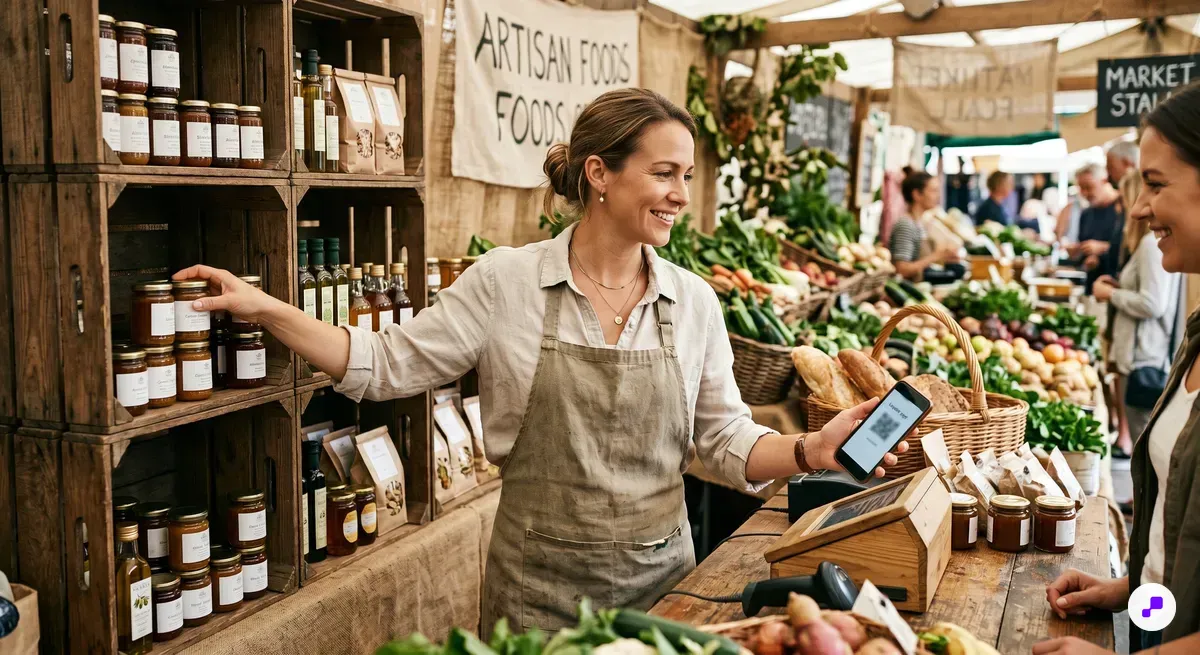
Food and beverage is one of the most naturally omnichannel categories in ecommerce. Your customers discover you at a farmers market, follow you on Instagram, order from your Shopify store, and buy your products at a local specialty retailer. Each of these touchpoints is an opportunity to build loyalty — and each one is wasted if your rewards program only works online.
The problem goes deeper than missed points. A customer who buys from you at a pop-up and doesn't earn rewards feels like a second-class buyer compared to online shoppers. Over time, they associate your brand with inconsistency. They might love your product but never develop the loyalty habit because their offline purchases don't count toward anything.
Single-channel loyalty also blinds you to your best customers. Someone who spends $200/month across your website, a local shop, and weekend markets might look like three separate small customers — or worse, might not appear in your loyalty data at all for their in-person purchases. Without a unified view, you can't identify your VIPs, you can't personalize their experience, and you can't reward them proportionally.
The food and beverage brands that dominate retention are the ones that treat every purchase as part of one continuous relationship. Whether a customer taps their wallet pass at a farmers market stand or checks out on Shopify, the points accumulate in the same account and the rewards are available everywhere. For the building blocks of a strong loyalty program, see our food brand loyalty program guide.
Single-channel loyalty misses in-person purchases, fragments customer profiles, and prevents food brands from recognizing their most valuable buyers.
List every channel where customers currently buy your products and identify which ones aren't connected to your loyalty program — that gap is where you're losing retention.
Shopify POS unifies in-store and online customer profiles, so a purchase at a pop-up and an order on your website both appear in the same customer record.
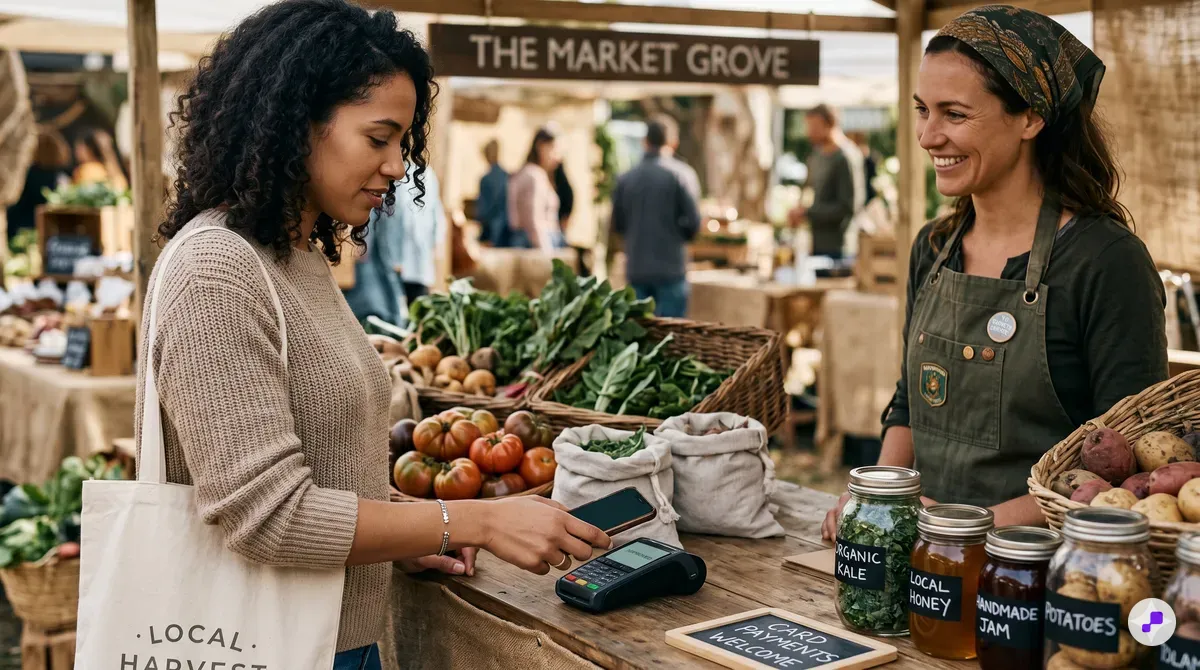
An omnichannel points structure for food and beverage needs to be simple enough for a farmers market transaction and robust enough for an online subscription. The key principle is consistency: one point per dollar spent, regardless of channel. When customers know the math is the same everywhere, they stop thinking about where to buy and start buying wherever is most convenient — which increases total purchase frequency.
Define your earning actions across all channels. In-person purchases via Shopify POS earn the standard 1 point per dollar. Online Shopify purchases earn the same. Subscription deliveries earn 1.5x as a premium for commitment. Referrals earn a flat 500 points. Product reviews earn 50 points. Social sharing earns 25 points. This mix ensures that every customer interaction, regardless of channel, contributes to their loyalty balance.
For food and beverage specifically, add channel-specific bonus events rather than different base rates. Run a 'Double Points Saturday' at your farmers market stand to drive foot traffic. Offer triple points on online-exclusive products to push new launches. Create a pop-up-only bonus where customers who buy in person and add a wallet pass earn 100 extra points. These promotions make each channel feel special without creating confusion about the base earning rate.
Redemption should also work everywhere. A customer who accumulates points online should be able to redeem a free product at your farmers market booth, and vice versa. This cross-channel redemption is what makes the program feel truly unified. Wallet passes make this practical — the customer shows their pass, the vendor scans it or looks up the account on Shopify POS, and the reward is applied. Learn more about the rewards that work best in our best rewards for food brands resource.
Use a consistent base earning rate across all channels with channel-specific bonus events — consistency builds trust while bonuses drive traffic to specific channels.
Set a universal earning rate of 1 point per dollar across all channels and plan one channel-specific bonus promotion per month to highlight different sales channels.
Shopify POS applies the same loyalty rules as your online store, ensuring that a customer earns points at a pop-up just as they would on your website.
The wallet pass displays a single points balance regardless of where points were earned — customers see their total loyalty value, not a confusing channel-by-channel breakdown.
Shopify POS is the backbone of omnichannel loyalty for food and beverage brands because it connects your in-person sales to the same customer database as your online store. Whether you're selling at a farmers market, a food festival, a pop-up, or your own retail location, Shopify POS ensures every transaction feeds into one unified loyalty profile.
The setup process starts with your hardware. For farmers markets and pop-ups, the Shopify POS mobile app on an iPad or iPhone with a card reader is all you need. For a permanent retail location, add a barcode scanner and a receipt printer. The critical addition for loyalty is an NFC reader — this lets customers tap their wallet pass to identify themselves, earn points, and redeem rewards in a single gesture.
Configure your loyalty app to work with POS. The best loyalty apps for food brands integrate seamlessly with Shopify POS, showing the customer's loyalty status, points balance, and available rewards directly on the POS screen during checkout. When a customer taps their wallet pass, the staff member sees: 'Sarah M. — Gold Member — 780 points — Free shipping reward available.' This information lets your team deliver a personalized experience even in a fast-paced market environment.
Train your market staff to make loyalty a natural part of every transaction. The script is simple: for new customers, 'Would you like to join our rewards program? You'll earn points on today's purchase.' For existing members, 'I see you're 50 points from a free jar of our seasonal preserve — want to add anything today?' These 10-second interactions dramatically increase enrollment and engagement. For more Shopify tools that complement your setup, see our food brand loyalty checklist.
Use Shopify's location feature to track which channels drive the most loyalty engagement. You can create separate POS locations for each farmers market, pop-up, or retail partner, then analyze which locations produce the highest loyalty enrollment rates and repeat purchase rates.
Shopify POS with NFC wallet pass scanning turns every in-person sale into a loyalty interaction — one tap handles identification, points earning, and reward redemption.
Set up your Shopify POS with an NFC reader before your next farmers market or pop-up, and brief your staff on a 10-second loyalty enrollment script.
Shopify POS locations let you track loyalty enrollment and engagement by channel — farmers market vs. pop-up vs. retail — so you know where your most loyal customers come from.
The biggest challenge in omnichannel loyalty isn't the technology — it's the customer experience. How does a customer prove they're a loyalty member at a farmers market? How do they check their points balance while browsing your pop-up? How do they redeem a reward earned online at an in-person event? Wallet passes answer all three questions with a single solution.
A digital wallet pass in Apple Wallet or Google Wallet serves as a universal loyalty identifier. The customer taps their phone at any Shopify POS location to identify themselves, and their entire loyalty history — points earned online, points earned in person, available rewards, tier status — appears instantly. No app to download, no card to carry, no phone number to recite. Just a tap.
For food and beverage brands selling at markets and events, this frictionless identification is critical. Farmers market transactions move fast — you have maybe 30 seconds between 'I'll take two jars of that salsa' and the next customer. A wallet tap takes 2 seconds. Asking someone to spell their email takes 20. That speed difference is the difference between 90% loyalty participation and 15%.
Wallet passes also bridge the gap between channels through push notifications. After a customer buys at your farmers market booth, send a notification: 'Great seeing you today! You earned 25 points — browse our online-exclusive flavors and earn more.' This message drives the customer from an in-person touchpoint to your online store, creating the cross-channel behavior that maximizes lifetime value. Read about how wallet pass engagement compares to other channels in our wallet pass guide for food brands.
The pass updates dynamically across all channels. A purchase at the market updates the balance. An online order updates it again. The customer always sees one accurate number — no confusion, no discrepancies, no frustrated emails asking 'Where are my points from Saturday?'
Wallet passes are the fastest and most reliable way to identify loyalty members across channels — a 2-second tap replaces 20 seconds of manual lookup.
Design your wallet pass with a prominent points balance and QR code backup (for venues without NFC readers), and distribute it to your top 50 customers before your next market event.
Wallet passes unify the omnichannel loyalty experience into a single tap — the same pass works at your farmers market booth, your pop-up, and your online store.
One of the trickiest aspects of omnichannel loyalty is running promotions that drive traffic to specific channels without making the program feel inconsistent. The solution is to keep your base program identical everywhere while layering promotional bonuses that are clearly temporary and channel-specific.
The rule of thumb: base earning rates never change. One point per dollar, everywhere, always. What changes is the bonus layer. 'This Saturday: 3x points at the Greenville Farmers Market' is a clear, time-limited promotion that drives foot traffic without confusing the core program. Customers understand that the base program is fair and consistent while bonuses are special opportunities.
For online-exclusive promotions, use loyalty to drive behaviors that only the digital channel enables. Double points for leaving a review (online-only activity), bonus points for subscribing (online-only option), or extra points for sharing on social media. These promotions reward digital engagement without penalizing in-person shoppers.
For in-person promotions, reward the behaviors unique to physical channels. Bonus points for attending a tasting event, extra points for buying at a new retail location, or a loyalty enrollment bonus at your first farmers market of the season. These promotions make in-person shopping feel like a loyalty event rather than just a transaction.
Create a monthly promotional calendar that alternates between channels. Week 1: double points online. Week 2: bonus points at the farmers market. Week 3: exclusive reward available only for in-store redemption. Week 4: social sharing bonus. This rotation keeps the program feeling fresh across all channels without playing favorites. Track which promotions drive the most incremental purchases to refine your calendar over time. For tiered reward ideas that work across channels, explore our VIP tiers for food brands.
Keep base earning rates identical across channels and use temporary bonus promotions to drive traffic to specific channels without fragmenting the program.
Create a monthly promotional calendar with one channel-specific bonus per week, alternating between online, market, pop-up, and social — track incremental revenue from each.
Shopify Flow can activate and deactivate channel-specific bonus point rules automatically based on your promotional calendar, eliminating manual management.
Measuring a loyalty program that spans multiple channels requires more nuanced analytics than a single-channel program. You need to understand not just overall performance, but how each channel contributes to and benefits from the loyalty ecosystem.
Track these omnichannel-specific metrics monthly. Cross-channel purchase rate: what percentage of loyalty members buy through more than one channel? This is your primary omnichannel success metric — target 25%+ within six months. Channel attribution: which channel drives the most loyalty enrollments? Which drives the most repeat purchases? This data should guide your promotional spending. Channel-to-channel flow: how many customers who enroll at a farmers market later purchase online? How many online subscribers later buy at events? This flow data reveals whether your omnichannel strategy is truly working.
Compare loyalty member behavior against non-members within each channel. At your farmers market booth, do loyalty members spend more per visit than non-members? Online, do loyalty members order more frequently? If loyalty members outperform non-members across all channels, your program is working. If they only outperform in one channel, you need to strengthen the program's presence in the underperforming channels.
Pay special attention to customers who engage across multiple channels — they're typically your most valuable segment. Research consistently shows that omnichannel customers spend 30-50% more than single-channel customers and retain at significantly higher rates. Identify these customers and create VIP experiences that reward their cross-channel behavior: an exclusive tasting invitation, early access to new products, or a personal thank-you from your team.
Review your omnichannel dashboard quarterly and make structural adjustments annually. The monthly reviews catch tactical issues (a market location with low enrollment, an online promotion that didn't move the needle). The quarterly reviews reveal strategic patterns (which channels produce the highest-CLV customers, whether cross-channel behavior is growing). Use our loyalty ROI calculator to quantify the impact across channels.
Cross-channel purchase rate is your primary omnichannel metric — customers who buy through multiple channels spend 30-50% more and retain at higher rates.
Set up a monthly report tracking what percentage of loyalty members purchase through more than one channel — if it's below 20%, add more cross-channel promotions and wallet pass notifications.
Shopify's unified customer profiles let you track purchase history across POS locations and online, enabling true omnichannel cohort analysis and attribution.
An omnichannel loyalty program unifies every customer touchpoint — online, farmers market, pop-up, retail — into one seamless rewards experience. For food and beverage brands selling across multiple channels, this unified approach captures revenue you're currently missing and identifies your most valuable customers regardless of where they buy.
JeriCommerce connects your loyalty program across every channel — wallet passes that work at Shopify POS, farmers markets, pop-ups, and online, with one points balance and one customer profile everywhere.
One wallet pass, one points balance, every channel. from your Shopify store to farmers markets and pop-ups. No app download required.
Install Free on Shopify