
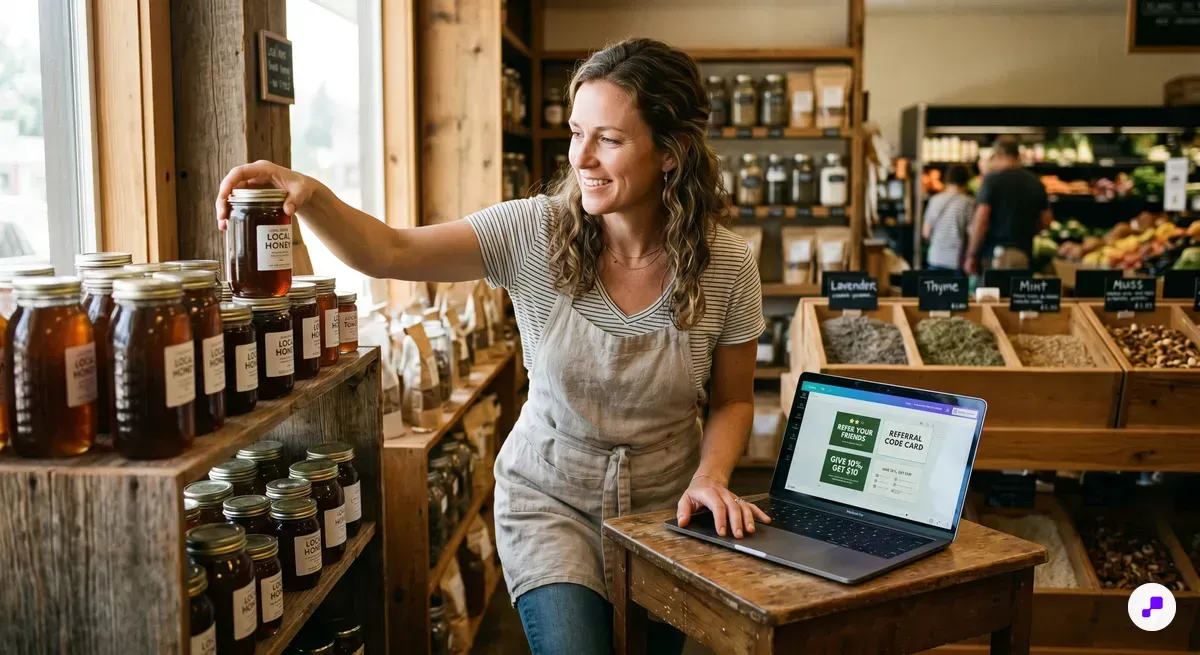
Health food store customers are natural advocates — a referral program amplifies behavior that's already happening at a fraction of the cost of paid ads.
Health food and organic store customers are already passionate advocates. They don't just buy groceries — they make lifestyle choices. When someone switches to organic produce, finds a supplement that works, or discovers a local store with better quality than the chain, they talk about it. At dinner parties, in group chats, at yoga class. Your store is part of their identity.
This makes referral programs disproportionately effective for health food retail compared to generic grocery. A referral from a health-conscious friend carries enormous trust. The new customer doesn't need convincing about the value of organic food — they need convincing about your specific store. A personal recommendation handles that instantly.
The economics are compelling. Customer acquisition through paid advertising costs health food stores $15-40 per new customer. A referred customer costs you only the referral reward — typically $5-10 in store credit or loyalty points. That's a 60-75% reduction in acquisition cost. And referred customers tend to spend 16-25% more in their first year than customers acquired through ads, because they already trust the recommendation. For a full breakdown of these economics, see our loyalty program ROI analysis for health food stores.
The timing is perfect. Your customers are already talking about your store. A referral program simply adds structure, tracking, and rewards to behavior that's already happening. You're not creating advocacy — you're amplifying it.
Ask your next 10 customers at checkout: 'How did you first hear about us?' Track the answers. If more than 30% say a friend or family member, you have strong referral potential to formalize.
Wallet passes make referral sharing instant — a customer taps 'Refer a Friend' on their pass, and the friend receives a welcome offer via text message.

Two-sided rewards (Give $10, Get $10) with a minimum purchase threshold create the ideal balance of generosity and sustainability.
The best referral programs reward both sides — the referrer who advocates for you and the new customer who takes the leap. A one-sided reward creates an awkward dynamic where the referrer feels like they're selling rather than sharing. Two-sided rewards make the referral feel generous.
For health food stores, the ideal structure is: the referrer earns loyalty points or store credit, and the new customer gets a welcome discount on their first purchase. A proven formula is "Give $10, Get $10" — the new customer gets $10 off their first purchase of $30+, and the referrer earns $10 in loyalty points or credit when the friend makes that first purchase.
The minimum purchase threshold is important. Without it, people game the system with tiny purchases. A $30 minimum ensures the new customer has a genuine shopping experience, not just a free item grab. For health food stores with an average basket of $35-65, a $30 threshold is low enough to feel accessible but high enough to represent a real visit.
Consider tiering your referral rewards for power advocates. The first 3 successful referrals earn $10 each. Referrals 4-10 earn $15 each. After 10 successful referrals, the advocate earns $20 per referral plus a permanent "Ambassador" status on their wallet pass. This escalating structure identifies and rewards your most influential customers. For more ideas on referral incentive structures, explore our referral program examples for health food stores.
Keep the rules simple. If a customer needs to read a terms-and-conditions page to understand the program, you've already lost them. One sentence should explain it: "Share your link with a friend. They get $10 off their first order over $30. You get $10 in rewards when they buy."
Launch with a 'Give $10, Get $10' structure and a $30 minimum first purchase. Track conversion rates for the first 60 days before adjusting.
Shopify discount codes can be auto-generated for each referral, with unique tracking links tied to the referrer's customer profile.
The referrer's wallet pass shows their referral count and earned rewards in real time: 'You've referred 4 friends — $40 earned. Keep sharing!'
Text message sharing is the highest-converting referral channel for local health food stores — make it a single tap from the wallet pass.
How your customers share referrals matters as much as what they share. For health food stores, the most effective channels are personal text messages, in-person conversations at the register, and social media sharing. Email referrals work but convert at lower rates for local businesses.
Text message sharing is the highest-converting channel for local stores. When a customer texts a friend "I love this organic store near us — here's $10 off your first order," the conversion rate is 3-5x higher than a social media post because it's personal and targeted. Make sharing via text effortless: a single tap on the wallet pass generates a pre-written text with the referral link.
In-store referral moments happen naturally. A customer is checking out and their friend says, "Where did you get that amazing sourdough?" Train your staff to jump on these moments: "If you share your referral link right now, your friend gets $10 off." Physical referral cards with QR codes work too — hand a card to the friend, they scan the code, and both people are connected in your system.
Social media sharing works for broader reach but lower conversion. A customer posting "Just discovered the best organic store" on Instagram creates awareness, but the conversion to a first purchase takes longer. Still, it's free marketing. Make the sharing template visually appealing — a branded referral image with the offer clearly stated. Our referral program hub covers channel strategy in more detail.
For online-first customers (local delivery users), embed referral sharing in the post-purchase experience. After an order confirmation, show: "Love your order? Share $10 with a friend." This catches customers at peak satisfaction — right after they've received their delivery.
Create a pre-written referral text template that customers can send with one tap. Include the store name, the offer, and a short tracking link.
Shopify's post-purchase page can include a referral sharing widget, capturing the moment of highest customer satisfaction.
A 'Refer a Friend' button on the wallet pass back generates a unique tracking link and pre-fills a text message — sharing takes under 5 seconds.
Every referral should be traceable from share to first purchase — unique codes tied to customer profiles make attribution clean and automatic.
You can't improve what you don't measure, and a referral program without proper tracking is just a discount with extra steps. Every referral should be traceable from share to purchase, so you know which customers are driving new business and which incentive amounts are working.
The simplest tracking method uses unique referral codes tied to each customer. When Sarah refers her friend, she shares a link or code (e.g., SARAH10) that gives the friend $10 off. When that code is used at checkout — in-store via Shopify POS or online — the system credits Sarah with the referral reward. This creates a clean attribution chain.
For Shopify stores, set up automatic discount code generation through your loyalty app. Each enrolled customer gets a unique referral link and code when they join. The code is displayed on their wallet pass and can be shared via text, social media, or verbally. When the new customer uses the code, Shopify tags the transaction as a referral and triggers the referrer's reward.
Track four key metrics weekly: shares (how many customers are sharing their referral link), conversions (how many shared links turn into first purchases), referral revenue (total revenue from referred customers), and payback period (how long until a referred customer's purchases exceed the combined reward cost). Most health food stores find that referred customers pay back the referral reward within 2-3 visits.
Set up automated notifications to keep referrers engaged. When their friend makes a purchase: "Your friend just shopped at [Store]! $10 in rewards has been added to your balance." This instant feedback loop motivates more sharing. For top referrers, send a monthly summary: "You've referred 3 friends this month — $30 earned. You're our #2 ambassador!" Read more about referral program structures in our ecommerce referral program guide.
Set up unique referral codes for your top 50 customers this week and track shares, conversions, and revenue in a simple dashboard.
Shopify discount codes with unique prefixes per customer create automatic referral attribution at both POS and online checkout.
Each customer's wallet pass displays their unique referral code and a 'Share' button — no need to look up codes or remember URLs.
A small group of power referrers will drive the majority of your new customer acquisition — identify, reward, and celebrate them.
Within your referral program, a small group of customers will drive the majority of referrals. These are your ambassadors — the people who genuinely love your store and actively tell everyone they know. Identifying and rewarding these power referrers turns casual advocacy into a structured acquisition channel.
Define ambassador tiers based on successful referrals. After 5 successful referrals, a customer becomes a "Community Ambassador" with enhanced rewards: $15 per referral instead of $10, a special badge on their wallet pass, and early access to new products. After 15 referrals, they become a "Founding Ambassador" with $20 per referral, a monthly free product sampler, and an invitation to quarterly brand partner events.
Ambassadors are not influencers — they're genuine customers who happen to be well-connected in your community. The yoga instructor who mentions your store to her class. The parent who organizes the neighborhood co-op. The nutritionist who recommends your supplements. These people have audiences that trust them, and their recommendations carry more weight than any paid promotion.
Make ambassador identification automatic. Any customer who hits 5 successful referrals in 6 months gets flagged in your Shopify system, their wallet pass updates with the ambassador badge, and they receive a personal thank-you message from the store owner. This personal touch matters — ambassadors want recognition, not just rewards.
Host exclusive ambassador events quarterly. A private tasting of new products, a meet-the-farmer evening, or a nutrition workshop just for ambassadors. These events cost little to host but create powerful social proof when ambassadors share photos and stories. The ROI is extraordinary: a single ambassador event generating 20 social media posts reaches thousands of potential customers organically.
Identify your top 5 referrers right now (even informally) and invite them to be founding members of your ambassador program with enhanced rewards.
Ambassador wallet passes feature a unique design with a badge, higher reward rates, and a real-time referral counter that creates visible social status.
Online referrals need a frictionless first-purchase experience — a dedicated landing page with pre-filled discount codes converts best.
If your health food store offers local delivery or pickup through your Shopify online store, your referral program needs to work seamlessly in the digital channel. Online referrals have different dynamics than in-store — the sharing is easier, but the friction of a first online order can be higher.
Optimize the referred friend's first online experience. When someone clicks a referral link, they should land on a dedicated page that says: "[Friend's name] thinks you'll love [Store name]. Here's $10 off your first order of $30+." Pre-fill the discount code. Show your most popular products. Make the path from click to cart as short as possible. If the first experience is clunky, the referral is wasted.
For local delivery referrals specifically, address the main objection: "Will the quality be as good as shopping in person?" Feature photos of your delivery packaging, mention your same-day delivery radius, and highlight that the same staff who stock the shelves pick the delivery orders. Referred delivery customers who have a great first experience become your most loyal online shoppers.
Track online vs. in-store referral conversion rates separately. You'll likely find that online referrals convert at a slightly lower rate (10-15% vs. 15-25% for in-store) but generate higher average first-order values because delivery customers tend to buy more per order to justify the delivery feel. Use these insights to adjust your incentive structure by channel if needed.
Integrate referral prompts throughout the online journey. After a customer places a delivery order: "Share $10 with a neighbor." In the delivery confirmation email: "Love your order? Your referral link: [link]." On the packing slip inside the delivery bag: a small card with a QR code and "Share this with a friend." Every touchpoint is an opportunity to turn one delivery customer into two. Our Shopify marketing guide for health food stores covers more online growth tactics.
Create a dedicated referral landing page for your Shopify store this week with a hero image, pre-filled discount code, and your 10 best-selling products.
Shopify landing pages can be configured to auto-apply referral discount codes when a customer arrives through a referral link.
Referred customers receive a wallet pass with their welcome discount pre-loaded — one tap to install, discount applied automatically at checkout.
Referred customers typically deliver 300-600% ROI and have 16-25% higher lifetime value than ad-acquired customers.
A referral program without measurement is a guessing game. You need to know whether your program is generating profitable growth, which incentive amounts work best, and where to invest more to scale what's working.
Calculate your referral program ROI monthly. The formula is simple: (Revenue from referred customers – Total referral rewards paid) / Total referral rewards paid × 100. If you paid $500 in referral rewards last month and referred customers generated $3,000 in revenue, your ROI is 500%. Most well-run health food store referral programs see 300-600% ROI because referred customers have higher lifetime values than ad-acquired customers.
Track the referral funnel weekly: impressions (how many people see a referral share), clicks (how many click the link), conversions (how many make a first purchase), and retention (how many become repeat customers). Each stage tells you something different. Low impressions mean not enough customers are sharing. Low click-to-conversion means the landing page needs work. Low retention means the first experience isn't meeting the expectation set by the referrer.
A/B test your referral incentives every quarter. Try $10 vs. $15 for the referrer. Test "$10 off" vs. "free item" for the new customer. Compare text-based sharing vs. social media sharing. Small changes in incentive structure can dramatically shift referral volume. Run each test for at least 30 days to get statistically meaningful results.
Compare referral customer lifetime value against other acquisition channels quarterly. Referred customers typically have 16-25% higher LTV than ad-acquired customers. If that premium holds in your data, it justifies increasing your referral reward — even doubling it might still be cheaper than paid ads. For detailed retention benchmarks, see our health food store retention statistics resource.
Set up a monthly referral ROI calculation: revenue from referred customers minus rewards paid, divided by rewards paid. Review it on the first of every month.
Shopify's customer segmentation lets you tag referred customers and compare their purchase history and retention against other acquisition channels.
Wallet pass data tracks referral link shares, giving you visibility into the top of the referral funnel without relying on email click tracking.
A referral program for your health food store turns existing customer advocacy into a structured, measurable acquisition channel. With two-sided rewards, wallet-based sharing, and ambassador tiers, you can reduce acquisition costs by 60%+ while attracting higher-value customers who already trust your brand through personal recommendations.
JeriCommerce makes referral programs effortless for health food stores — wallet pass sharing, automatic referral tracking, Shopify POS integration, and ambassador tier management, all without asking customers to download an app.
Wallet-based referral sharing, automatic tracking, and ambassador tiers. built for health food stores on Shopify.
Install Free on Shopify