
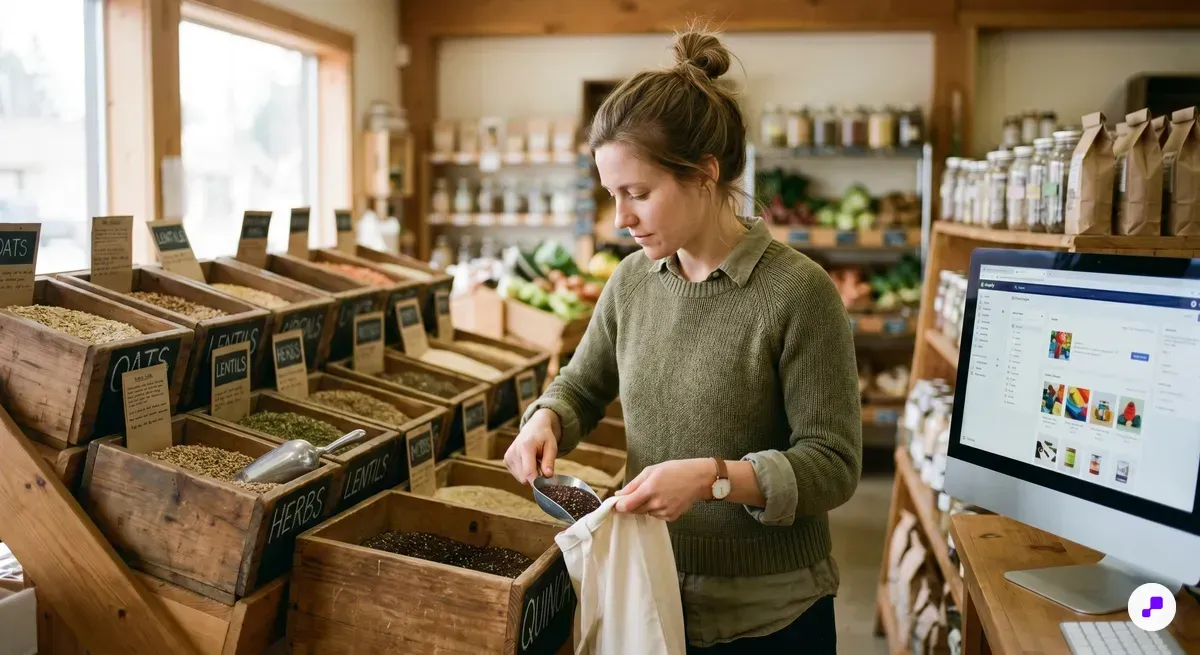
Google Business Profile optimization and systematic review collection are the highest-ROI local SEO tactics for health food stores.
When someone searches "organic grocery near me" or "health food store" on their phone, your store needs to appear in the top 3 Google Maps results. Local SEO is the highest-ROI marketing channel for health food stores because it captures customers at the moment of intent — they're literally looking for what you sell, right now, nearby.
Start with your Google Business Profile. Claim it if you haven't already, and optimize every field: accurate name, address, phone number, business hours (including holiday hours), and categories (primary: "Health Food Store," additional: "Organic Food Store," "Grocery Store," "Vitamin & Supplement Store"). Add 20+ high-quality photos: storefront, interior, produce section, supplement wall, juice bar, staff, and events. Google ranks profiles with more photos higher in local results.
Build your review count systematically. After every positive in-person interaction, train staff to say: "If you enjoyed your experience, we'd love a Google review — it really helps our small business." After every delivery order, send a follow-up with a direct review link. Aim for 100+ reviews with a 4.5+ average. For local search, review count and recency are the two strongest ranking factors after proximity.
Create location-specific content on your Shopify blog. Write about local farmers you partner with, seasonal produce availability in your region, and community events you host. Each post signals to Google that your store is relevant to local searches. Use keywords naturally: "organic grocery store in [city]," "local health food store [neighborhood]," "organic delivery [city]." This local content strategy also supports your broader retention efforts — see our customer retention strategies hub for more.
Ensure your Shopify online store has consistent NAP (Name, Address, Phone) information, a Google Maps embed on the contact page, and structured data markup for local business. These technical basics are table stakes for local SEO.
Add 10 new photos to your Google Business Profile this week and ask 5 satisfied customers for reviews. Track your local search ranking for 'health food store near me' monthly.
Shopify's built-in blog and SEO tools let you create location-optimized content that supports local search visibility.
Include a Google review link on the back of your wallet pass — customers can tap to leave a review right after a positive shopping experience.

Instagram for product storytelling, Facebook for local community building, and TikTok for educational content — focus on local engagement, not virality.
Social media for health food stores isn't about going viral — it's about building a local community of engaged followers who become regular customers. The platforms that work best for health food retail are Instagram (visual product storytelling), Facebook (local community engagement), and TikTok (educational short-form content about nutrition and health).
Instagram is your primary platform. Post three types of content on rotation: product arrivals (fresh produce, new supplements, seasonal items), behind-the-scenes (farm visits, staff picks, delivery prep), and educational (nutrition tips, ingredient spotlights, cooking inspiration). Use local hashtags (#[city]organic, #[neighborhood]foodie) to reach nearby users. Reels showing "what's fresh today" or "staff picks of the week" consistently outperform static posts in engagement.
Facebook is where your community lives. Create a private Facebook group for loyalty members called something like "[Store Name] Insiders." Share exclusive deals, ask for product requests, and post about upcoming events. A group of 200-500 engaged local shoppers is more valuable than 10,000 passive followers. Use Facebook Events for every in-store event — cooking classes, tastings, farmer meet-and-greets — and invite your group members.
TikTok is underutilized by health food stores but increasingly powerful. Short videos (30-60 seconds) about nutrition myths, product comparisons ("organic vs. conventional — here's the real difference"), and day-in-the-life store content perform well. You don't need polished production — authenticity works better. A 45-second video of your buyer explaining why they chose a specific farm's eggs can drive more trust than any ad.
For all platforms, the goal is to drive two actions: in-store visits and online orders. Include your Shopify store link in every bio and use Stories/Reels to promote specific products available for delivery. Track social-attributed revenue monthly using UTM links in your Shopify store. Our referral program guide covers how social sharing can amplify your reach.
Start a 30-day Instagram Reels challenge: post one 30-second video daily showing fresh arrivals, staff picks, or a quick nutrition tip. Track follower growth and store mentions weekly.
Shopify's Instagram and Facebook sales channels let you tag products in social posts and Stories, creating direct purchase paths from social content.
Combine weekly emails for planned communication with wallet push notifications for time-sensitive alerts — together they create unmatched customer reach.
Email remains the highest-ROI digital marketing channel, returning $36-42 for every dollar spent. But for health food stores, the real opportunity is combining email with wallet push notifications to create a multi-channel communication system that actually reaches your customers.
Build your email list through three channels: in-store sign-up at the register (train staff to ask), loyalty program enrollment (email is required), and online order accounts. Aim for 60%+ of your active customers on your email list. Segment your list into active shoppers (purchased in the last 30 days), at-risk shoppers (30-60 days since last purchase), and lapsed shoppers (60+ days).
Send three types of emails on a regular cadence. First, a weekly "What's Fresh" email on Tuesday or Wednesday that highlights new arrivals, seasonal produce, and limited-stock items. This drives mid-week store visits during your slow periods. Second, a monthly loyalty recap showing each customer's points balance, tier progress, and available rewards. Third, event invitations for cooking classes, tastings, and community events.
Wallet push notifications complement email for time-sensitive messages. When you get a fresh shipment of local strawberries that will sell out by Saturday, a wallet push reaches 85-95% of customers within minutes. Email can't match that speed or visibility. Use wallet pushes for: flash sales, limited-stock alerts, bonus point promotions, and personalized win-back messages. Keep pushes to 2-3 per week maximum to avoid notification fatigue.
Automate your most important emails with Shopify Email or a connected tool. Post-purchase follow-up (thank them, show loyalty progress), birthday emails (with a reward), and win-back sequences (escalating offers at 21, 35, and 50 days of inactivity). These automated flows generate revenue while you sleep. For more on preventing customer loss, see our churn reduction guide for health food stores.
Launch a weekly 'What's Fresh' email this week. Send it every Wednesday with 5 product highlights and one loyalty bonus offer. Track open rates and in-store visits Thursday-Saturday.
Shopify Email integrates directly with your product catalog and customer segments, making it easy to create personalized product recommendation emails.
Wallet pushes reach 85-95% of customers for time-sensitive messages — use them for flash sales, limited-stock alerts, and bonus point promotions.
Loyalty and referral programs outperform paid advertising on cost per acquisition, lifetime value, and retention — treat them as marketing channels, not just retention tools.
Most store owners think of loyalty programs as retention tools and referral programs as acquisition tools. They're both of those things — but they're also marketing channels with better ROI than paid advertising.
Your loyalty program generates marketing touches every time a customer earns points, redeems a reward, or receives a tier notification. Each of these interactions reinforces your brand, reminds the customer you exist, and creates a reason to return. A customer who gets a wallet push saying "You're 50 points from a free smoothie" is receiving marketing — but it doesn't feel like marketing because it's about their progress, not your promotion.
Your referral program turns customers into a sales force. Every referral share is a personal endorsement from someone the recipient trusts. The referred friend arrives pre-sold on your store, with a discount to remove the friction of a first visit. Referral customers cost 60-75% less to acquire than paid ad customers and have 16-25% higher lifetime value. That's the best marketing math in the business.
Combine loyalty and referral for compounding effects. When a loyal customer earns points for referring a friend, and that friend earns points for their first purchase, you've created a viral loop where every transaction feeds the next one. Top-performing health food stores generate 25-40% of new customers through their referral program — at a fraction of the cost of paid ads.
Track your loyalty and referral programs as marketing channels in your marketing dashboard. Compare cost per acquisition, lifetime value, and retention rates against Facebook ads, Google ads, and other paid channels. You'll almost certainly find that loyalty and referral outperform paid on every metric. For a full breakdown of the numbers, see our loyalty program ROI analysis.
Add 'loyalty program' and 'referral program' as attribution channels in your marketing tracking. Compare their cost per acquisition against paid ads for 90 days.
Shopify's customer tags and order attribution let you track revenue from loyalty-driven and referral-driven purchases as distinct marketing channels.
Every loyalty notification and referral share through the wallet pass is a zero-cost marketing touch with 85%+ delivery — better reach than any paid ad.
Community events, local partnerships, and in-store experiences are your unfair advantage — they generate marketing content, customer loyalty, and revenue simultaneously.
Community marketing is the unfair advantage that small health food stores have over big chains. Whole Foods can stock organic produce, but they can't host a monthly farm-to-table dinner with a local chef in a 12,000 square foot warehouse. Your store's intimate size and local connections make community marketing your most powerful and least expensive strategy.
Host monthly events that combine education and socializing. Cooking classes using ingredients from your store ($15-20 per person, capped at 15 attendees) generate direct revenue, introduce customers to new products, and create social media content. Nutrition workshops with local practitioners (free, open to loyalty members first) position your store as a health authority. Farmer meet-and-greets on Saturday mornings (free, with samples) connect customers directly to the source of their food.
Partner with complementary local businesses for cross-promotion. A yoga studio, a naturopathic clinic, a meal prep service, a local gym — these businesses share your customer base without competing directly. Cross-promote each other's services: your flyers in their studio, their class schedule at your register. Offer joint loyalty perks: "Show your [Yoga Studio] membership for 10% off supplements." These partnerships extend your reach without extending your marketing budget.
Sponsor and participate in local health and wellness events. Farmer's markets, 5K charity runs, health fairs, school nutrition programs — every local event is an opportunity to put your brand in front of potential customers in a positive context. Bring samples, hand out wallet pass enrollment cards, and collect email addresses.
Create a content engine from your community activities. Every cooking class becomes an Instagram Reel. Every farmer visit becomes a blog post. Every event becomes a Facebook photo album. Your community marketing generates social proof, content, and customer engagement simultaneously — something no paid ad can replicate. For more acquisition strategies, read our referral program guide for health food stores.
Schedule your first monthly event this week. Start simple: a free Saturday morning tasting of 3 new products, open to loyalty members first. Photograph everything for social media.
Use Shopify's customer segments to send event invitations to your most engaged shoppers and track post-event purchase behavior.
Paid ads should supplement loyalty, referral, and community marketing — not replace them. Use them for awareness and specific promotions, not broad brand campaigns.
Paid advertising should be your last marketing lever, not your first. Loyalty programs, referral programs, email, social, and community marketing all deliver better long-term ROI. But paid ads have a role: driving initial awareness, promoting seasonal products, and reaching customers who don't know you exist yet.
Google Local Service Ads are the highest-value paid channel for health food stores. When someone searches "organic grocery store near me," your ad appears at the very top of the page with your star rating, phone number, and distance. You only pay when someone calls or requests directions. Budget $300-500/month and track how many ad-attributed calls convert to first-time store visits.
Facebook and Instagram ads work well for promoting specific products and events. A $50 boosted post about your Saturday morning tasting event can reach 5,000-10,000 local users. Target by location (5-mile radius), interests (organic food, healthy eating, fitness), and lookalike audiences based on your existing customer email list. For product ads, carousel formats showing 4-5 products with prices and a "Shop Now" button drive the highest click-through rates.
Avoid broad awareness campaigns with vague messaging like "We sell organic food." Every paid ad should have a specific call to action: visit today for 20% off local produce, order delivery this weekend with free shipping over $50, or RSVP to our cooking class. Specificity drives action; generality wastes budget.
Track paid advertising ROI ruthlessly. Calculate your customer acquisition cost (total ad spend / new customers acquired) and compare it to your referral program CAC. If paid ads cost $30 per new customer and referrals cost $10, shift budget from ads to referral incentives. Most health food stores find that after the initial awareness phase, 70-80% of their marketing budget should go to retention and referral, not acquisition.
Use retargeting ads to bring back website visitors who didn't purchase. Someone who browsed your Shopify store for supplements but didn't buy is a warm lead. A retargeting ad showing the specific products they viewed, with a first-purchase discount, converts at 3-5x the rate of cold ads.
Allocate 70% of your marketing budget to retention channels (loyalty, email, community) and 30% to acquisition (paid ads, referrals). Review monthly and adjust based on CAC comparison.
Shopify integrates with Facebook Ads and Google Ads for automated product catalog syncing, making it easy to run retargeting campaigns based on browsing behavior.
A structured weekly marketing calendar ensures consistent communication across all channels — consistency beats sporadic effort every time.
Consistent marketing beats sporadic marketing every time. A health food store marketing calendar ensures you're always communicating with customers, promoting the right products at the right time, and building momentum rather than starting from scratch each month.
Build your calendar around four pillars: seasonal products, community events, loyalty promotions, and content creation. Each week should include at least one activity from each pillar. For example: Monday — write and schedule the Wednesday email. Tuesday — post an Instagram Reel of this week's produce arrivals. Wednesday — send the "What's Fresh" email. Thursday — run a loyalty bonus (2x points on supplements). Friday — prepare for Saturday's in-store tasting event. Saturday — host the event and capture social content. Sunday — plan next week.
Align your marketing with health and food seasons. January is the biggest opportunity — new year health resolutions drive massive demand for supplements, clean eating products, and meal planning. September is back-to-school healthy lunch season. November-December is holiday gifting for health-conscious gift givers. Spring is detox and garden season. Each season gives you a natural marketing hook.
Plan loyalty promotions 30 days in advance. Rotating category bonuses (double points on produce in March, supplements in April, bulk bins in May) keep the program fresh and give you a reason to communicate monthly. Align these bonuses with your inventory strategy — promote categories where you want to drive volume or introduce new products.
Review your marketing performance monthly. Track four numbers: new customers acquired, returning customer rate, email open rate, and total revenue attributed to marketing activities. If any number is declining for two consecutive months, diagnose and adjust. Marketing is not "set and forget" — it's a living system that needs regular tuning.
Block 2 hours this Sunday to build your marketing calendar for the next 30 days. Fill in one activity per day across email, social, loyalty, and events.
Shopify Email's scheduling feature lets you batch-create and schedule a month of emails in one sitting, aligned with your marketing calendar.
Schedule wallet push promotions 30 days in advance — rotating loyalty bonuses, event reminders, and seasonal offers — so your marketing runs on autopilot.
Marketing a health food store on Shopify in 2026 means putting retention before acquisition, community before paid ads, and consistency before virality. With local SEO, strategic social media, email and wallet push campaigns, and a loyalty/referral engine driving organic growth, you can compete with big chains on marketing effectiveness without matching their budget.
JeriCommerce powers the loyalty and referral engine at the heart of your health food store marketing — wallet passes, Shopify POS integration, automated campaigns, and referral tracking that turns your best customers into your best marketing channel.
Wallet passes, referral tracking, and Shopify POS loyalty. the marketing engine that pays for itself through customer retention.
Install Free on Shopify