
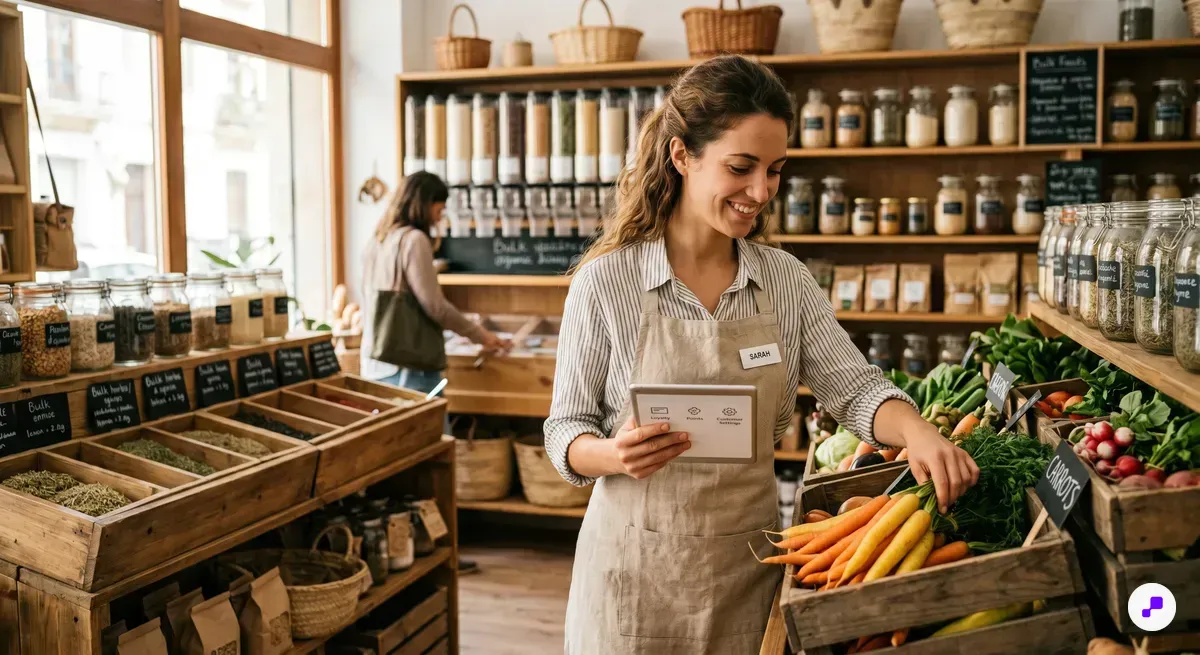
Health food stores compete on trust, not price — a loyalty program puts measurable value on that relationship.
The natural and organic food market hit $63 billion in the U.S. in 2024, and it's still growing at 6% annually. But here's the problem: the growth isn't just yours. Whole Foods, Sprouts, Trader Joe's, and Amazon Fresh are all chasing your customer. Every major grocery chain now has an organic aisle, and online delivery services make it easy to skip the trip to your store entirely.
What keeps your customers coming back isn't product availability — it's trust. They trust that your produce is genuinely local. They trust your staff to recommend the right supplement. They trust your sourcing standards. But trust alone doesn't survive a $20 difference on a weekly grocery run. A loyalty program puts a tangible value on that trust.
The average health food store customer spends $35-65 per visit and shops 2-3 times per week. That's $3,600-$10,000 per year from a single loyal customer. Losing even 10 of those customers to a competitor costs you $36,000-$100,000 annually. A well-designed loyalty program that retains just 5% more of your customer base can add six figures to your annual revenue. If you want to see the math for your specific store, try our loyalty ROI calculator.
The stores that are winning right now aren't the cheapest — they're the ones that make loyalty feel personal. A digital loyalty card that tracks spending, rewards consistency, and sends relevant offers through Apple or Google Wallet does more for retention than any price match ever could.
Calculate your average customer lifetime value this week by multiplying average basket size by visit frequency by average customer lifespan. That number is what you're protecting with a loyalty program.
Shopify POS tracks every in-store and online transaction, giving you the data foundation to calculate CLV and design a loyalty program around actual shopping patterns.
Digital wallet passes replace paper punch cards with a system that updates automatically at every purchase — no lost cards, no forgotten stamps.

Spend-based earning rewards your highest-value customers and lets you use multipliers to shape purchasing behavior.
Health food stores should build their loyalty program around spend, not visit count. Why? Because your customer who spends $60 twice a week is more valuable than the one who pops in for a $5 kombucha every day. Spend-based earning rewards the behavior that actually drives your revenue.
Start with a simple ratio: 1 point per dollar spent. It's clean, memorable, and customers can do the math in their heads. At a $45 average basket, that's 45 points per visit. Set your first reward at 250 points — roughly 6 visits — so customers see progress quickly. A first reward that takes 3+ months to earn kills motivation before the habit forms.
Add bonus multipliers for behaviors you want to encourage. Double points on local produce purchases supports your farmers and gives customers a reason to buy local over imported organic. Triple points on bulk bin purchases increases basket size and margin. A 2x multiplier on Shopify online orders for local delivery drives adoption of your e-commerce channel, which is critical for competing with Amazon Fresh.
Consider category-based bonuses that rotate monthly. February is a 2x points month on supplements. March doubles points on fresh juice and smoothie bar orders. These rotating bonuses create urgency and give you a reason to communicate with customers every month. For more creative ideas on structuring rewards, explore our loyalty program ideas for health food stores.
Set points to expire after 12 months with a 60-day warning notification via wallet pass. This creates gentle urgency without punishing customers who take a vacation or have a tight month. The goal is to motivate, not frustrate.
Set your base earning at 1 point per dollar and your first reward at 250 points. Test a 2x multiplier on your highest-margin category for the first month.
Shopify POS tags every transaction by product category, letting you apply category-specific point multipliers automatically at checkout.
After each purchase, the wallet pass updates instantly with the new point balance — customers see their progress without opening an app or asking staff.
The best rewards for health food stores are product samples, wellness experiences, and community access — not percentage-off discounts.
The wrong rewards will sink your program before it starts. A 10% discount on the next purchase trains customers to wait for deals. A branded tote bag collects dust. Health food store customers want rewards that align with their values: health, quality, and community.
The highest-performing rewards in natural food retail fall into three categories: product rewards, experience rewards, and community rewards. Product rewards are the easiest to implement. A free item from a specific category — a $5 smoothie, a bag of house-made granola, a bottle of kombucha — feels tangible and relevant. Choose items with high perceived value but manageable cost to you. Your house-made items work perfectly because the margin is better than resale products.
Experience rewards create deeper connection. A free nutrition consultation, a cooking class ticket, a farm tour, or early access to a new product line makes customers feel like insiders. These rewards cost you time rather than inventory, and they build the kind of relationship that big-box stores can't replicate. A 30-minute session with your in-house nutritionist has a perceived value of $50-75 but costs you only the staff time.
Community rewards tap into why your customers chose a local health food store over a chain. Reserved spots at your weekly farmer meet-and-greet, a vote on the next product line you stock, or a "founding member" badge on their wallet pass when you open a second location. These perks make customers feel like owners, not just shoppers.
Avoid percentage-off discounts as your primary rewards. They erode margin and train customers to expect deals. Instead, use dollar-off thresholds: "Spend $50, get $5 off" is better than "10% off" because it encourages a higher basket size. Save discounts for your highest tier as an exclusive perk.
Survey your top 20 customers this week with one question: 'What reward would make you feel most valued as a regular?' Use their answers to build your reward menu.
Push a wallet notification when a customer earns a reward: 'You've unlocked a free smoothie — show this pass at the juice bar.' Instant gratification drives redemption above 40%.
Shopify POS unifies in-store and online loyalty tracking into one customer profile, eliminating the gap between channels.
If your health food store runs on Shopify POS — and with its inventory management and multi-channel capability, it should — you already have the foundation for a powerful loyalty program. The key is connecting your point-of-sale system with a loyalty solution that handles both in-store purchases and online orders seamlessly.
Start by installing a Shopify loyalty app that integrates with POS hardware. You need an app that awards points automatically at checkout, supports both in-store NFC tap and online order tracking, and syncs customer profiles across channels. JeriCommerce, for example, lets you create digital wallet passes that function as loyalty cards — one tap at the NFC reader handles identification and point earning. For a broader look at useful tools, check our best Shopify apps for health food stores roundup.
Configure your POS to display loyalty information at checkout. When a regular customer buys their weekly groceries, the staff member should see: "Sarah — Gold member, 420 points, 80 points from a free kombucha." This turns every transaction into a loyalty conversation. Train your cashiers to mention the progress: "You're really close to your next reward!"
For online orders — especially local delivery — loyalty integration is critical. Customers ordering through your Shopify store for delivery or pickup should earn points automatically, just like in-store purchases. This bridges the gap between your physical store and your e-commerce channel, making it irrelevant which way the customer shops.
Use Shopify Flow to automate loyalty workflows: send a wallet push when a customer hasn't purchased in 14 days, trigger a bonus points offer when someone's basket drops below their average, or automatically upgrade a customer's tier when they hit a spending milestone. Automation keeps your loyalty program running while you focus on sourcing great products.
Set up a Shopify Flow automation this week: 'If customer hasn't purchased in 14 days, send a wallet push with 2x points on their next visit.'
Shopify POS handles in-store checkout while Shopify Flow automates loyalty triggers like win-back campaigns, tier upgrades, and milestone celebrations.
The wallet pass replaces paper punch cards, plastic loyalty cards, and separate apps with a single NFC-enabled tap at Shopify POS.
Wallet passes deliver 85-95% notification reach and replace the entire paper punch card system with zero customer friction.
If your health food store still uses paper punch cards, you're leaving money on the table. Studies show that 20-30% of punch cards are lost before they're redeemed, customers forget to carry them, and you have zero data on purchasing patterns. Digital wallet passes solve every one of these problems.
A wallet pass lives in your customer's Apple Wallet or Google Wallet — right next to their credit cards and boarding passes. They don't need to download a separate app, create an account, or remember a password. One tap to install, and it's there permanently. For health food stores, this matters because your customers are already holding their phone at checkout. A wallet pass turns that phone into a loyalty card with zero friction.
The engagement numbers tell the story. Push notifications through wallet passes see 85-95% delivery rates, compared to 20-30% for email and 45-60% for app push notifications. When you send a message like "Double points on local produce this weekend," it actually reaches the customer. That's the difference between a promotion that drives traffic and one that disappears into an inbox.
Wallet passes also update dynamically. When a customer earns points at checkout, the pass refreshes automatically — the new balance appears on their lock screen within seconds. When they reach a new tier, the pass design changes to reflect their status. This persistent visibility keeps your store top-of-mind between visits. To understand how this fits into a broader retention strategy, read our complete guide to digital punch cards.
The setup is straightforward: design your pass template with your store's branding, connect it to your Shopify loyalty system, and distribute passes via text message, email, or a QR code at the register. Most stores see 60-70% adoption within the first month because there's literally no friction — no download, no account, no password.
Print a QR code that links to your wallet pass enrollment and place it at every register and on every receipt this week.
Wallet passes sync with Shopify POS so every in-store and online purchase automatically updates the customer's points and tier on their phone.
Wallet passes replace paper punch cards, plastic cards, and loyalty apps with a single NFC-enabled digital pass that updates in real time.
A unified loyalty profile across in-store and online channels creates two shopping habits instead of one, making customers much harder to lose.
Your customers shop both ways: they browse the aisles on Saturday morning and order delivery on Wednesday evening. If your loyalty program only works in-store, you're giving them a reason to skip your online channel — or worse, order from Amazon Fresh instead.
The key is a unified customer profile that tracks spending across both channels. When Sarah buys $50 of groceries in-store on Saturday and orders $35 of supplements online for delivery on Wednesday, her loyalty account should show $85 in weekly spending and award points for both. No separate accounts, no manual merging, no confusion.
Shopify makes this straightforward because POS and online orders already share the same customer database. A loyalty app that integrates with both channels automatically creates a single loyalty profile per customer. The wallet pass serves as the universal identifier — in-store, it's an NFC tap at the register. Online, the customer's email or phone number links to the same profile.
Use channel-specific bonuses to drive behavior. Offer 2x points on online orders for the first month to build the delivery habit. Then switch to 2x points on in-store purchases during slow weekday afternoons. You can even offer a "shop both channels" bonus: customers who make both an in-store and online purchase in the same week earn 100 bonus points. This cross-channel behavior is the stickiest kind of loyalty because it creates two habits instead of one.
Local delivery loyalty is especially powerful for health food stores. Your customers already prefer buying local — extend that preference to delivery. A subscription-style delivery program (weekly produce box, monthly supplement refill) with bonus loyalty points locks in recurring revenue and makes switching to a competitor genuinely inconvenient. Our omnichannel loyalty guide covers this strategy in depth.
Launch a 'shop both channels' bonus this month: 100 extra points for customers who make both an in-store and online purchase in the same week.
Shopify POS and Shopify Online share the same customer database, making it simple to build unified loyalty profiles that work across both channels.
The wallet pass serves as the universal loyalty ID — NFC tap in-store, linked profile online — so customers earn and redeem seamlessly regardless of how they shop.
Staff training and a compelling sign-up bonus are the two biggest drivers of enrollment velocity in the first 60 days.
A loyalty program with low enrollment is worse than no program at all — it wastes your time and gives customers the impression you're behind the times. Aim for 50%+ of regular customers enrolled within the first 60 days. That takes a deliberate launch strategy, not just a sign at the register.
Start with a soft launch to your top 30 customers — the regulars your staff knows by name. Give them early access and ask for honest feedback. These customers become your ambassadors. When they tap their phone at checkout and mention their points to the person behind them in line, that peer influence is more effective than any marketing you could run.
For the full launch, use a sign-up bonus to create urgency: "Join our loyalty program this week and start with 100 bonus points — enough for a free kombucha." The immediate reward eliminates the "I'll do it later" hesitation. If you're using wallet passes, enrollment takes 10 seconds: text a link, customer taps to add, done. No app to download, no form to fill out.
Train every staff member on the program details. Cashiers should mention it at every checkout: "Are you earning points on this? It takes 10 seconds to sign up and you'd earn 45 points on today's purchase." Your juice bar staff can mention it when customers order a smoothie. Even your produce team can point to the "Double points on local produce" sign. Staff enthusiasm is the single biggest predictor of enrollment speed.
Create visible touchpoints throughout the store. A chalkboard near the entrance showing this month's featured reward. A small sign at the register showing how many points today's average basket earns. A poster in the supplement section highlighting the monthly category bonus. Every visual cue reminds customers that earning rewards is effortless.
Brief your entire team this week with a 30-second enrollment script and set a goal of signing up 15 customers per day for the first two weeks.
Use Shopify's customer tags to segment enrolled vs. non-enrolled customers and trigger targeted email campaigns to drive sign-ups.
Wallet pass enrollment takes under 10 seconds — text a link, customer taps to add — making it the fastest onboarding method for in-store sign-ups.
Track basket size lift and purchase frequency lift between loyalty members and non-members — these directly measure program effectiveness.
Launching your loyalty program is the beginning, not the finish line. The health food stores that get the most value from loyalty are the ones that measure weekly and iterate monthly. You need a clear set of metrics that tell you whether the program is actually driving retention and revenue.
The five metrics that matter most: enrollment rate (target 50%+), monthly active rate (customers earning or redeeming in the last 30 days — target 40%+), redemption rate (target 30-40%), average basket size lift (are loyalty members spending more per visit?), and purchase frequency lift (are they visiting more often?). Track these weekly in a simple spreadsheet. If any metric is trending down, act immediately.
Run a cohort analysis every quarter. Compare customers who joined the loyalty program versus those who didn't. Track their 3-month and 6-month retention rates side by side. Most health food stores find that loyalty members retain at 20-30% higher rates and spend 15-25% more per visit. Use the retention rate calculator to benchmark your numbers against industry averages.
Optimize based on what the data tells you. If redemption is low, your rewards might not be appealing enough or the points thresholds are too high — test lowering the first reward to 150 points instead of 250. If basket size isn't increasing, add a spend-threshold bonus: "Earn 50 bonus points on orders over $50." If certain rewards are never redeemed, replace them with options customers actually want.
Send a quarterly survey to enrolled customers. Three questions: "What's your favorite reward?" "What reward would you like us to add?" and "How easy is the program to use (1-5)?" This feedback prevents the program from going stale and shows customers you value their input. The most valuable loyalty programs evolve — the ones that stay static lose engagement within 6 months.
Set up a weekly report comparing average basket size and visit frequency between loyalty members and non-members. Review it every Monday morning.
Shopify's analytics and customer segments let you compare purchasing behavior between loyalty and non-loyalty customer cohorts with a few clicks.
Wallet pass engagement data — notification opens, pass views, tap frequency — gives you real-time insight into program health without relying on email open rates.
A health food store loyalty program built around spend-based rewards, digital wallet passes, and unified in-store/online tracking can retain more customers, increase basket size, and compete effectively with big-box chains. The key is designing for how your customers actually shop — weekly visits, local delivery, and the trust-based relationship that makes your store irreplaceable.
JeriCommerce makes it easy to launch an omnichannel loyalty program for your health food store — digital wallet passes, NFC tap at Shopify POS, unified online and in-store tracking, and automated engagement campaigns, all without a separate app for your customers to download.
Spend-based rewards, wallet passes as loyalty cards, and Shopify POS integration. built for health food and organic stores.
Install Free on Shopify