
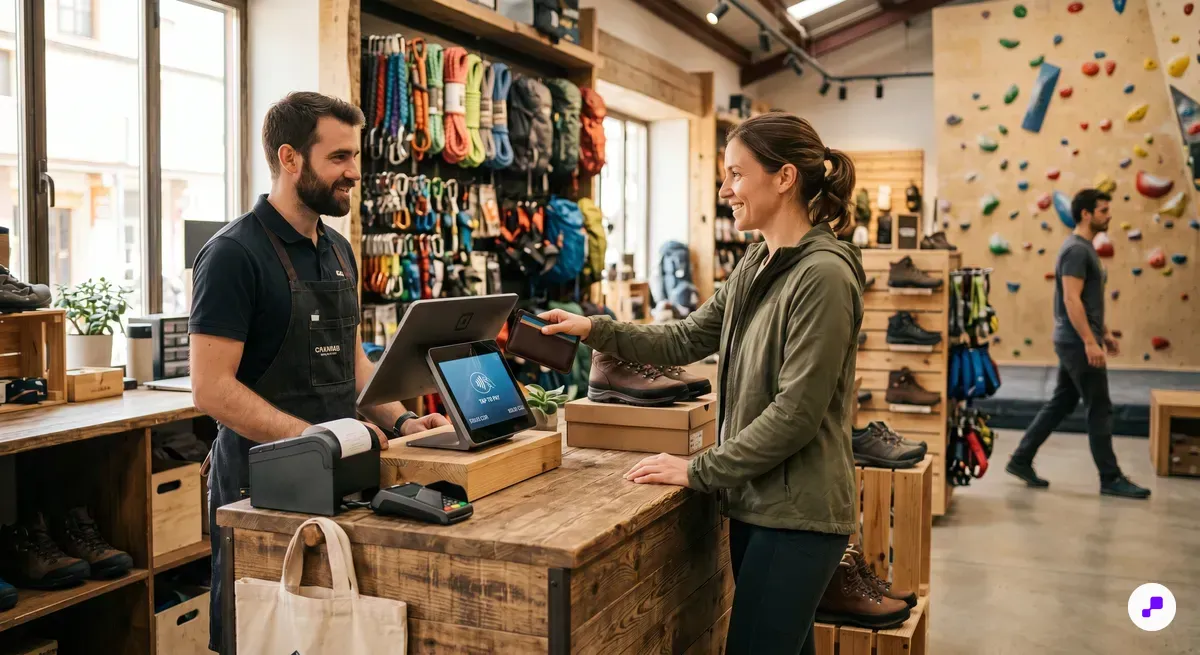
Understanding cross-channel shopping behavior is essential before you design an omnichannel loyalty program. Sports and outdoor customers don't think in channels — they think in decisions. A single purchase decision might touch three or four channels before completion.
The most common pattern is online research followed by in-store purchase. A customer reads reviews of hiking boots on your website, watches a comparison video you posted, and then drives to your store to try them on and feel the fit. If your loyalty program only tracks online activity, you've lost credit for the two touchpoints that brought them through the door. If your in-store system doesn't recognize them, the staff can't reference their browsing history or loyalty status.
The reverse pattern is equally common for replenishment items. A customer discovers energy gels, moisture-wicking socks, or running supplements in your physical store, then reorders online because it's more convenient. If online points don't merge with their in-store history, they appear as a new customer in your digital system — and your retention metrics are wrong.
Event and pop-up purchases add another channel. Outdoor brands frequently sell at trail races, ski expos, cycling events, and farmers markets. A customer who buys a jacket at your booth should earn loyalty points just like they would online or in-store. If that transaction exists in a separate system, you've fragmented the customer's history. For loyalty strategies designed around this shopping behavior, check our sports and outdoor loyalty program ideas.
Omnichannel customers are worth dramatically more than single-channel customers. Research consistently shows they spend 20-30% more annually and have 30% higher lifetime value. In sports and outdoor, where purchases are already high-ticket and seasonal, that uplift represents significant revenue. The investment in omnichannel loyalty infrastructure pays for itself through increased cross-channel spending alone.
Outdoor customers naturally shop across channels — omnichannel loyalty captures the full customer journey instead of fragmented snapshots.
Survey 20 recent customers about their purchase journey: how many touched multiple channels (website, store, social, events) before buying? Use the results to prioritize your omnichannel integration.
Shopify's unified customer profiles link online and POS transactions automatically when customers are identified, providing one view of cross-channel behavior.
The technical foundation of omnichannel loyalty is a single customer record that captures every interaction across every channel. Without this, you're running parallel programs that happen to share a brand name.
Shopify provides the underlying infrastructure through its unified customer system. When a customer makes an online purchase and later buys at your POS location, both transactions appear under the same customer profile — but only if the customer is identified at both touchpoints. Online identification happens through account login. In-store identification is the hard part.
Digital wallet passes solve the in-store identification problem elegantly. When a customer adds your loyalty pass to their Apple Wallet or Google Wallet, they carry their identity with them everywhere. At the POS, they tap their phone or show a barcode, and the system instantly recognizes them, displays their loyalty balance, and links the purchase to their unified profile. No app to open, no phone number to recite, no loyalty card to dig out of a wallet.
For customers transitioning from a fragmented system, migration requires care. Export your existing online customer list and POS customer list. Match records by email address and phone number. For matched records, merge the profiles and combine their purchase history and any existing loyalty balances. For unmatched records, assign them to the channel where they're most active and attempt to capture the missing identifier at their next interaction.
Clean your data quarterly. Duplicate profiles creep in through misspellings, alternate email addresses, and phone number format differences. A monthly automated check for potential duplicates, followed by a quarterly manual review of flagged records, keeps your unified database accurate. Inaccurate data undermines the entire omnichannel experience. For a structured approach to program setup, see our sports and outdoor loyalty program checklist.
The wallet pass is the identification key that connects in-store and online into one profile — without it, unification breaks at the POS.
Count how many customer profiles exist in your online store vs. your POS system, and estimate the overlap — this reveals how much fragmentation you're dealing with.
Shopify's unified customer database merges online and POS records automatically when matched by email or phone, giving you a single source of truth.
The wallet pass is the universal identifier — one tap at any channel links the interaction to the customer's complete loyalty history across all touchpoints.
Nothing frustrates a loyal customer faster than inconsistent earning rules across channels. If they earn 1 point per dollar online but discover their in-store purchase earned nothing, trust in the program collapses immediately. Consistency is the non-negotiable principle of omnichannel earning.
Establish a universal base earning rate: 1 point per dollar spent, regardless of channel. Online orders, POS transactions, pop-up purchases, and any other sales channel all earn at the same rate. This simplicity ensures customers never have to think about where to buy — they earn the same everywhere.
Channel-specific bonuses can be layered on top of the universal rate for strategic purposes. If your physical store traffic is below target, run a 'Double Points In-Store' weekend. If you're launching a new online feature (like virtual try-on for sunglasses), offer triple points on online purchases for a week. These promotions steer traffic without undermining the base consistency.
Non-purchase earning should also be channel-agnostic. A product review earns 75 points whether it's written on your website or submitted via a post-purchase email after an in-store transaction. A referral earns 500 points whether the referred friend shops online or in-store. An event attendance check-in earns 100 points whether it's at your flagship store or a pop-up tent at a trail race.
For sports and outdoor specifically, consider activity-based earning that transcends channels entirely. A 'Log your trail run' challenge that awards 25 points per activity logged creates earning that exists outside of any sales channel. These activity touchpoints keep the loyalty program alive during the long gaps between purchases that are natural in outdoor retail. For more reward strategies, explore our best rewards for sports and outdoor stores.
Document your earning rules on a single page — if they can't be summarized in a one-page reference, they're too complex. Display this reference online, print it for in-store counter display, and ensure every staff member can explain the rules in 30 seconds.
A universal base earning rate across all channels builds trust — layer strategic bonuses on top for specific channel goals.
Write your complete earning rules on a single sheet of paper and pin it at every register — if staff can't explain it in 30 seconds, simplify.
Shopify Flow enables channel-specific bonus rules that trigger automatically based on order source, keeping configuration centralized and consistent.
If customers can earn points anywhere but can only redeem in one channel, your omnichannel promise is broken. Universal redemption is where loyalty programs either deliver on their promise or reveal their limitations.
Design every reward to be redeemable across all channels. A customer who earns enough points for a free pair of socks should be able to claim them online (shipped to their door) or in-store (picked up at the register). A $20 loyalty discount should apply to online checkout and POS transactions equally. No exceptions, no asterisks.
In-store redemption via wallet pass should feel instant. When the customer taps their pass at the POS, the staff member sees available rewards on their screen. One tap applies the selected reward, deducts the points, and updates the wallet pass balance in real time. The customer walks out knowing exactly how many points they have remaining. This immediacy is what separates wallet-based redemption from clunky alternatives that require logging into an app or reciting a member number.
Online redemption should be equally frictionless. Display available rewards in the shopping cart with a one-click 'Apply' button. Show the points balance alongside the price on product pages: 'This item costs $120 or 1,200 points.' Some loyalty programs even allow partial points-plus-cash redemption, which increases redemption rates because customers don't have to save up for a full reward.
Edge cases need predefined policies. What happens when a customer redeems an online reward but wants to exchange the item in-store? What if they return a purchase that earned points? What if they earned points at an event pop-up that used a different POS system? Build policies for each scenario before they arise, and train every staff member on the answers. See our points value calculator to model your redemption economics across channels.
Track redemption patterns by channel to understand customer preferences. Many outdoor brands find that in-store redemption rates are significantly higher than online because the physical act of claiming a reward feels more satisfying. If so, use this insight to drive more foot traffic: 'Redeem your free headlamp at our store and get 50 bonus points.'
Universal redemption across all channels is the proof point of omnichannel loyalty — any restriction breaks the customer's trust.
Test your own redemption experience by earning points online and redeeming in-store within the same week — identify and fix every friction point you encounter.
Shopify POS shows the customer's full loyalty profile and available rewards during checkout, enabling one-tap in-store redemption synced with the online system.
The wallet pass shows available rewards before the customer reaches the register — they walk in knowing what they can claim, making redemption feel planned, not improvised.
Digital wallet passes are the simplest technology for connecting every channel into a unified loyalty experience. For sports and outdoor brands that operate both online and in physical retail — plus events, pop-ups, and partner locations — the wallet pass is the one constant the customer always carries.
The wallet pass functions as a universal loyalty card. At your online store, the customer's account links to their email. At your physical store, they tap the wallet pass for instant identification. At a pop-up event, the same tap works with a mobile POS. Across all channels, the experience is identical: tap, earn, done.
Notification capabilities make wallet passes particularly valuable for seasonal outdoor brands. You can push geo-targeted notifications when loyalty members are near your store: 'Your Summit member early access sale starts today — stop in for first picks.' You can send pre-season reminders: 'Ski season is 4 weeks out — your loyalty balance covers a free goggle lens swap.' You can notify about community events: 'Group trail run this Saturday at 8am — earn 100 bonus points just for showing up.'
The engagement metrics from wallet passes give you omnichannel insight that email and web analytics alone can't provide. You can see how often customers view their pass (interest level), how quickly they open notifications (engagement quality), and how pass views correlate with subsequent purchases (path to conversion). These behavioral signals help you time your communications perfectly.
Adoption rates for wallet passes consistently exceed other loyalty identification methods. 65-75% of customers add the pass when offered, compared to 12-15% who download a dedicated loyalty app. The difference comes down to friction: adding a wallet pass takes one tap and uses no phone storage. Downloading an app requires finding it in the store, waiting for it to install, creating an account, and remembering to open it. For outdoor enthusiasts who prize efficiency and simplicity, the wallet pass wins decisively.
Wallet passes also update dynamically. When a customer's tier changes, the pass design updates to reflect their new status. When they earn points, the balance refreshes. When a new reward becomes available, a badge appears. This living, breathing loyalty card keeps your brand present in the customer's daily life — a constant reminder between those seasonal purchases that are months apart. For referral strategies that leverage wallet distribution, check our sports and outdoor referral program ideas.
Wallet passes provide a frictionless, always-present loyalty identity that works across online, in-store, and event channels without any app download.
Design a wallet pass with your brand colors and outdoor imagery this week, then pilot it with 10 team members before rolling out to customers.
The wallet pass is the omnichannel constant — it works at your store, online, at pop-ups, and at events, providing one-tap identification and real-time loyalty updates everywhere.
Measuring the return on omnichannel loyalty requires tracking metrics that capture cross-channel behavior — not just channel-specific performance. The goal is proving that unified loyalty drives incremental revenue that justifies the integration investment.
Cross-channel adoption rate is your primary leading indicator. What percentage of loyalty members have made purchases in two or more channels? Target 25-35% within the first year. If this number is below 15%, customers either don't know the program works across channels or the cross-channel experience has friction that discourages it.
Omnichannel CLV premium measures how much more cross-channel loyalty members are worth compared to single-channel members. Calculate the 12-month and 24-month CLV for three segments: non-loyalty customers, single-channel loyalty members, and omnichannel loyalty members. The waterfall should show a clear progression, with omnichannel members at 2-3x the CLV of single-channel members.
Channel influence attribution tracks how channels work together. If a customer browses products online and buys in-store within 48 hours, the online session influenced the in-store sale. If an in-store customer signs up for email and makes their next purchase online, the store influenced the digital sale. Understanding these influence patterns helps you allocate marketing spend more accurately. Use the loyalty ROI calculator to quantify the combined impact.
Redemption by channel reveals where customers prefer to claim rewards. If 70% of redemptions happen in-store despite 60% of points being earned online, your physical locations are serving as reward fulfillment centers — a powerful driver of foot traffic. If online redemption is low, your checkout integration might not be surfacing rewards prominently enough.
Program cost per omnichannel member should decrease over time as adoption scales. Track the total program cost (platform fees, reward costs, staff time) divided by the number of active omnichannel members. This efficiency metric should improve quarter over quarter as fixed costs are spread across more members.
Build a monthly dashboard with these five metrics and review trends, not snapshots. Omnichannel loyalty is a long-term investment — you won't see the full CLV impact until customers have had 12-18 months to establish cross-channel shopping patterns. Set realistic timelines and celebrate incremental improvements. For a comprehensive look at retention metrics, see our sports and outdoor retention strategies.
Omnichannel loyalty members are worth 2-3x single-channel members — track cross-channel adoption rate as the leading indicator of program success.
Segment your customer database into non-loyalty, single-channel loyalty, and omnichannel loyalty groups this week, and calculate the CLV for each — the gaps will justify your omnichannel investment.
Shopify's unified analytics let you see customer journeys across online and POS in one place, making cross-channel attribution practical without enterprise tools.
Sports and outdoor customers naturally shop across channels — your loyalty program should meet them everywhere. By unifying customer profiles, standardizing earning and redemption rules, and using wallet passes as the cross-channel connector, you capture the full lifetime value of outdoor enthusiasts instead of seeing fragmented snapshots of their relationship with your brand.
JeriCommerce connects your Shopify online store, physical retail locations, and event pop-ups with omnichannel loyalty — wallet passes — one tap for identification, earning, and redemption across every channel your outdoor brand operates.
One wallet pass for your online store, retail locations, and event pop-ups. smooth earning, instant redemption, and push notifications that drive cross-channel spending.
Install Free on Shopify