
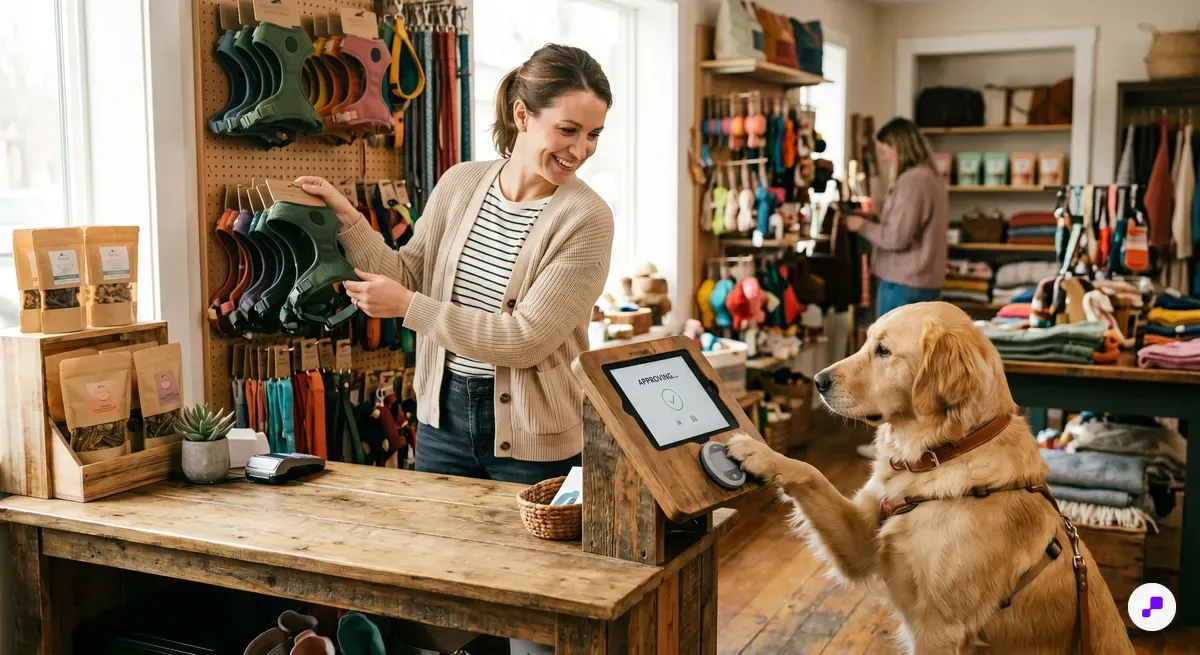
Pet supplies customers naturally shop across channels in ways that other retail categories don't. A pet parent might research specialty food online, but prefer to buy it in-store so they can check ingredient labels. They might stock up on bulk litter online for home delivery, but grab treats and toys during a quick in-store visit. They might order prescription food through your website but pick up grooming supplies while dropping off their dog for a bath.
This multi-channel behavior isn't occasional — it's the norm. Studies show that omnichannel customers spend 15-30% more than single-channel shoppers. In pet supplies specifically, where the product range spans everyday consumables, specialty health items, and impulse purchases, the cross-channel spending uplift can be even higher because each channel serves a different purchase motivation.
The problem is that most pet supplies brands treat online and in-store as separate businesses. Different POS systems, different customer databases, different (or nonexistent) loyalty programs. A customer who has spent $2,000 online over the past year walks into your physical store and gets treated like a stranger. That disconnect doesn't just feel impersonal — it actively pushes customers toward competitors who offer a unified experience.
The solution isn't rebuilding your entire tech stack. It's creating a single loyalty layer that sits on top of all your channels and recognizes the customer everywhere. A digital wallet pass that works as both an online loyalty identifier and an in-store tap-to-earn card is the simplest path to omnichannel unification. For a look at how other pet brands are structuring their rewards, explore our best pet supplies rewards guide.
Pet parents who shop across two or more channels with a unified loyalty profile have 2-3x the lifetime value of single-channel customers. That's the prize for getting omnichannel right.
Omnichannel pet customers spend 15-30% more than single-channel shoppers — but only if you unify their loyalty experience across all touchpoints.
Audit how many of your current customers shop both online and in-store, and check whether their loyalty data is connected — most stores discover significant fragmentation.
Shopify's unified customer profiles work across both your online store and Shopify POS, providing a single customer record regardless of purchase channel.
The foundation of omnichannel loyalty is a single customer profile that captures every interaction, regardless of where it happens. Without this, you're running two separate loyalty programs under one brand name — and customers will notice the gaps.
Start with Shopify's native customer profile system, which already merges online and POS transactions under one record when the customer is identified. The challenge is identification: online, customers log in to their account. In-store, they need a way to identify themselves quickly at checkout. This is where digital wallet passes become essential. A wallet pass scanned or tapped at the POS terminal instantly links the in-store purchase to the customer's unified profile.
For customers who already exist in your online system, migration is straightforward: send them a wallet pass via email or SMS, and their existing points balance, tier status, and purchase history travel with them. When they shop in-store and tap their wallet pass, the system recognizes them immediately and applies the same earning rules as online.
For in-store-only customers who don't have an online account, the wallet pass serves as their enrollment mechanism. At checkout, staff offer a wallet pass: 'Would you like to earn rewards on today's purchase? It takes 10 seconds.' The customer receives a text, taps to add the pass, and their loyalty account is created — linked to their phone number and email, ready to unify with future online purchases.
Handle profile merging carefully. A customer might have an online account under their email and an in-store profile under their phone number. Your system needs matching logic (email + phone number) to merge these into one record. Review unmatched profiles monthly and manually merge any obvious duplicates. Clean data is the backbone of omnichannel loyalty. For more tips on building robust programs, see our pet supplies loyalty program checklist.
A single customer profile — identified via wallet pass across all channels — is the non-negotiable foundation of omnichannel loyalty.
Export your online customer list and your POS customer list, compare them by email and phone number, and identify how many customers exist as duplicates across systems.
Shopify unifies online and POS customer records automatically when customers are identified — wallet passes provide the identification layer that makes this work in-store.
The wallet pass is the physical-to-digital bridge: one NFC tap at the register links the in-store purchase to the customer's complete loyalty history.
Omnichannel earning rules must feel fair and consistent. If a customer earns 1 point per dollar online but nothing in-store, they'll feel penalized for shopping in person. If in-store purchases earn double points, online customers feel shortchanged. Consistency builds trust.
The simplest approach is channel-agnostic earning: 1 point per dollar spent, regardless of where the purchase happens. Online orders, in-store transactions, and mobile purchases all earn at the same rate. This eliminates confusion and removes any incentive to game the system.
On top of the base rate, add channel-specific bonuses that encourage behaviors you want to drive. If your in-store traffic needs a boost, offer double points on in-store purchases during weekdays. If you're pushing online subscription adoption, offer triple points on first subscription orders. These bonuses are additive, not replacements — the base earning rate stays consistent.
Non-purchase earning actions should also work across channels. A product review earns 75 points whether it's written on your website or prompted by a post-purchase email after an in-store transaction. A referral earns 500 points regardless of whether the referred friend shops online or in-store. Pet profile completion earns 50 points once — and the profile data enhances personalization across all channels.
One unique opportunity for pet supplies is in-store service earning. If you offer grooming, veterinary consultations, or training classes at your physical location, these services should also earn loyalty points. A grooming appointment that earns 50 points connects the service experience to the product loyalty program, encouraging customers to consolidate all their pet spending with your brand. Explore more strategies in our pet supplies loyalty program ideas resource.
Document your earning rules clearly and display them both online (loyalty program page) and in-store (counter cards, staff training materials). Transparency prevents frustration and builds confidence in the program.
Keep base earning rates identical across channels, then use temporary bonuses to steer traffic where you need it most.
Create a one-page earning rules summary that works both as a web page and a printed counter card — if the rules can't fit on one page, they're too complex.
Shopify Flow lets you configure channel-specific bonus point rules that trigger automatically based on order source — POS, online store, or mobile app.
Earning points across channels is meaningless if customers can't redeem them wherever they want. The promise of omnichannel loyalty breaks the moment a pet parent tries to use their online points at your physical register and hears, 'Sorry, those points only work on the website.'
Design your redemption system so that every reward is redeemable everywhere. If a customer earns a free bag of treats through online purchases, they should be able to claim it in-store by showing their wallet pass. If they accumulate points through in-store visits, they should be able to apply those points to an online order at checkout. Universality is non-negotiable.
For in-store redemption, the wallet pass is your redemption tool. When a customer taps their pass at the POS, the staff member sees the available rewards on their screen: 'This customer has 2,100 points — eligible for: Free treat bag (500 pts), Free grooming upgrade (1,000 pts), $20 off any purchase (1,500 pts).' One tap to apply the reward, and the points are deducted across the unified profile.
For online redemption, display available rewards directly in the cart and checkout flow. A banner that says 'You have 1,200 points — use 500 points to save $5 on this order' with a one-click apply button makes redemption effortless. Don't bury rewards in a separate loyalty portal that customers have to navigate to find.
Handle edge cases proactively. What happens if a customer redeems points online for a product they want to pick up in-store? What if they return an item they earned points on? What if they have a reward expiring tomorrow? Build clear policies for each scenario and train staff on all of them. Most omnichannel loyalty friction comes from edge cases that nobody planned for, not from the core system.
Track redemption by channel to understand where customers prefer to use their rewards. Many pet stores find that 60-70% of redemptions happen in-store, even when most points are earned online, because in-store redemption feels more immediate and tangible. Use the points value calculator to ensure your redemption economics work across all channels.
Every reward must be redeemable across every channel — any restriction breaks the omnichannel promise and frustrates loyal customers.
Mystery-shop your own loyalty program by earning points online and attempting to redeem them in-store (or vice versa) — experience the friction firsthand.
Shopify POS displays the customer's loyalty balance and available rewards in real time during checkout, enabling instant in-store redemption with one tap.
The wallet pass displays available rewards with a 'ready to redeem' badge — customers walk into the store already knowing what they can claim.
Digital wallet passes solve the hardest problem in omnichannel loyalty: how does the customer carry their loyalty identity across every channel without friction? The answer is the device they already have in their pocket.
An Apple Wallet or Google Wallet pass functions as a universal loyalty card. Online, the customer's account is linked by email. In-store, the same customer taps their phone at the POS. On mobile, the pass displays their current balance, tier, and rewards. Across all three channels, it's the same profile, the same points, the same experience — and the customer never has to think about it.
The push notification capability of wallet passes is especially valuable for omnichannel pet brands. You can send location-triggered notifications when a loyalty member walks near your physical store: 'You have a free treat bag waiting — stop in and claim it with a tap.' You can send reorder reminders that link directly to your online store. You can send in-store event invitations to your best online customers. Each notification is context-appropriate because you know the customer's complete purchase history across channels.
Wallet passes also solve the 'brand visibility' problem that email and apps struggle with. An email gets buried in an inbox. An app gets deleted or forgotten. But a wallet pass sits alongside the customer's credit cards and boarding passes — surfaces they interact with daily. Every time they open their wallet to pay for something, your brand is right there. For pet supplies, where purchase cycles run monthly, this persistent visibility ensures customers think of you before they think of Amazon.
The enrollment process is the same regardless of channel. In-store: staff texts a link, customer taps to add. Online: email or SMS with an 'Add to Wallet' button. The pass appears in their wallet within seconds, pre-loaded with their existing loyalty balance if they have one. Adoption rates for wallet passes consistently hit 65-75% because there's no app to download, no password to create, and no extra space taken on the phone.
For a deeper look at how wallet passes drive loyalty engagement, check out our pet supplies referral program ideas — many of the highest-performing referral mechanics are wallet-driven.
Wallet passes are the simplest path to omnichannel loyalty — one pass that works online, in-store, and on mobile without any app download.
Design your wallet pass with your pet brand colors and logo this week, then test it with 5 staff members across both online and in-store scenarios.
The wallet pass is the omnichannel linchpin — it identifies customers at the POS, displays loyalty data on their lock screen, and delivers notifications with 85-95% reach.
Omnichannel loyalty measurement is more complex than single-channel because you need to track performance across channels individually and as a unified whole. The metrics that matter most are cross-channel adoption, channel migration, and unified customer lifetime value.
Cross-channel adoption rate measures what percentage of your loyalty members shop in more than one channel. Target 25-35% within the first year. If this number is below 15%, your channels aren't aware of each other — customers don't know they can earn and redeem across touchpoints. Promote cross-channel capabilities in every communication: 'Your points work in-store and online — shop however suits you.'
Channel migration patterns show you how customers move between channels over time. Do they start online and migrate to in-store? Do in-store customers begin ordering online for convenience? Understanding these flows helps you allocate marketing spend and optimize each channel's role. In pet supplies, the typical pattern is online discovery followed by in-store relationship building — customers try a brand online and then become regulars at the physical store once they trust the products.
Unified CLV is the ultimate metric. Calculate the lifetime value of omnichannel loyalty members versus single-channel members and versus non-loyalty customers. The waterfall should show a clear premium: non-loyalty < single-channel loyalty < omnichannel loyalty. Most pet brands find that omnichannel loyalty members have 2-3x the CLV of single-channel members, justifying the investment in omnichannel infrastructure.
Track channel-specific metrics as well: in-store visit frequency for loyalty members, online conversion rate for loyalty members, average order value by channel, and redemption rates by channel. These granular metrics help you optimize each channel while the unified metrics tell you whether the overall program is working.
Review your omnichannel dashboard monthly and look for anomalies. If in-store points earning is declining while online earning is steady, your POS identification process might be breaking down — staff might be skipping wallet pass scans during busy periods. If online redemption is low, your checkout integration might not be surfacing available rewards prominently enough. Use the loyalty ROI calculator to quantify the impact across channels.
Remember that omnichannel loyalty is a long-term play. You won't see the full CLV impact until customers have had 6-12 months to establish cross-channel shopping patterns. Set realistic timelines and measure trends, not snapshots.
Omnichannel loyalty members typically have 2-3x the lifetime value of single-channel members — track cross-channel adoption as your leading indicator.
Create a monthly report that segments your customers into three groups (non-loyalty, single-channel loyalty, omnichannel loyalty) and compare CLV, purchase frequency, and AOV across all three.
Shopify's unified analytics let you track customer behavior across online and POS channels in one dashboard, making omnichannel measurement practical without third-party tools.
Omnichannel loyalty is the natural evolution for pet supplies brands that sell both online and in-store. By unifying customer profiles, creating consistent earning and redemption rules, and using digital wallet passes as the cross-channel bridge, you unlock the full lifetime value of pet parents who want to shop with you everywhere — not just in one channel.
JeriCommerce connects your online Shopify store and physical locations with omnichannel loyalty — wallet passes — one tap for identification, point earning, and reward redemption across every channel, no separate app required.
One wallet pass for online and in-store. smooth point earning, instant redemption, and push notifications that drive cross-channel spending.
Install Free on Shopify