

Baby product purchases follow a uniquely complex buying journey. Parents research online, feel fabrics in-store, ask friends for recommendations, create registries, and receive gifts from people who've never shopped with you before. A single baby purchase might involve three different channels and two different buyers (the parent and the gift-giver). If your loyalty program only tracks one channel, you're missing most of the picture.
The stakes are higher in baby retail because the customer lifecycle is compressed. You have roughly 3-5 years to capture value from each parent-child relationship, and every missed touchpoint is a lost opportunity that you can't recover later. A parent who doesn't know they can earn loyalty points on registry purchases has no incentive to register with your brand over a competitor. A gift buyer who purchases a $100 item from your store but never gets recognized is a customer you'll never see again.
Omnichannel baby customers exhibit dramatically different behavior from single-channel ones. Research consistently shows that omnichannel customers spend 30% more per transaction and have 2-3x higher lifetime value. For baby brands, this multiplier is even larger because cross-channel customers are more likely to stay through multiple growth stages. A parent who shops both in-store and online has built a deeper relationship with your brand and is 45% less likely to churn at a size-up transition.
The registry channel is unique to baby retail and represents an enormous omnichannel opportunity. Every registry item purchased by a gift-giver is a chance to convert a new customer. Every registry created by a parent is a signal of high purchase intent across multiple categories. Yet most baby brands treat the registry as a standalone feature disconnected from their loyalty program. For foundational loyalty strategies to build on, see our baby store loyalty ideas guide.
The bottom line: a baby brand without omnichannel loyalty is leaving 30-40% of customer lifetime value uncaptured. Parents want one relationship with your brand — your technology should deliver that.
Baby brands interact with parents across more channels than almost any retail category — and omnichannel parents are 45% less likely to churn at growth-stage transitions.
Map every customer touchpoint for your baby brand: store, website, registry, social, events, gift purchases. Identify which ones currently earn loyalty points and which ones don't. The gaps are your biggest omnichannel opportunities.
Shopify POS and Online Store share a unified customer database, providing the foundation for omnichannel loyalty that connects in-store browsing with online purchasing.
The foundation of omnichannel baby loyalty is a single parent profile that captures every interaction — store visits, online orders, registry activity, gift purchases attributed to their network, community participation, and milestone data. On Shopify, building this unified profile is achievable because POS and online already share the same customer database.
Start with customer identification across channels. In-store, the wallet pass serves as the universal identifier: a parent taps their phone at checkout, and the system matches them to their Shopify customer profile. Online, their email address connects all orders. For registries, link the registry to the same customer profile so that every gift purchased from it attributes to the parent's network value.
The critical data to capture goes beyond purchase history. Store the child's birth date (or due date) in a customer metafield — this powers your milestone rewards and size-up reminders across all channels. Store size preferences, product category interests, and feeding stage data. Store the number of children (for multi-child families) and whether the customer was referred or is a converted gift-buyer. This rich profile enables personalization that no single-channel competitor can match.
Merge duplicate profiles aggressively. It's common for baby brands to have fragmented customer records: one from the registry, one from the first in-store purchase, and one from the online order. Shopify's customer merge tool combines these into a single record. Run a monthly audit checking for duplicate emails, phone numbers, or addresses.
Tag customers with their primary channel and current lifecycle stage. A customer tagged as "in-store primary, infant stage" gets different communications than one tagged "online primary, prenatal." These tags drive personalized omnichannel campaigns: the in-store parent gets online-exclusive recommendations via wallet push, while the online parent gets an invitation to visit the store for a tactile product experience. Learn more about VIP segmentation in our baby store VIP tiers guide.
Once your unified profile is in place, every interaction enriches the customer's record. A wallet tap at the store, an online order, a community post, a referral — they all contribute to a comprehensive view that enables truly personalized omnichannel loyalty.
A unified parent profile storing purchase history, child lifecycle data, and channel preferences across every touchpoint enables personalization that single-channel competitors can't match.
Run a duplicate audit in your Shopify customer list this week. Merge any profiles sharing an email, phone number, or shipping address to create clean unified records.
Shopify customer metafields store lifecycle data (child birth date, sizes, stage) while the unified customer database connects POS, online, and registry interactions.
The wallet pass acts as the universal parent identifier — one tap at any store location or online login links the interaction to their unified family profile.
Designing a points system for an omnichannel baby brand means accounting for purchase channels, registries, and gift-buyer conversion — a more complex earning ecosystem than most retail categories.
Use a universal earning rate of 1 point per dollar spent across all channels. In-store purchases, online orders, and subscription deliveries all earn at the same rate into the same balance. This keeps the system simple for parents who are already overwhelmed with parenting logistics.
The registry channel needs special treatment because it involves two parties: the parent who creates the registry and the gift-buyer who fulfills it. Award the parent loyalty points on every registry item purchased, even though someone else is buying. This incentivizes parents to create comprehensive registries with your brand rather than a competitor. The parent earns points passively as gifts come in, building a loyalty balance before they've even made their own first purchase.
For gift-buyers, create a secondary engagement path. When someone purchases a registry item, send them a thank-you message with an invitation to join the loyalty program themselves: "Thanks for your gift to [parent's name]! Join our rewards program and earn points on baby gifts — because you'll be buying a lot of them." This converts one-time gift-buyers into recurring customers. Gift-buyers who become loyalty members represent an acquisition channel with near-zero cost.
Cross-channel redemption must be seamless. A parent who earns points through online bean purchases and in-store visits should redeem rewards in either channel. A free product reward earned through registry gifts should be claimable online or in-store. Any friction in cross-channel redemption damages the unified experience you're building.
Add cross-channel bonuses that drive behavior. A "First Online Order" bonus for in-store regulars (50 points) drives e-commerce adoption. A "Visit Our Store" bonus for online customers (50 points) drives foot traffic. A "Complete Your Registry" milestone bonus (100 points when the registry reaches 20 items) drives registry engagement. These one-time bonuses are small investments that unlock significantly higher lifetime value. For referral strategies that amplify your cross-channel approach, see our baby store referral ideas.
Award loyalty points on registry gifts to incentivize parents to register with your brand, and convert gift-buyers into loyalty members for near-zero acquisition cost.
Enable registry-to-loyalty point attribution this month: every gift purchased from a parent's registry should earn the parent loyalty points automatically. This single change drives registry creation and builds pre-purchase loyalty.
Shopify's registry features connect to the same customer profile as POS and online, enabling unified point earning across all channels including gift purchases.
For busy parents carrying diaper bags, wrangling toddlers, and juggling a hundred daily decisions, the last thing they need is another app to download or card to carry. Digital wallet passes solve this perfectly — they live in Apple Wallet or Google Wallet, require no login or app download, and work across every channel with a single tap.
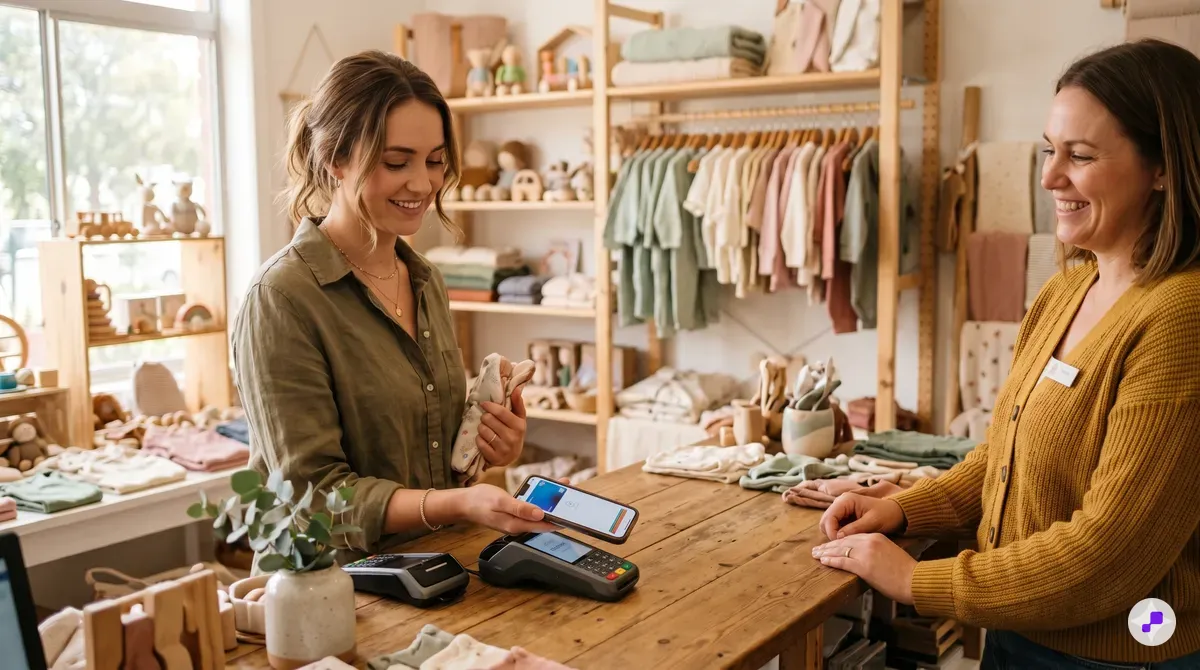
In the physical store, the wallet pass replaces the loyalty card, the membership number, and the phone number lookup. A parent taps their phone at checkout, and the system identifies them, awards points, and checks their child's lifecycle data to trigger any relevant recommendations. The barista — or in this case, the sales associate — doesn't need to ask for any information. The transaction takes seconds, which matters when you're holding a baby in one arm.
Online, the wallet pass connects to the parent's Shopify account. Their loyalty status, points balance, and available rewards are visible across the website. When they place an online order, the same wallet pass updates in real time to reflect the new points. There's no need to check a separate loyalty portal or remember a login for a rewards dashboard.
For registry-related interactions, the wallet pass serves as a status tracker. Parents can see their total registry gift points accumulating on the pass without checking a website. A push notification when a gift is purchased — "Someone just bought the stroller from your registry! 200 points added to your balance" — creates excitement and reinforces the loyalty connection.
The push notification channel is invaluable for baby brands because timing is everything. A size-up reminder delivered via wallet push at 85-95% reach is dramatically more effective than an email that gets buried under a hundred other messages. A milestone celebration notification — "Happy 6 months! Here are your milestone bonus points" — arrives on the lock screen at exactly the right moment.
Wallet passes also enable family features. A parent can share the pass with a partner or caregiver, so anyone shopping for the child can tap to earn points to the family account. This removes the common friction point of "only one parent has the loyalty card" that causes missed point-earning opportunities on 30-40% of family purchases. For a complete look at retention tactics, see our baby retention strategies guide.
Wallet passes are the ideal omnichannel credential for parents — no app, no card, no login, shareable with partners, and 85-95% push notification reach for time-sensitive messages.
Set up pass sharing so both parents can tap to earn points on the same family account. Test the flow by sharing a pass between two phones and verifying that points accumulate correctly.
Wallet passes unify the parent experience across store, online, and registry channels — one tap, one family balance, shareable with partners and caregivers.
Baby brands have a unique cross-channel opportunity that most retailers lack: the gift-buyer channel. Every baby shower, birthday, and holiday generates purchases from people who aren't your current customers — grandparents, aunts, uncles, friends, coworkers. Each of these gift-buyers is a potential loyalty member if you handle the post-purchase experience correctly.
Start with a gift-buyer welcome flow. When someone purchases a registry item or buys a product marked as a gift, trigger a post-purchase email: "Thank you for your thoughtful gift! Did you know you can earn points on every baby gift you buy? Join our rewards program and save on future gifts." Include a link to add a wallet pass. Gift-buyers who join the loyalty program become recurring customers because they'll buy gifts for birthdays, milestones, and holidays over the next several years.
For existing parent loyalty members, drive cross-channel adoption systematically. Segment your members by channel behavior: in-store only, online only, and omnichannel. Then create targeted campaigns for each single-channel segment.
In-store-only parents should receive wallet notifications promoting online-exclusive benefits: "Shop online for free shipping on orders over $50, plus earn double points on your first online order." Include a direct link to a curated collection based on their child's current age stage. The personalization makes the online experience feel like an extension of their in-store relationship, not a separate channel.
Online-only parents should receive invitations to visit the physical store: "See and feel our new organic cotton collection in person — plus earn 50 bonus points on your first in-store visit. Show your wallet pass at checkout." For baby products especially, the tactile experience of feeling fabrics, testing stroller handles, and seeing colors in person often drives larger basket sizes and builds stronger brand connection.
Create family events that bridge channels. A "New Season Preview" evening at your store, exclusively for loyalty members, lets online customers experience the brand physically while earning bonus points. A virtual "Stage Guide" webinar for in-store regulars introduces them to your online content and community features. These bridge events convert single-channel members to omnichannel at 2-3x the rate of promotional offers alone. For more creative loyalty approaches, check our best baby store rewards guide.
Gift-buyers represent a zero-cost acquisition channel unique to baby brands — a post-purchase welcome flow converts them into recurring loyalty members who buy for years.
Set up a gift-buyer welcome email this week: trigger it on any order marked as a gift or purchased from a registry, and include a wallet pass enrollment link with a sign-up bonus.
Shopify Flow can detect gift orders (gift wrapping selected, registry purchase, or gift message included) and trigger automated welcome flows for the gift-buyer.
The most powerful aspect of omnichannel loyalty for baby brands is combining lifecycle data with cross-channel targeting. When you know a child's age and the parent's channel preferences, you can deliver perfectly timed, perfectly placed messages that feel like personal service rather than marketing.
Build a lifecycle campaign calendar that aligns child stages with cross-channel promotions. At 3 months (first major size-up), trigger a campaign that sends in-store parents an online collection link and online parents a store event invitation — both with size-up bonus points. At 6 months (solid food introduction), promote feeding products across all channels with a "Starting Solids" loyalty challenge: buy three feeding essentials across any channel and earn 100 bonus points.
Seasonal campaigns should be lifecycle-aware too. A winter clothing promotion should filter product recommendations by the child's current size, not blast the entire catalog. A back-to-school campaign should only reach parents with preschool-age children. This targeting prevents the irrelevance that causes parents to tune out — and irrelevance is the #1 reason parents disengage from loyalty programs.
Create omnichannel milestone celebrations. When a child turns 1, the parent receives a wallet notification with a birthday message and milestone bonus, an email with a curated gift guide for 12-18 month products, and (if they're an in-store customer) a staff alert to congratulate them at their next visit. This multi-touchpoint celebration creates a brand moment that parents remember and share.
Use channel-specific content strategies for each lifecycle stage. Prenatal parents benefit most from in-depth online content (guides, comparisons, registry tools) because they're in research mode. Newborn parents respond best to push notifications and simplified reordering because they're time-starved. Toddler parents engage most with community features and events because they're seeking connection and activity ideas.
Automate everything through Shopify Flow. Set triggers based on the child's age metafield combined with the parent's channel tag. If child_age = 6 months AND channel = "in-store primary," trigger an online discovery campaign. If child_age = 12 months AND channel = "online primary," trigger a store event invitation. These lifecycle-aware, channel-specific automations run continuously, ensuring every parent receives the right message in the right place at the right time. Use the loyalty ROI calculator to model the revenue impact of these targeted campaigns.
Combining lifecycle stage data with channel preference targeting creates hyper-relevant campaigns that feel like personal service — the strongest loyalty driver for parents.
Build one lifecycle-aware cross-channel campaign this month: pick a stage transition (e.g., 6 months) and create different messages for in-store-primary versus online-primary parents, each driving the other channel.
Shopify Flow combines customer metafields (child age) with channel tags to trigger lifecycle-aware, channel-specific campaigns automatically.
Wallet notifications are the delivery mechanism for time-sensitive lifecycle messages — a milestone celebration or size-up alert on the lock screen beats email every time for busy parents.
Omnichannel metrics for baby brands need to account for the lifecycle dimension that makes this category unique. Standard omnichannel KPIs (cross-channel adoption rate, revenue multiplier) are important, but they need to be layered with lifecycle-specific measurements.
Omnichannel adoption rate: what percentage of your loyalty members have purchased in two or more channels? Benchmark at 15-20% and target 30% within 12 months. For baby brands, count the registry channel separately — a parent who creates a registry and also shops in-store is omnichannel even if they haven't placed an online order yet.
Lifecycle-adjusted revenue multiplier: compare the total lifecycle spending of omnichannel parents versus single-channel ones, controlling for child age. An omnichannel parent with a 12-month-old should have spent more than a single-channel parent with a 12-month-old. This controlled comparison removes the confounding factor of lifecycle stage and shows the true impact of omnichannel engagement.
Gift-buyer conversion rate: what percentage of gift-buyers who receive your welcome flow join the loyalty program? Target 8-12%. Track the subsequent purchase rate of converted gift-buyers — they should make at least one non-gift purchase within 90 days. This metric validates your gift-buyer acquisition channel.
Registry completion rate for loyalty members versus non-members: parents who are loyalty members should complete (fill) their registries at a higher rate because they earn points on every gift purchased. If there's no difference, your registry-to-loyalty connection isn't visible enough.
Cross-channel stage retention: measure stage-to-stage retention separately for single-channel and omnichannel parents. You'll likely find that omnichannel parents retain at 30-50% higher rates through growth transitions because they have multiple touchpoints and multiple reasons to stay.
Channel contribution by lifecycle stage: which channels drive the most revenue at each stage? Prenatal might be registry-heavy. Newborn might be in-store-heavy (parents buying urgently). Toddler might be online-heavy (parents know what they want). Understanding these patterns helps you allocate cross-channel promotion budgets effectively.
Build a monthly dashboard with these metrics and review with your team. The insight you're looking for is the correlation between omnichannel engagement and lifecycle retention — when you can prove that getting a parent into a second channel increases their stage-to-stage retention by a specific percentage, you have the business case for every cross-channel investment. For a comprehensive program diagnostic, use our baby loyalty checklist.
Layer standard omnichannel metrics with lifecycle-specific measurements — the most valuable insight is how cross-channel engagement affects stage-to-stage retention.
Compare stage-to-stage retention rates between omnichannel parents and single-channel parents. The difference is the revenue case for your entire omnichannel investment.
Shopify analytics combined with customer tags for channel preference and lifecycle stage enable the cross-dimensional analysis that omnichannel baby loyalty requires.
Omnichannel loyalty for baby and kids brands means connecting every parent touchpoint — store, website, registry, and gift-buyer channel — into one unified experience that grows with the family. By using wallet passes as the universal parent credential, enabling registry-to-loyalty attribution, and converting gift-buyers into loyal customers, baby brands can capture 2-3x more lifetime value than single-channel approaches allow. The brands that win aren't just selling baby products — they're building a family relationship that spans channels and stages.
JeriCommerce connects your baby store, online shop, and registry into one omnichannel loyalty experience — one tap, one family profile, and milestone rewards that grow with every child.
One family profile across store, online, and registry. milestone rewards, size-up reminders, and gift-buyer conversion built in.
Install Free on Shopify