Baby and kids brands have a unique advantage when it comes to loyalty: parents are creatures of habit once they find brands they trust for their children. But they're also overwhelmed, skeptical of gimmicks, and hyper-focused on safety and quality. Your loyalty program launch needs to respect that mindset. This checklist covers everything from the foundational data capture to advanced wallet pass features. If you're still exploring what kind of program to build, start with our loyalty program ideas for baby stores.
63%
of parents who join a baby brand's loyalty program make their second purchase within 30 days — if the onboarding experience is smooth
Loyalty360 Family Brand Report 2025
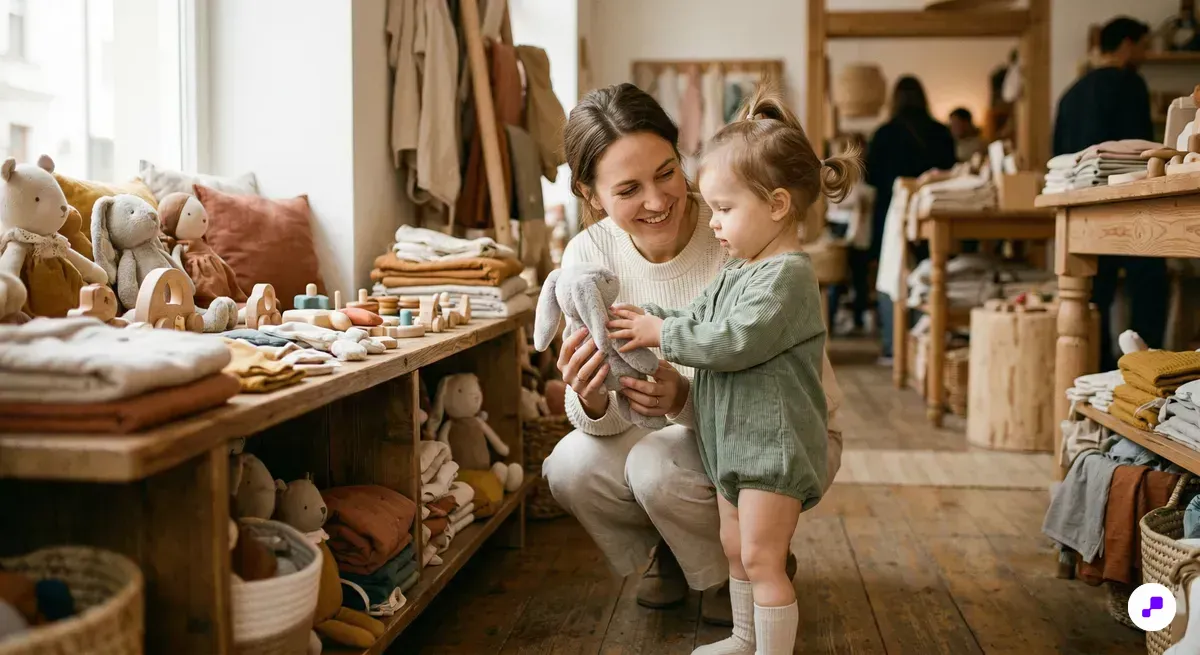
Family-friendly shopping experiences build the emotional connection that drives loyalty program sign-ups.
Foundation: Program Structure & Data Capture
Before launching anything visible to customers, get your program structure right. These foundational steps determine whether your program scales smoothly or creates headaches later.
Define Your Point-to-Reward Ratio
high impactbeginner
Set a clear, simple earning structure: e.g., 1 point per $1 spent, with 500 points = $10 reward. For baby stores, make the first reward achievable within 1-2 purchases (not 5+). Parents need a quick win to form the loyalty habit — especially during the high-spend newborn phase when they're evaluating dozens of brands.
Example
A baby essentials brand set their ratio at 1 point per $1 with first reward at 200 points ($5 off). 71% of new members reached their first reward within 2 purchases, compared to 29% at the previous 500-point threshold.
Capture the Child's Birthday at Signup
high impactbeginner
Add a simple 'child's birthday or expected due date' field to your loyalty enrollment. This single data point powers your entire growth-stage automation: milestone rewards, size-up reminders, age-appropriate product suggestions, and birthday celebrations. Without it, your program is generic — with it, it's personal.
Example
A baby brand added an optional 'baby's birthday' field at signup. 84% of parents provide it, and those who do have a 43% higher 12-month retention rate than those who skip it.
Design Your Tier Structure
high impactintermediate
Create 3-4 tiers aligned with baby spending patterns: a free Welcome tier, a mid-tier at ~$200 annual spend (achievable for most parents), and a top tier at ~$500+ for power shoppers with multiple kids. Name tiers with family-friendly language (Seedling, Sprout, Blossom, Mighty Oak) rather than generic Gold/Silver. Check our VIP tier examples for baby programs for detailed structure ideas.
Example
A kids' clothing brand uses Seedling → Sprout → Blossom → Mighty Oak tiers. The friendly naming resonates with parents and creates natural social sharing: 'I just hit Blossom status at [brand]!'
Set Up Multi-Child Profile Support
high impactintermediate
Ensure your loyalty system can track multiple children per family — each with their own birthday, size preferences, and growth stage. Families with 2+ children are your highest-LTV segment, and a program that only tracks one child feels incomplete for growing families.
Example
A baby brand enabled multi-child profiles. Families with 2+ children registered have 91% annual retention and 2.9x higher LTV compared to single-child profiles.
Map Your Earning Opportunities Beyond Purchases
medium impactbeginner
Define all the ways parents can earn points: purchases, reviews, referrals, social shares, quiz completions, newsletter signups, and birthday registrations. Document each earning action, its point value, and its business purpose. A well-mapped earning structure keeps the program engaging between purchases.
Example
A baby store mapped 8 earning actions (purchase, photo review, referral, quiz, social share, birthday registration, newsletter, and subscription signup). Members who use 3+ earning methods have 2.4x higher annual spend.
Reward Selection & Redemption Setup
Your rewards determine whether parents actually engage with your program. These steps ensure your reward catalog is relevant, achievable, and aligned with what parents genuinely value.
Include at Least One Non-Discount Reward
high impactbeginner
Beyond percentage-off discounts, offer at least one practical reward: free expedited shipping, extended returns, or priority support access. Parents in the baby category value convenience over savings. A free next-day shipping reward often outperforms a 15% discount in redemption rates and satisfaction scores.
Example
A baby brand added free 2-day shipping as a 500-point reward alongside their existing discount rewards. The shipping reward became the #1 most redeemed reward within 60 days, used on 38% of all loyalty orders.
Create Growth-Stage Specific Rewards
high impactintermediate
Design rewards that align with each developmental stage: newborn welcome kits, crawler essentials bundles, toddler transition packs, and school readiness sets. These rewards feel curated and timely rather than generic, and they keep your program relevant as children age. See our best rewards guide for baby stores for the full breakdown.
Example
A baby-to-toddler brand offers stage bundles as loyalty rewards. Stage-specific rewards have 2.1x higher redemption rates than generic rewards and drive 31% of total loyalty revenue.
Wallet Pass Angle
Wallet notification when stage-specific reward unlocks: 'New reward available! Your Toddler Transition Bundle is ready to redeem — 800 points.'
Set Up Birthday Reward Automation
medium impactintermediate
Configure automatic birthday rewards for both the child and the parent. Child's birthday: bonus points + age-appropriate product suggestions. Parent's birthday: a personal thank-you + discount. Automate via Shopify Flow + Klaviyo so you never miss a birthday in your loyalty database.
Example
A baby brand automated birthday rewards for both child and parent. Child birthday emails have a 62% open rate (vs. 22% for standard promos), and birthday-month spending averages 2.5x the normal monthly spend.
Offer a Charity Donation Option
medium impactbeginner
Let parents redeem points as a donation to a children's charity (hospitals, literacy programs, environmental causes). This costs you nothing beyond the standard reward value but creates deep emotional resonance. Provide a digital certificate parents can save for the child's memory book.
Example
A kids' brand offers point donations to 3 children's charities. 19% of top-tier members choose donation over discounts, and donors have 84% annual retention — the highest of any reward type.
Test Reward Accessibility and Redemption Flow
high impactbeginner
Before launching, test the full redemption flow from a parent's perspective: Can they find their rewards easily? Is the redemption process under 3 taps? Does it work on mobile? Baby parents shop in 90-second windows — if redemption takes longer than a minute, most will abandon it.
Example
A baby store reduced their redemption flow from 5 steps to 2 taps (wallet notification → auto-applied at checkout). Redemption rate jumped from 19% to 47% within the first month.
Communication & Onboarding Setup
How you introduce and communicate your loyalty program determines adoption rates. These steps ensure parents discover, understand, and engage with your program from their very first order.
Design a Post-Purchase Onboarding Flow
high impactintermediate
Set up a Klaviyo email sequence triggered by first purchase: Email 1 (immediate) — welcome + wallet pass install link. Email 2 (day 3) — how points work + first earning opportunity. Email 3 (day 7) — first reward teaser. This sequence converts one-time buyers into loyalty members without any manual effort.
Example
A baby brand's 3-email onboarding flow converts 41% of first-time buyers into loyalty members. Members onboarded via the flow have 3.2x higher 90-day repeat purchase rates.
Wallet Pass Angle
Email 1 includes a one-tap wallet pass install link. Pass arrives pre-loaded with first-order points, child's age profile, and a welcome reward.
Add Loyalty Visibility to Your Product Pages
high impactbeginner
Display 'Earn X points with this purchase' on every product page, near the Add to Cart button. For baby products (where price comparison is constant), showing the loyalty value tips the decision. Parents who see point earnings at the product level join loyalty programs at 2x the rate of those who don't.
Example
A baby gear brand added 'Earn 85 points with this purchase' badges to product pages. Loyalty enrollment from product pages increased 117%, and overall conversion rate improved by 8%.
Set Up Wallet Push Notification Strategy
high impactintermediate
Plan your wallet push notification calendar: welcome message, milestone alerts, size-up reminders, birthday notifications, seasonal campaigns, and reward availability. Limit to 2-3 pushes per week maximum. Time notifications for parent-friendly windows: early morning (6-7 AM), naptime (1-2 PM), or post-bedtime (8-9 PM).
Example
A baby brand sends 2 wallet pushes per week (milestone + promotional). Post-bedtime pushes (8:30 PM) have 3.1x higher tap-through than midday sends.
Wallet Pass Angle
Wallet pushes have 90%+ open rates. Use them for high-value messages only — milestone rewards, expiring offers, and birthday celebrations.
Create a Loyalty Explainer Page on Your Site
medium impactbeginner
Build a dedicated loyalty program page that explains: how to earn points, what rewards are available, tier structure and benefits, and how wallet passes work. Use clear visuals and keep the language simple — parents don't have time to decode complicated programs. Link to this page from your navigation, footer, and confirmation emails.
Example
A kids' brand created a visual loyalty explainer page with tier comparisons and a points calculator. The page has become their 5th most-visited page and is the entry point for 23% of loyalty signups.
Configure Abandoned Loyalty Reminders
medium impactintermediate
Set up automated reminders for members who haven't redeemed points in 45+ days: a wallet push + email combo showing their balance and available rewards. In baby retail, 45 days without activity often means parents have found another brand for the current growth stage. Re-engage before they forget about you.
Example
A baby store's 45-day re-engagement flow (wallet push + email) recovers 28% of dormant members. Recovered members' next purchase is 35% higher AOV than their average — they've been saving up needs.
Referral & Social Sharing Setup
Parents trust other parents. These steps ensure your loyalty program includes a referral engine that taps into the communities where baby product recommendations naturally happen.
Configure Dual-Sided Referral Rewards
high impactbeginner
Set up referral rewards where both the referrer and the friend receive value: the referrer gets points, the friend gets a welcome discount or bonus. Dual-sided referrals outperform one-sided by 3x in baby retail because parents won't recommend something that doesn't also help their friend. See our referral ideas for baby brands for creative approaches.
Example
A baby brand switched from one-sided to dual-sided referrals. Referral volume increased 280%, and referred customers' 6-month retention was 58% vs. 31% for paid-acquisition customers.
Wallet Pass Angle
One-tap referral sharing from wallet pass reverse. Friend receives a wallet pass pre-loaded with welcome points — instant enrollment with zero friction.
Enable Social Sharing Rewards
medium impactintermediate
Award points when loyalty members share purchases, reviews, or milestone moments on Instagram, Facebook, or TikTok. Baby content is naturally shareable (cute kids + products = engagement). Provide branded, trackable sharing links from the wallet pass for easy attribution.
Example
A children's clothing brand awards 75 points per social share. Their top 50 sharers generated 1,800 tracked clicks in Q4, with a 7.1% conversion rate — far exceeding paid social performance.
Set Up Parent Group Referral Codes
high impactintermediate
Create dedicated referral codes for local parent groups, mommy-and-me classes, and daycare communities. Track which groups generate the most referrals and offer escalating rewards to the group organizer. These codes tap into high-trust, tight-knit communities where recommendations carry enormous weight.
Example
A baby brand created unique codes for 15 local parent groups. Group referral codes convert at 14.2% (vs. 4.8% for generic referral links), and group-sourced members have 67% 12-month retention.
Automate Referral Follow-Up Sequences
medium impactintermediate
When a referral code is shared but the friend hasn't purchased within 7 days, send an automated reminder to the friend (with the referrer's endorsement). When a referral converts, immediately notify the referrer of their reward. Fast feedback loops keep your referral engine spinning.
Example
A baby store automated referral follow-ups at day 3 and day 7. The day-3 reminder converts an additional 18% of pending referrals, increasing overall referral conversion by 42%.
Create a Seasonal Referral Campaign Calendar
medium impactbeginner
Plan 4-6 referral boost campaigns per year, aligned with baby spending peaks: New Year (resolutions), spring (outdoor gear), back-to-school (August), holiday gifting (November), and end-of-year clearance (January). Double or triple referral rewards during these windows to generate volume surges.
Example
A kids' brand runs 5 seasonal referral campaigns per year. Seasonal campaigns generate 55% of annual referral volume, with the holiday campaign alone driving 22% of new loyalty signups.
Analytics, Optimization & Launch Readiness
Before you flip the switch, ensure you can measure what matters and iterate quickly. These final checklist items prepare your program for a successful launch and ongoing optimization.
Set Up Core Loyalty KPIs in Your Dashboard
high impactintermediate
Track these metrics from day one: enrollment rate, active member rate (purchased in last 60 days), redemption rate, repeat purchase rate for members vs. non-members, points liability, and referral conversion rate. If you can't measure it, you can't improve it. Set up a dedicated loyalty dashboard in your analytics tool.
Example
A baby brand tracks 8 core loyalty KPIs in a weekly dashboard. Data-driven adjustments to their point ratios and reward structure led to a 34% increase in redemption rate within 90 days of launch.
Configure A/B Testing for Reward Types
medium impactadvanced
Set up the ability to test different reward types, point thresholds, and communication channels with different member segments. Start with testing your top 2 reward options against each other. Baby retail has enough purchase frequency to generate statistically significant results within 4-6 weeks.
Example
A baby store A/B tested free shipping vs. 15% discount as their primary reward. Free shipping won with 2.1x higher redemption and 18% higher post-redemption AOV — a finding that reshaped their entire reward catalog.
Run a Soft Launch with Your Best Customers
high impactbeginner
Before a public launch, invite your top 50-100 customers (by LTV or purchase frequency) to join a 'beta' loyalty program. Gather feedback on the enrollment flow, reward relevance, and redemption experience. Fix issues before scaling. Beta testers also become your most vocal program advocates.
Example
A baby brand soft-launched with their top 75 customers. Beta feedback led to 3 critical UX fixes and 2 new reward ideas. When the public launch went live, enrollment rate was 2x their projected target.
Plan Your Points Liability Management
medium impactintermediate
Set point expiration policies (12-18 months is standard for baby retail), communicate them clearly, and send reminders before points expire. Unexpired points create a financial liability on your books. A 'use it before you lose it' reminder 30 days before expiration recovers 35%+ of dormant points.
Example
A kids' brand set 12-month point expiration with 30-day and 7-day reminders. Expiration reminders drive 31% of monthly redemptions and recover an average of $4,200/month in otherwise dormant points.
Document Your Program Rules Clearly
medium impactbeginner
Write clear, jargon-free terms: how points are earned, how they expire, tier qualification criteria, referral rules, and reward redemption limits. Make this accessible from the loyalty program page, wallet pass reverse, and confirmation emails. Clarity prevents support tickets and builds trust with safety-conscious parents.
Example
A baby store reduced loyalty-related support tickets by 61% after publishing a clear, visual FAQ page with their program rules. Parents specifically praised the transparency in post-purchase surveys.
Pro Tips for Baby & Kids
1
Launch with your simplest tier structure (2-3 tiers max) and expand later based on data. Overcomplicating tiers at launch confuses parents and creates unnecessary support overhead. You can always add complexity once the foundation is working.
2
Use the first 90 days post-launch to monitor which earning actions parents use most and which rewards they redeem. Double down on what works and remove what doesn't — baby parents have no patience for irrelevant program features.
3
Set up Shopify Flow automations before launch, not after. Automated milestone rewards, size-up reminders, and birthday notifications should be live from day one. Manual processes don't scale in baby retail where timing is everything.
4
Brief your customer support team on the loyalty program before launch. They'll field questions about points, rewards, and wallet passes — and a well-informed support team converts confused shoppers into enrolled members at a 40% rate.
5
Create a 30/60/90 day optimization plan before launch. Define what success looks like at each milestone, what adjustments you'll test, and what triggers a program redesign. Having a plan prevents the common trap of launching and forgetting.
Common Mistakes to Avoid
✕
Launching without growth-stage automation in place. If your loyalty program doesn't anticipate the child's next size, next stage, or next need, it's just a generic points system. The automation is what makes baby loyalty programs feel personal and indispensable.
✕
Overcomplicating the enrollment process. If signup requires more than name, email, and child's birthday, you'll lose most parents at the form. Every additional field reduces completion rates by 15-20%. Collect other data later through quizzes and preference surveys that earn points.
✕
Skipping the wallet pass integration. Email open rates for baby brands average 18-22%. Wallet pass push notifications hit 90%+. In a category where parents' inboxes are flooded with advice and promotions, wallet passes are the only channel that consistently cuts through.
Baby & Kids Benchmarks
25-40% (baby & kids average; brands that follow this checklist reach 50%+ within 6 months)
Avg. Repeat Purchase Rate
$420-$680 over a 24-month period for baby and kids retailers
Avg. Customer Lifetime Value
78% of parents say they would join a baby brand's loyalty program if enrollment took under 30 seconds
Loyalty Program Adoption
Launch Your Baby Store's Loyalty Program Today
Wallet passes, growth-stage automation, Klaviyo integration, and Shopify POS. the complete loyalty toolkit for baby and kids brands.
Work through this checklist sequentially — foundation first, then rewards, then communication, then referrals, then analytics. JeriCommerce handles the technical heavy lifting: wallet pass generation, Shopify Flow integration, Klaviyo automation, and POS support — so you can focus on the strategy. Start free at jericommerce.com.