The spa and salon industry has changed dramatically. Clients have more options than ever — from boutique blowout bars to medical aesthetic clinics popping up on every corner. According to the Global Wellness Institute, the global wellness economy surpassed $6 trillion, and competition for each client dollar is fierce. Without a loyalty program, your business relies entirely on new client acquisition, which costs five to seven times more than retaining an existing one.
A loyalty program shifts the economics in your favor. Instead of competing purely on price or novelty, you create a reason for clients to return to you specifically. For spas, this means turning that monthly facial client into someone who also books massages, buys retail skincare, and refers friends. For salons, it means the client who comes for a cut every six weeks starts adding color services and purchasing styling products.
MedSpas face an even more compelling case. Treatments like Botox, fillers, and laser services are inherently recurring — clients need maintenance appointments every three to six months. A loyalty program that rewards consistent visits creates a powerful incentive to stay with your practice rather than price-shopping competitors. When a client sees they are halfway to a free treatment upgrade, they are far less likely to switch providers.
The data backs this up. Research from Bain & Company shows that increasing customer retention by just 5% can boost profits by 25% to 95%. For a spa doing $500,000 in annual revenue, even a modest improvement in client retention could add $50,000 or more to the bottom line. A well-designed loyalty program is the most reliable path to that improvement.
Client acquisition costs 5-7x more than retention — a loyalty program shifts your economics toward profitable repeat business.
Calculate your current client retention rate by dividing the number of clients who visited more than once in the last 12 months by total unique clients. This baseline tells you exactly how much room you have to improve.
Digital wallet passes give clients a persistent, branded reminder on their phone — unlike email promotions that get buried, a wallet pass surfaces your spa every time they open Apple or Google Wallet.
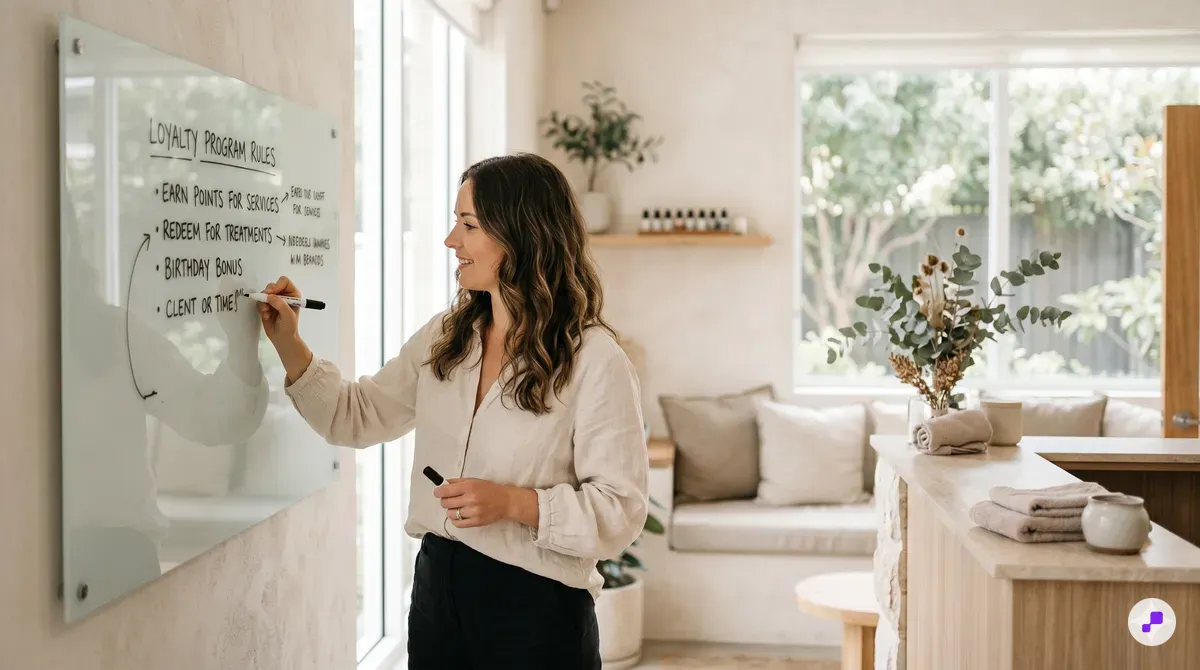
Not all loyalty programs work the same way, and the right structure depends on your service mix and average ticket size. There are three main models that work well for spas, salons, and medspas, and you can combine elements from each.
The first is a visit-based program. Clients earn credit toward a reward after a set number of visits — for example, every tenth haircut earns a free blowout, or every fifth facial includes a complimentary add-on treatment. This model works best for salons and spas where the average service price is relatively consistent and the goal is increasing visit frequency. It is simple to understand and easy to track.
The second is a points-based program. Clients earn points on every dollar spent across services and retail purchases. Points can be redeemed for service upgrades, retail products, or exclusive experiences. This model works especially well for medspas and full-service spas where ticket sizes vary widely. A client spending $800 on Botox and another spending $80 on a facial both participate, but the high-spender accumulates rewards faster, which feels fair.
The third is a tiered program that combines points or visits with status levels. Think Bronze, Silver, Gold — or use spa-themed names like Refresh, Restore, Renew. Each tier unlocks progressively better perks: priority booking, complimentary upgrades, birthday treatments, and exclusive access to new services. Tiers create aspiration and make clients feel recognized for their loyalty.
For most spas and salons, a hybrid approach works best: points-based earning with tier milestones. This gives you flexibility to reward both frequent visitors and high spenders while creating the status-driven motivation that keeps clients engaged. Use your loyalty ROI calculator to model different structures before launching.
Points-based programs with tier milestones offer the most flexibility for spas and salons with varied service menus.
Map out your top 10 services by revenue and frequency. If most clients book the same service repeatedly, a visit-based model works. If your menu is diverse and ticket sizes vary, go with points.
Shopify POS lets you track both retail purchases and service bookings in one system, so loyalty points accumulate seamlessly whether a client buys a $40 shampoo or books a $200 treatment.
The biggest mistake spa and salon owners make with loyalty programs is defaulting to percentage-off discounts. A 10% discount feels transactional and trains clients to expect lower prices. The rewards that actually drive rebooking are experiential — they make clients feel valued while maintaining your margins.
Service upgrades are the highest-impact reward category. Offer a complimentary scalp massage with a haircut, a hydrating mask add-on with a facial, or an extended treatment time. These upgrades cost you minimal labor and product but feel luxurious to the client. They also introduce clients to premium services they might not have tried otherwise, often leading to future full-price upgrades.
Retail product rewards work beautifully for businesses that sell skincare, haircare, or beauty products alongside services. Let loyalty members redeem points for travel-size or full-size products. This drives retail revenue awareness — many spa and salon clients do not realize you sell products — while giving them something tangible to take home that extends the experience.
Exclusive access rewards create the aspirational element your program needs. This could be early booking for a new treatment, an invitation to a members-only skincare masterclass, or first access to seasonal menus. For medspas, consider loyalty-exclusive pricing on new injectable treatments or technology. The key is making members feel like insiders.
Birthday and anniversary rewards are table stakes but still powerful. Offer a complimentary mini-service (a 15-minute hand massage, an eyebrow shaping, a lip treatment) during the client's birthday month. The time-limited window creates urgency to book. Keep the reward simple enough that it does not require a dedicated appointment slot — an add-on to an existing booking works best. Check out these loyalty program ideas for spas for more reward inspiration tailored to your specific business type.
Service upgrades and exclusive access rewards maintain margins and feel more luxurious than discounts — they also introduce clients to premium services.
List three service add-ons that cost less than $5 in product but feel premium (hot towel wrap, aromatherapy upgrade, paraffin dip). These become your most profitable loyalty rewards.
Wallet passes can display available rewards right on the lock screen: 'You've earned a free scalp massage — redeem at your next visit.' This visual reminder drives rebooking better than email reminders that go unread.
If your spa, salon, or medspa uses Shopify for retail and point-of-sale, you already have a strong foundation for loyalty. Shopify POS handles the transactional side — tracking purchases, managing customer profiles, and processing payments — and a loyalty app layer adds the rewards logic on top.
Start by ensuring every client has a customer profile in Shopify. When a client checks out via Shopify POS — whether buying a retail product or paying for a service — their purchase should be linked to their profile. This is the data backbone of your loyalty program. Train your front desk staff to ask for the client's name or phone number at every transaction so points are never missed.
Next, configure your earning rules. A common setup for spas is 1 point per dollar spent, with bonus point multipliers for specific behaviors you want to encourage. For example, 2x points on retail purchases (to boost product sales), 2x points on weekday bookings (to fill slow periods), or bonus points for booking the next appointment before leaving. These multipliers let you use your loyalty program as a strategic tool, not just a passive reward system.
Set your redemption thresholds carefully. The sweet spot is a reward that feels achievable within two to three visits. If a client spends an average of $120 per visit, and you set a reward at 500 points (1 point per dollar), they will hit their first reward after about four visits. That is close enough to motivate but far enough to generate meaningful revenue before the reward cost kicks in.
Finally, connect loyalty to your booking system. When a client books online or calls to schedule, they should be reminded of their points balance and how close they are to the next reward. For the best Shopify apps that support this integration, see our recommended app roundup. This is where the rebooking magic happens — clients who see they are 80 points from a free upgrade are significantly more likely to add a retail product or book an additional service.
Link every transaction to a customer profile in Shopify POS so no loyalty points are ever missed — this data backbone powers your entire program.
Create a laminated card at your front desk that says: 'Don't forget to ask for the client's name at checkout.' This simple reminder ensures 100% of purchases are tracked for loyalty.
Shopify Flow can automate loyalty milestones — when a customer reaches a point threshold, Flow triggers an automatic notification or tags the customer for your next campaign.
If your spa or salon still uses paper punch cards, you are leaving money on the table. Punch cards get lost, forgotten in purses, and create zero data about client behavior. Digital wallet passes solve all of these problems while adding capabilities that paper simply cannot match.
A digital wallet pass lives on your client's phone in Apple Wallet or Google Wallet. It displays their loyalty tier, current points balance, and available rewards — updated in real time after every visit. There is nothing to carry, nothing to lose, and nothing to forget. When a client opens their phone to pay, your brand is right there.
But the real power of wallet passes goes beyond convenience. They enable location-based notifications — when a client walks near your spa, their phone can surface your pass with a reminder like 'You have 200 points — just 100 away from a free upgrade.' This passive marketing is incredibly effective because it reaches clients at the exact moment they are nearby and available.
Wallet passes also support push notifications for time-sensitive promotions. A medspa could send a notification on a slow Tuesday: 'Double points on all treatments booked today.' A salon could push a reminder: 'Your highlights are due for a refresh — book this week and earn 50 bonus points.' These messages bypass email clutter and social media algorithms, landing directly on the lock screen.
For medspas specifically, wallet passes can serve double duty as digital appointment cards. Instead of a paper appointment reminder, the client's wallet pass updates with their next appointment date, time, and any pre-treatment instructions. This reduces no-shows while keeping your loyalty program front and center. The client sees their appointment and their points balance on the same pass — a constant, branded touchpoint.
The transition from punch cards to wallet passes is also seamless. Clients simply scan a QR code at your front desk or tap a link in a text message to add the pass. No app download required. Most clients add it in under ten seconds, and once it is there, it stays — wallet pass retention rates exceed 90%.
Digital wallet passes combine loyalty tracking, appointment reminders, and location-based marketing in one always-present touchpoint — no app download needed.
Print a simple QR code sign for your front desk and treatment rooms: 'Add your loyalty pass to Apple or Google Wallet — never lose your points again.' Track how many passes are added in the first week.
Wallet passes support dynamic updates, so when a client earns points or moves up a tier, the pass updates automatically. This real-time feedback loop reinforces the loyalty behavior.
A strong launch sets the tone for your entire loyalty program. The first 30 days are about enrollment, education, and quick wins that get clients excited. Do not overcomplicate this phase — simplicity drives adoption.
Week one is about enrollment. Your goal is to sign up at least 50% of your existing client base in the first seven days. Start by emailing your full client list with a clear explanation: what the program is, how it works, and what they earn. Offer a sign-up bonus (50-100 bonus points, or an immediate small perk like a free lip balm or mini hand cream) to create urgency. At the front desk, train every team member to mention the program during checkout and hand clients a QR code to add their wallet pass.
Week two is about first rewards. The fastest way to hook clients on your loyalty program is to let them experience a redemption quickly. Set a low-threshold reward that most enrolled clients can reach within their first or second visit — a complimentary add-on service worth $10-$15. When clients redeem their first reward, they emotionally invest in the program. They now have a reason to keep coming back.
Week three is about referrals. Once your enrolled members have experienced the program, activate a referral program that rewards them for bringing friends. The ideal offer: the referring client and the new client both get bonus points. This turns your loyal clients into your marketing team, and new clients arrive already enrolled in your program.
Week four is about measurement. Pull your first month of data: How many clients enrolled? What percentage redeemed a reward? What is the average visit frequency of enrolled vs. non-enrolled clients? How many referrals came in? These baseline numbers tell you whether your program structure is working or needs adjustment. Use the retention rate calculator to benchmark against industry averages. Do not wait months to evaluate — early data lets you course-correct while enthusiasm is still high.
Aim for 50% enrollment in week one, first redemptions in week two, referral activation in week three, and data review in week four.
Create a 'launch day' event — offer 3x points on all services for one day only. Announce it via email, social, and in-store signage. This creates urgency and gives clients a memorable start to the program.
Use Shopify's customer tags to segment loyalty members vs. non-members, then create targeted email campaigns in your email tool based on enrollment status and point balance.
A loyalty program is an investment, and you need to track return just like any other business expense. The good news is that the metrics for spa and salon loyalty programs are straightforward — and the numbers tend to be compelling.
The most important metric is visit frequency. Compare the average number of visits per year for loyalty members versus non-members. In most spa and salon programs, members visit 30-50% more frequently than non-members. If your average non-member visits 4 times per year and your average member visits 6 times, that is a 50% increase in revenue per client before you even account for higher spend per visit.
The second metric is average ticket size. Loyalty members typically spend 15-25% more per visit because they are motivated by point earning and comfortable trying new services. Track this monthly to see the real-dollar impact.
Third, measure your loyalty program's cost versus revenue generated. Calculate the total cost of rewards redeemed in a given period (the wholesale cost of products given away plus the labor cost of complimentary services), then compare it to the incremental revenue generated by loyalty members. A healthy loyalty program should generate $8-$15 in revenue for every $1 spent on rewards.
Fourth, track your client retention rate. What percentage of clients who visited in Q1 also visited in Q2? Segment this by loyalty members and non-members. You should see a significant gap — if you do not, your rewards are not compelling enough or your communication cadence needs improvement.
Finally, monitor your referral metrics if you have a referral component. Track cost per acquired client through referrals versus your other acquisition channels (Google Ads, Instagram, Groupon). Referral clients typically have higher lifetime value because they arrive with a personal recommendation, and they cost a fraction of paid acquisition.
Do not wait for perfect data. Start tracking from day one with whatever tools you have — even a spreadsheet works for the first few months. The insights compound over time.
Track visit frequency, average ticket size, reward cost vs. revenue, retention rate, and referral cost — loyalty members should generate $8-$15 for every $1 in rewards.
Set a calendar reminder to pull loyalty metrics on the first of every month. Create a simple spreadsheet with five columns: total members, avg visits (member vs. non-member), avg ticket (member vs. non-member), rewards cost, and referral count.
After working with hundreds of spa, salon, and medspa owners, the same loyalty program mistakes come up again and again. Avoiding these pitfalls will save you months of frustration and lost revenue.
The first mistake is making rewards too hard to earn. If a client needs to spend $2,000 or visit 20 times before earning anything, they will disengage long before reaching the goal. The psychological sweet spot is a first reward within two to three visits. Even if that first reward is modest — a complimentary paraffin treatment or a travel-size product — the act of redeeming it creates emotional investment in the program.
The second mistake is ignoring retail purchases. Many spa and salon loyalty programs only reward service bookings, completely overlooking retail. This misses a huge opportunity. Clients who buy retail products between appointments stay connected to your brand and spend more overall. Reward every dollar spent, whether on a $150 facial or a $30 moisturizer.
The third mistake is poor communication. A loyalty program that clients forget about is a loyalty program that fails. You need regular touchpoints: post-visit point balance updates, monthly statements, reminders when they are close to a reward, and birthday notifications. Wallet passes handle much of this automatically, but you should also include loyalty messaging in your email and SMS marketing.
The fourth mistake is treating all clients the same. A first-time visitor and a client who has been with you for five years should have different experiences. Tiered programs solve this, but even without formal tiers, you can create VIP touches for your top clients — a complimentary glass of champagne, first access to new treatments, or a handwritten birthday card. These gestures cost almost nothing but create fierce loyalty.
The fifth mistake is not training your team. Your front desk staff and service providers are the face of your loyalty program. If they do not understand how it works, cannot explain it clearly, or forget to mention it, enrollment and engagement will suffer. Dedicate time in team meetings to review the program, role-play enrollment conversations, and celebrate loyalty wins. For a deeper look at keeping clients from leaving, read our guide on reducing churn in spas and salons.
The five most common loyalty mistakes are: rewards too hard to earn, ignoring retail, poor communication, treating all clients the same, and not training your team.
Do a secret shopper test: have a friend visit your spa and see if anyone mentions the loyalty program during their visit. If not, you have a training gap that is costing you members.
A well-structured loyalty program transforms your spa, salon, or medspa from a business that constantly chases new clients into one that grows through repeat visits and referrals. The fundamentals are straightforward: choose the right structure, design rewards that feel luxurious (not transactional), integrate with Shopify POS for seamless tracking, and use digital wallet passes to stay top-of-mind between appointments.
JeriCommerce makes it easy to launch a loyalty program with digital wallet passes that work with your Shopify POS — no app download required for your clients, no complicated setup for your team.
Launch a wallet-pass loyalty program for your spa, salon, or medspa. no app download, no punch cards, just smooth rewards on every client's phone.
Install Free on Shopify