
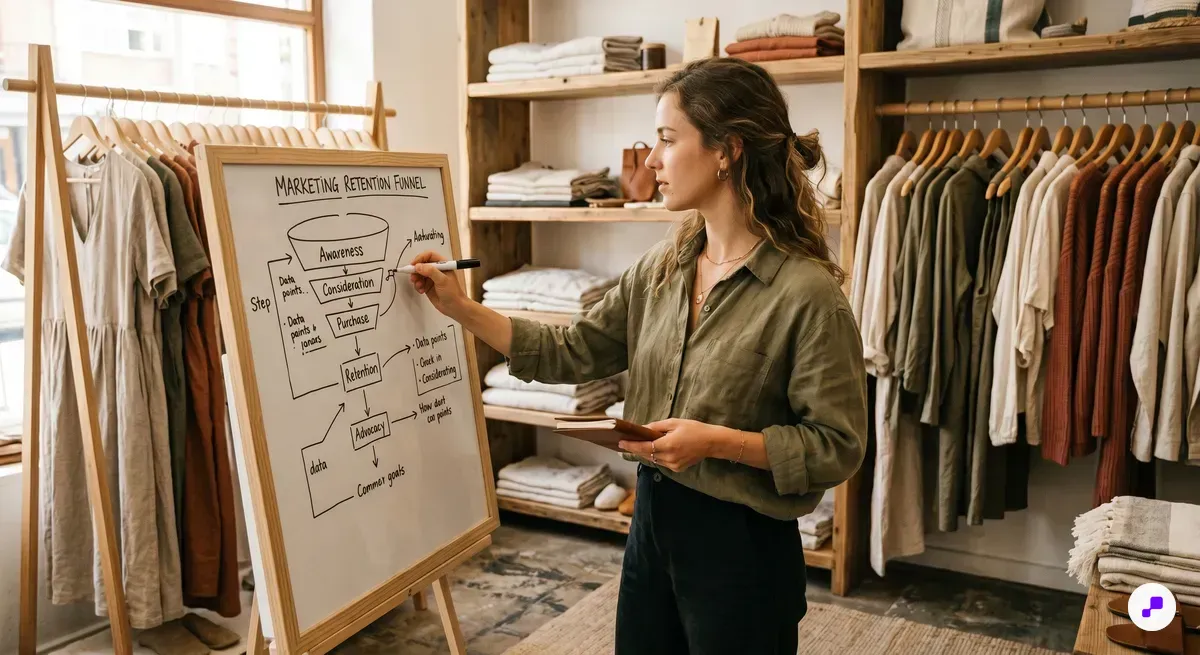
Understanding why fashion customers churn is the first step to keeping them. Unlike subscription businesses where cancellation is a conscious action, fashion churn is passive — customers simply stop thinking about your brand. They don't unsubscribe; they just move on to the next thing that catches their eye.
The biggest churn trigger in fashion is a disappointing first experience. If the sizing runs inconsistent, the fabric doesn't match the photos, or the delivery takes too long, there's no second chance. Fashion is visual and emotional — the gap between expectation (the curated Instagram photo) and reality (the package that arrives) determines whether you get a repeat buyer or a returns-and-gone customer.
The second major trigger is irrelevance. If your post-purchase communications feel generic — "Here are this week's new arrivals" sent to everyone regardless of style preference — you're training customers to tune you out. A customer who bought minimalist basics doesn't want emails about bold prints. A customer who exclusively buys dresses doesn't need a campaign about denim. Every irrelevant touchpoint erodes the relationship.
The third trigger is competition without differentiation. If your customer can find similar styles at a similar price from five other brands, there's no switching cost. The brands that retain are the ones that create something worth staying for: a community, a rewards program that actually feels valuable, a styling experience that gets smarter over time, or exclusive access that feels genuinely special. For data on what drives fashion customer loyalty, check our fashion retention strategies resource.
The good news is that fashion customers who make it past their third purchase become dramatically more loyal. Your retention strategy needs to focus most of its energy on the gap between purchase one and purchase three — that's where the battle is won or lost.
Fashion churn is passive — customers don't cancel, they just forget about you. Focus retention energy on the critical window between the first and third purchase.
Pull your Shopify data and calculate the percentage of first-time buyers who make a second purchase within 90 days. That number is your retention baseline — everything you do should move it upward.
The moment after a customer places their first order is the highest-opportunity window for retention. They're excited about their purchase, engaged with your brand, and open to deepening the relationship. Most fashion brands waste this moment with a transactional confirmation email and then silence until the next promotional blast.
Design a post-purchase sequence that builds anticipation and delivers value at each stage. Order confirmation should include a personal touch — not just the order details, but a message that reinforces their choice: "Great taste — this piece pairs perfectly with [complementary item]." Shipping notification should include styling tips for the item they bought. Delivery confirmation should invite them to share their outfit on social media with a branded hashtag.
Three days after delivery, send a check-in email: "How's your new [item]? We'd love to hear your thoughts." This serves double duty — it catches potential returns early (you'd rather help them exchange than process a refund and lose them forever) and it generates the reviews that drive future conversions.
Seven days after delivery, introduce your loyalty program if they haven't enrolled yet. Frame it around value, not points: "You already have 150 points from your purchase — that's halfway to free shipping on your next order." Showing them a balance they've already earned creates a psychological pull to use it.
Two weeks after delivery, send a personalized recommendation based on their purchase. If they bought a summer dress, suggest the sandals or bag that complete the look. If they bought workout leggings, show the matching sports bra. Shopify's product recommendation features make this easy, and conversion rates on personalized post-purchase recommendations are 3-4x higher than generic browse campaigns.
This entire sequence should feel like a conversation with a knowledgeable friend, not a brand blasting promotions. For more tactical ideas on keeping fashion shoppers engaged, see our fashion loyalty ideas guide.
The post-purchase window is your highest-leverage retention moment — use it to deliver value, build the relationship, and introduce your loyalty program.
Set up a 5-email post-purchase sequence in Shopify: confirmation with styling tip, shipping update, delivery check-in, loyalty enrollment, and personalized recommendation.
Shopify Flow and Shopify Email let you build automated post-purchase sequences triggered by order status changes — no third-party tools needed for the basics.
Not all retention channels perform equally for fashion. Email is essential but increasingly competitive — fashion brands send an average of 6-8 emails per week, and open rates have dropped below 18%. You need a channel mix that reaches customers where they're most receptive.
SMS delivers strong retention results for fashion brands, with open rates above 90% and click-through rates of 15-25%. Use it sparingly and with high-value messages: restocks of items they viewed, flash sales for loyalty members, and personalized style alerts. Overuse kills the channel — two to four SMS messages per month is the sweet spot.
Digital wallet passes are emerging as the most effective retention channel for fashion brands running loyalty programs. Push notifications through wallet passes reach 85-95% of recipients, and they're contextual — they appear on the lock screen alongside payment methods. When a customer sees "You're 50 points from early access to our new collection" every time they pull out their phone, your brand stays top-of-mind without feeling intrusive.
Social media retention is often overlooked in favor of acquisition-focused social spending. Create a private community (Instagram Close Friends, Facebook Group, or Discord) for your loyalty members. Share behind-the-scenes content, sneak peeks at upcoming collections, and styling challenges that encourage engagement. Community-driven retention is powerful because it creates social switching costs — leaving your brand means leaving the group.
Retargeting ads for existing customers should be a distinct budget line from acquisition. Create custom audiences of past purchasers and serve them new arrival ads, loyalty program reminders, and personalized product ads based on their browse and purchase history. The cost per click for retargeting existing customers is typically 50-70% lower than cold acquisition. For a structured approach to managing these channels, see our fashion loyalty program checklist.
The key is using each channel for its strength: email for content and storytelling, SMS for urgency and flash offers, wallet passes for loyalty engagement, social for community, and retargeting for personalized product discovery.
Diversify your retention channels — email alone won't cut it. SMS, wallet passes, community, and retargeting each serve a specific role in keeping fashion customers engaged.
Audit your current retention channel mix and identify the one channel you're underusing. If you're not using wallet passes or SMS for loyalty, start testing this month.
Wallet passes deliver near-perfect notification delivery rates and keep your loyalty program visible on the customer's phone — no app download, no email to find, always accessible.
Generic experiences kill fashion retention. When every customer gets the same homepage, the same emails, and the same recommendations, you're competing purely on product and price — a race to the bottom. Personalization is how you create switching costs in an industry with none.
Start with purchase-based personalization, which requires zero additional data collection. Shopify already tracks what each customer has bought, browsed, and added to cart. Use that data to segment your communications. A customer who buys exclusively from your sustainable line should receive content about your sustainability initiatives. A customer who shops your petite range shouldn't see campaigns featuring items that don't come in their size.
Style profile quizzes are a powerful retention and personalization tool. Offer loyalty points for completing a 2-minute quiz about style preferences, size, color palettes, and shopping occasions. This data transforms your communications from guesswork to precision. "We picked these 5 pieces based on your style profile" converts at 3-5x the rate of "Check out our new arrivals."
Size and fit personalization directly impacts retention because returns are the silent killer of fashion loyalty. If a customer has to return three items to find one that fits, they'll eventually stop buying. Use purchase and return data to provide personalized size recommendations: "Based on your previous purchases, we recommend a size M in this style." This reduces returns and increases satisfaction simultaneously.
Personalize the loyalty experience itself. Instead of offering the same rewards to everyone, let members choose their own perks at each tier. Some customers value free shipping above all else. Others want early access to sales. Some prefer birthday surprises. A choose-your-own-reward model makes the program feel tailored rather than transactional.
Browse abandonment flows should feel helpful, not pushy. "Still thinking about the linen blazer? Here's how three of our stylists would wear it" performs better than "Don't forget! Your cart is waiting." Fashion is aspirational — your personalization should inspire, not pressure. For reward ideas that resonate personally with different customer segments, check our best rewards for fashion brands.
Personalization creates switching costs in fashion by making customers feel understood — size recommendations, style profiles, and curated selections that generic competitors can't replicate.
Launch a style profile quiz this month — offer 100 loyalty points for completion and use the data to segment your next three email campaigns.
Shopify's customer metafields let you store style preferences, size data, and quiz responses directly on the customer profile for use across all marketing channels.
Exclusivity is the most underused retention lever in fashion ecommerce. While most brands compete on discounts, the brands with the highest retention rates compete on access. They make their best customers feel like insiders — and that feeling of belonging is far stickier than any coupon code.
A VIP program creates tiered exclusivity that gives customers a reason to consolidate their fashion spending with you rather than splitting it across multiple brands. The psychology is simple: once a customer has earned Preferred or VIP status, the idea of losing that status (and its perks) creates a switching cost that didn't exist before.
Design your VIP benefits around what fashion customers actually value. Early access to new collections is consistently the #1 most-valued perk — it taps into the desire to be first and to get items before they sell out. Extended return windows reduce purchase anxiety and increase order frequency. Free express shipping removes a common friction point. Invitations to private events (virtual styling sessions, collection previews, sample sales) create memorable experiences.
The most effective retention tactic for top-tier VIP members is surprise and delight. An unexpected gift in their order, a handwritten note from the founder, early access to a collaboration piece, or a personal styling recommendation via DM — these unannounced moments create emotional connections that no competitor can copy. They also generate organic social shares, which drives acquisition without ad spend.
Communicate tier status and progress consistently. Every email should show the member's current tier and how close they are to the next level. "You're $85 away from VIP Gold — unlock exclusive early access and complimentary alterations." This visibility creates incremental purchase motivation without needing to discount. For the full framework on building aspiration-driven tiers, see our VIP tiers for fashion brands guide.
Track tier upgrade rates and the average time to upgrade. If very few members reach your middle tier, the threshold may be too high. If everyone reaches the top tier easily, the program doesn't create aspiration. The ideal distribution is roughly 60% entry tier, 30% middle tier, and 10% top tier.
VIP exclusivity creates emotional switching costs that discounts can't — once a customer earns insider status, the fear of losing it keeps them loyal.
Identify your top 10% of customers by annual spend, manually enroll them in a VIP tier, and deliver one surprise-and-delight moment this month to test the impact on their next purchase.
Use Shopify customer tags to segment VIP tiers and trigger tier-specific automations — welcome to tier messages, exclusive access pages, and personalized gift-with-purchase offers.
Wallet passes display the customer's VIP tier prominently and update automatically when they level up — creating a visible, shareable status symbol on their phone.
The best retention strategy is preventive — catching customers before they leave, not trying to win them back after they've gone. In fashion, there are clear behavioral signals that indicate a customer is losing interest, and Shopify gives you the data to spot them.
The most reliable churn signal is a break in purchase cadence. If a customer who bought quarterly hasn't purchased in 5 months, they're at risk. But here's the nuance: in fashion, the warning signs start earlier. Declining email engagement (lower open rates over time), fewer site visits, and abandoned carts that go unrecovered are the early indicators. By the time someone stops buying, you've already missed the window.
Create a risk segmentation model with three tiers. Green (active): purchased in the last 90 days or actively engaging with emails and your site. Yellow (at-risk): last purchase 90-180 days ago with declining engagement. Red (lapsed): no purchase in 180+ days. Each segment gets a different retention approach.
For yellow (at-risk) customers, trigger a personalized re-engagement campaign. Skip the generic "We miss you" email — it feels automated because it is. Instead, send a curated selection based on their purchase history: "We just got new pieces in the styles you love — and as a loyalty member, you get early access." Pair this with a wallet push notification for maximum reach.
For red (lapsed) customers, escalate with a more compelling offer: exclusive reactivation points, a personalized discount, or an invitation to a style consultation. Make it clear this is special treatment, not a mass blast: "We're offering our most loyal customers 500 bonus points this month — your account is ready."
Automate these workflows using Shopify Flow so they run continuously without manual intervention. The flow should check customer purchase dates weekly and automatically move customers between segments, triggering the appropriate re-engagement campaign. Use the retention rate calculator to set your benchmark targets and track improvement.
Track your recovery rate — the percentage of at-risk customers who make a purchase after receiving a re-engagement campaign. A healthy recovery rate is 10-15% for yellow customers and 3-5% for red customers. If your numbers are below that, your offers aren't compelling enough or your timing is off.
Build automated risk segmentation that catches declining engagement before the customer fully lapses — the earlier you intervene, the higher your recovery rate.
Create three customer segments in Shopify this week (active, at-risk, lapsed) based on last purchase date, and set up a targeted re-engagement Flow for the at-risk group.
Shopify Flow can automatically tag customers based on purchase recency and trigger segment-specific re-engagement campaigns without any manual work.
You can't improve what you don't measure, and fashion brands often track vanity metrics (total customers, social followers) instead of the retention indicators that actually predict profitable growth. Build a simple retention dashboard that you review monthly and use to drive decisions.
Start with your core retention metrics. Repeat purchase rate is your north star — calculate it as the percentage of customers who make more than one purchase within a 12-month period. For fashion ecommerce on Shopify, 30-35% is average, 40-45% is strong, and above 50% puts you in elite territory. Track this monthly and set a goal of improving it by 2-3 percentage points per quarter.
Customer lifetime value (CLV) is your second critical metric. Calculate it as average order value multiplied by average purchase frequency multiplied by average customer lifespan. Compare CLV between loyalty members and non-members — this comparison justifies your loyalty program investment and guides reward budget allocation.
Cohort analysis reveals patterns that aggregate metrics hide. Group customers by their first-purchase month and track what percentage of each cohort makes a second purchase, a third purchase, and so on. Plot these cohort curves over time. If your retention curves are improving (newer cohorts retaining at higher rates), your strategies are working. If they're declining, you have a product or experience problem to diagnose.
Track your repurchase time distribution — how many days between first and second purchase, second and third, and so on. This tells you when to time your retention communications. If the median repurchase interval is 45 days, your re-engagement campaigns should start at day 50, not day 90.
Set up a monthly retention review meeting (even if it's just you reviewing a dashboard for 15 minutes). Look at: repeat purchase rate trend, cohort curves, CLV comparison (loyalty vs. non-loyalty), churn segment sizes, and recovery rates from re-engagement campaigns. If any metric is trending down for two consecutive months, investigate the cause before it compounds.
Finally, calculate your retention economics: what does it cost to retain a customer (loyalty rewards + retention marketing spend) versus what they're worth in incremental revenue? Most fashion brands find that every dollar spent on retention generates $3-5 in incremental revenue, compared to $1-2 for acquisition spending. That ratio should guide your budget allocation.
Track repeat purchase rate as your north star, run monthly cohort analysis, and compare lifetime value between loyalty members and non-members to quantify retention ROI.
Calculate your current repeat purchase rate and median repurchase interval this week — these two numbers will shape the timing and urgency of every retention campaign you run.
Shopify's analytics dashboard and customer reports provide the raw data for cohort analysis, repeat purchase tracking, and CLV calculation without additional tools.
Fashion customer retention is won in the details — a thoughtful post-purchase experience, personalized communications, VIP exclusivity, and early intervention for at-risk customers. The brands that retain at 40%+ aren't spending more; they're spending smarter by investing in relationships over acquisition and using Shopify's tools to automate the entire retention engine.
JeriCommerce makes retention effortless for fashion brands — omnichannel loyalty that stays visible on your customer's phone, automated engagement campaigns, and VIP tiers that make your best shoppers feel like insiders.
Build a retention engine powered by omnichannel loyalty, automated re-engagement, and VIP tiers that make your best customers feel like insiders.
Install Free on Shopify