
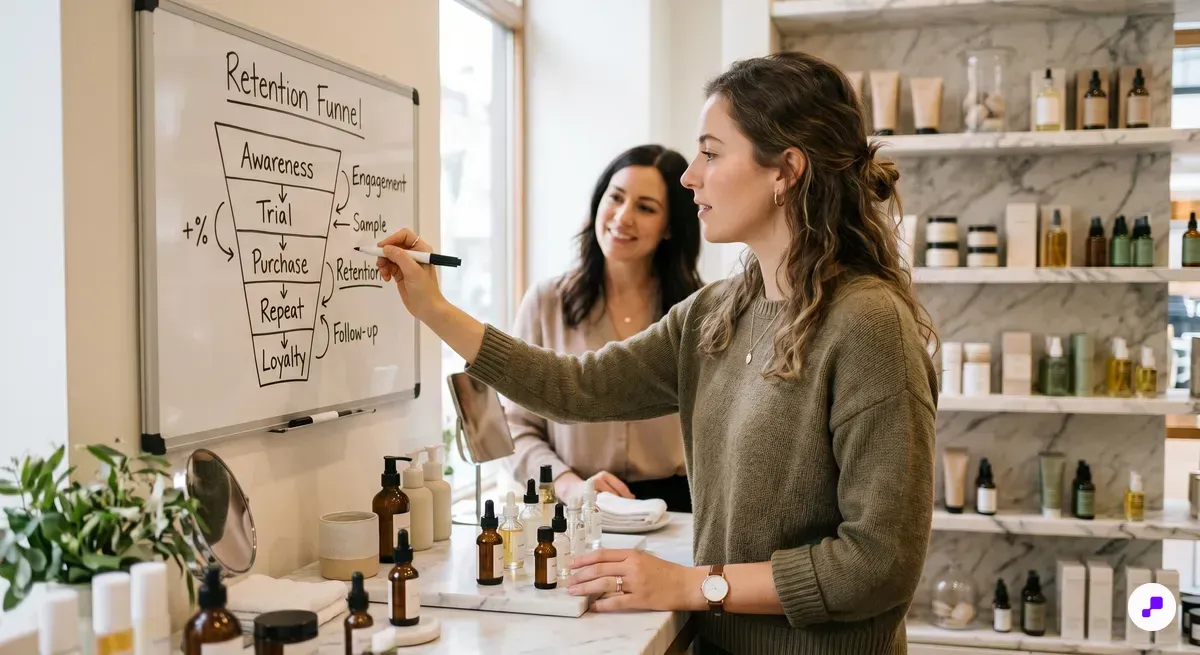
Beauty brands sit on a goldmine of natural repeat demand, yet most fail to capture it. Understanding why requires looking at the unique dynamics of beauty consumer behavior.
The first dynamic is what we call the "curiosity gap." Beauty consumers are inherently curious — they love discovering new products, testing new formulas, and following the latest ingredient trends. This curiosity is what brought them to your brand in the first place, but it's also what pulls them toward competitors. A customer who's perfectly happy with your vitamin C serum will still be tempted by a competitor's version if a trusted influencer raves about it.
The second dynamic is the "results timeline." Skincare products often take 4-8 weeks to show visible results. During that waiting period, the customer's enthusiasm fades, and the emotional high of the purchase is long gone. If you haven't maintained engagement during those weeks — education about the product, reassurance that it's working, tips for best results — the customer may abandon the product before it has a chance to prove itself.
The third dynamic is "sample saturation." Your customer isn't just receiving your marketing — they're getting samples from subscription boxes, trial-size offers from competitors, and constant new-product recommendations from social media. Every one of those samples is a potential brand switch. Without a loyalty mechanism that creates a reason to stay, even satisfied customers will wander.
The good news is that beauty customers who make it to their third purchase become remarkably loyal. Research shows that beauty consumers who find products that work for their skin type or aesthetic develop stronger brand attachment than almost any other category. Your retention strategy needs to bridge the gap between first purchase and third purchase — once they're there, the natural repurchase cycle takes over. For data-driven tactics, explore our beauty retention strategies resource — or zoom out with our guide on how to retain customers across the full lifecycle, then layer in the beauty-specific tactics below.
The brands that crack retention treat every customer interaction as a chance to deepen trust, demonstrate expertise, and reinforce why your product is worth sticking with.
Beauty customers are naturally curious and constantly tempted by alternatives — retention is about maintaining engagement during the critical window between first and third purchase.
Identify the average time between first and second purchase for your brand, then build a communication plan that fills that gap with education, results stories, and loyalty incentives.
The most powerful retention tool for beauty brands is one that most ignore: timed replenishment reminders. Your products have predictable usage cycles — a 1oz serum lasts about 6-8 weeks, a cleanser about 4-6 weeks, a lipstick about 3-4 months. If you know when the product will run out, you can be the brand that shows up at exactly the right moment.
Calculate your replenishment windows for your top 20 products. Use order data to identify the average time between purchases of the same product. If customers reorder your bestselling moisturizer every 52 days on average, your replenishment reminder should land on day 45 — early enough to beat competitors but late enough that the customer is actually running low.
Layer your replenishment strategy with loyalty incentives. The first reminder (day 45) is a gentle nudge: "Your moisturizer is running low — reorder now to keep your routine uninterrupted." The second reminder (day 52, if they haven't reordered) adds urgency with a loyalty bonus: "Reorder today and earn double loyalty points on your replenishment order." The third reminder (day 60) escalates to a small incentive: "We've reserved your moisturizer — reorder this week with free shipping as a loyalty member perk."
The channel you use for replenishment reminders matters enormously. Email reminders have open rates around 20% — meaning 80% of your perfectly-timed messages go unseen. SMS reaches more customers but feels intrusive for routine reorders. Digital wallet passes hit the sweet spot: a push notification with 85-95% delivery that says "Your moisturizer is about to run out — tap to reorder with bonus points" reaches the customer in the moment without feeling spammy.
Subscription offers complement replenishment reminders but shouldn't replace them. Not every customer wants a subscription — many prefer the flexibility of reordering when they choose. Your loyalty program should make on-demand reordering so rewarding and convenient that it functions like a subscription without the commitment. For more ideas on keeping beauty customers engaged, see our beauty loyalty program ideas.
Track your replenishment capture rate: what percentage of customers who received a replenishment reminder actually reordered? A healthy target is 25-35%. If you're below 15%, your timing is off or your incentive isn't compelling enough.
Time your replenishment reminders to land just before the customer runs out — and layer loyalty incentives to make reordering from you the easiest choice.
Pull your Shopify order data for your top 5 products, calculate the average reorder interval, and set up automated reminders that land 1 week before that interval.
Shopify Flow can trigger replenishment reminders based on purchase date and estimated product usage, with escalating messages and loyalty bonuses at each stage.
In beauty, the post-purchase experience determines whether a customer becomes a repeat buyer or a one-and-done. Unlike most ecommerce categories, beauty products require education to deliver results. A customer who doesn't know how to properly layer serums, or who applies their new treatment at the wrong time of day, won't see results — and they'll blame the product, not their technique.
Build a post-purchase education sequence for every product category. When someone buys a new serum, send them a three-part mini-course: Day 1 — "How to introduce your new serum into your routine (start every other day)." Day 4 — "The best time of day to apply, and which products to pair it with." Day 14 — "What results to expect in weeks 2-4 (patience is key with active ingredients)." This education prevents early abandonment and sets realistic expectations.
User-generated content is your most powerful retention tool. After the customer has used the product for 3-4 weeks, ask for a review with a before/after photo. Incentivize it with loyalty points (100 points for a photo review). These reviews serve double duty: they validate the customer's choice (seeing their own results reinforces commitment to the product) and they provide social proof that drives new customer acquisition.
Ingredient education builds trust and creates switching costs. When your customer understands why you use specific concentrations of niacinamide or why your formulation process matters, they develop confidence in your expertise. A competitor's cheaper alternative becomes harder to justify when your customer understands the science behind your formula. Send monthly ingredient spotlights, routine tips, and skincare myth-busting content to position your brand as an authority.
Community engagement amplifies education-driven retention. Create a space (Facebook Group, Discord, or even an email series) where customers share routines, ask questions, and celebrate results. Beauty consumers are highly social — they want to connect with others who use the same products. A brand-facilitated community creates belonging that transcends any individual product. For structuring rewards around education engagement, check our best rewards for beauty brands.
Track the correlation between educational content engagement and repeat purchase rates. Customers who open your educational emails typically repurchase at 2-3x the rate of those who don't. This data justifies investing in content over discounts as your primary retention strategy.
Post-purchase education prevents early product abandonment, sets realistic expectations, and positions your brand as a trusted authority — all of which drive repeat purchases.
Create a 3-email post-purchase education sequence for your bestselling product this week: application tips, routine integration, and results timeline expectations.
Use Shopify's automated email sequences triggered by product-specific purchases to deliver targeted education content based on exactly what the customer bought.
Beauty consumers are among the most community-oriented shoppers in ecommerce. They discuss products in group chats, share routines on social media, and actively seek peer validation before and after purchases. Brands that tap into this social behavior create retention through belonging — a loyalty that transcends product performance.
Start by turning your loyalty program into a community membership. Beyond points and tiers, offer community-exclusive benefits: a private Instagram Close Friends list with behind-the-scenes content, a Facebook Group for routine sharing, or a monthly virtual meet-up with your brand's skincare expert. These community touchpoints create social connections that make leaving your brand feel like leaving a friend group.
User-generated content programs serve as both retention and acquisition tools. Create a branded hashtag and actively repost customer content on your channels. Feature a "Customer of the Month" with their full routine using your products. Offer loyalty points for content creation: 50 points for a social share, 100 points for a video review, 200 points for a before-and-after story. When customers see their content featured by your brand, the emotional bond deepens significantly.
Leverage social proof in your retention communications. Instead of sending generic "We miss you" emails to lapsing customers, send them recent reviews from customers with similar skin types: "Customers with dry skin like yours are loving our winter hydration duo — here's what they're saying." Peer testimonials from similar demographics are 3x more persuasive than brand messaging.
Brand ambassador programs turn your most loyal customers into retention advocates. Identify customers with high engagement (frequent purchasers, active reviewers, social media sharers) and invite them into a formal ambassador program. Ambassadors get exclusive perks (free products, early access, commission on referrals) and become invested in your brand's success. Their authentic advocacy retains their own loyalty while attracting like-minded new customers.
Measure community health alongside financial metrics. Track active community members, content creation rates, referral-driven purchases, and the retention rate of community members versus non-members. If community members retain at 2x the rate of non-members, your community investment is delivering measurable ROI. For referral program inspiration, see our beauty referral ideas guide. Brands with a brick-and-mortar salon component should also see our salon loyalty program guide for in-chair retention tactics.
Community creates retention through belonging — beauty customers who feel part of your brand's community are significantly less likely to switch to competitors.
Launch a branded hashtag campaign this month: offer 100 loyalty points for every social post featuring your product, and repost the best content on your brand channels.
Wallet push notifications can spotlight community content: 'See how @customer uses your moisturizer in her morning routine — tap to watch.' This bridges community engagement with loyalty visibility.
Beauty is deeply personal — skin type, tone, sensitivity, preferences, and goals vary enormously between customers. Brands that personalize the experience based on these individual factors create a level of relevance that generic competitors can't match, and that relevance translates directly into retention.
Skin profile data is your personalization foundation. Offer a detailed skin quiz during onboarding (incentivize completion with 100 loyalty points) that captures skin type, primary concerns, shade preferences, ingredient sensitivities, and routine complexity. Store this data in Shopify customer metafields so it's accessible across your marketing stack. Every communication going forward should reflect this profile.
Personalized product recommendations based on purchase history and skin profile drive repeat purchases more effectively than any promotion. "Based on your dry skin profile and your love of our hydrating serum, we think you'll love our new overnight mask" converts at 4-5x the rate of generic "New arrivals" emails. The recommendation feels like advice from a trusted friend, not a sales pitch.
Replenishment personalization goes beyond timing. If a customer's purchase history shows they use moisturizer faster than average (reordering every 40 days instead of the typical 55), adjust their reminders accordingly. If they always buy two products together (cleanser + toner), bundle the replenishment reminder. These small personalizations signal that you pay attention to their individual behavior.
Personalize the loyalty experience itself. Instead of a one-size-fits-all reward catalog, surface rewards that match the customer's profile. A skincare-focused customer sees sample rewards from your skincare line. A makeup enthusiast sees early access to new shade launches. A sensitive-skin customer sees hypoallergenic product previews. This curation makes the loyalty program feel designed for them, not for a generic "beauty customer."
Birthday and milestone personalization creates emotional connections. Don't just send a discount code on their birthday — send a curated gift based on their profile: "Happy birthday, Sarah! We picked a hydrating trio for your dry skin — enjoy these minis on us." Celebrate loyalty milestones with equally personal touches: "You've been with us for 1 year — here's a full-size version of the product you reorder most." For more on building personalized tier experiences, see our VIP tiers for beauty brands guide.
Personalization in beauty creates a relevance advantage that generic competitors can't replicate — skin profiles, tailored recommendations, and curated rewards make customers feel uniquely understood.
Launch a skin profile quiz this month with a 100-point loyalty incentive, and use the results to segment your next three email campaigns by skin type and primary concern.
Store skin quiz data in Shopify customer metafields and use it to personalize automated flows, product recommendations, and loyalty reward suggestions across all channels.
In beauty, churn signals are more predictable than in most industries because product usage creates a natural purchase rhythm. When that rhythm breaks, you have a clear warning sign — and a narrow window to intervene before the customer switches to a competitor.
The primary churn signal is a missed replenishment window. If a customer who reorders moisturizer every 55 days hasn't purchased by day 70, they've likely found an alternative. But the real early warning comes before the missed reorder: declining email engagement (fewer opens over the last 3 sends), reduced site visits (no browse sessions in the last 30 days), and abandoned reorder carts. By the time the replenishment window passes, you've already lost the battle.
Build a three-tier risk model. Green (healthy): purchased within their normal replenishment window, engaging with emails and site. Yellow (at-risk): approaching or past their replenishment window with declining engagement. Red (churning): missed two replenishment windows with no engagement. Each segment gets a different intervention.
For yellow customers, trigger a value-focused campaign. Don't lead with discounts — lead with relevance. "We noticed you haven't reordered your serum — here's how 3 customers with your skin type are layering it with our new moisturizer for even better results." Social proof and education work better than panic-discount offers because they reinforce the brand relationship rather than training price sensitivity.
For red customers, escalate with a more direct approach. A personalized reactivation offer works: "We've set aside 500 bonus loyalty points for you — reorder any product this week and they're yours." Or offer a free deluxe sample of a new product: "Try our newest launch free — we think it's perfect for your skin type." The goal is re-engagement, not just a one-time purchase.
Automate these interventions using Shopify Flow. Set up a weekly check that flags customers based on purchase recency relative to their individual replenishment interval (not a generic 90-day threshold). Customer-specific timing is what separates effective beauty retention from generic win-back campaigns.
Track recovery rates by intervention type and segment. What percentage of yellow customers reactivate? What offer type (bonus points, free sample, educational content) drives the highest recovery? Use the retention rate calculator to set benchmarks and monitor improvement. Optimize monthly based on what works.
Beauty churn is predictable because product usage creates a natural purchase rhythm — when that rhythm breaks, act quickly with value-driven interventions before the customer switches.
Set up a Shopify Flow that flags customers who are 15 days past their normal replenishment window and automatically sends a personalized re-engagement email with bonus loyalty points.
Shopify Flow can calculate customer-specific replenishment intervals from order history and trigger automated at-risk campaigns when the expected reorder date passes.
Wallet push notifications reach at-risk customers with 85-95% delivery — far more effective than email for time-sensitive reactivation messages when the replenishment window is closing.
A retention dashboard transforms gut feelings into data-driven decisions. For beauty brands, the dashboard should combine standard retention metrics with beauty-specific KPIs that reflect product usage, discovery, and community engagement.
Your dashboard should track these metrics weekly or monthly: repeat purchase rate (30-day, 90-day, and 12-month windows), replenishment capture rate (what percentage of expected reorders actually happen), cross-category adoption rate (average number of product categories per customer over time), customer lifetime value by cohort (grouped by first-purchase month), and churn segment distribution (what percentage of customers are green, yellow, and red).
Add loyalty-specific metrics: enrollment rate (target 50%+ of active customers), active participation rate (members earning or redeeming in last 30 days — target 40%+), sample-to-purchase conversion (target 25-35%), and points liability (outstanding unredeemed points). These loyalty metrics tell you whether your retention engine is healthy and whether rewards are driving the behaviors you want.
Cohort analysis is essential for beauty brands because product launches and seasonal trends can mask underlying retention changes. Group customers by first-purchase month and track their 30-day, 60-day, 90-day, and 12-month repurchase rates. If newer cohorts are retaining better than older ones, your retention strategies are working. If they're retaining worse despite higher acquisition spending, you have a product or experience problem.
Compare everything between loyalty members and non-members. Repeat purchase rate, AOV, CLV, product return rate, cross-category adoption — the side-by-side comparison quantifies the value of your loyalty program and justifies the investment. Most beauty brands find loyalty members outperform non-members by 50-100% on these metrics.
Set up automated alerts for key thresholds: if the red (churning) segment exceeds 30% of total customers, if replenishment capture drops below 20%, or if loyalty enrollment slows to less than 50 new members per week. These alerts ensure you catch problems early, before they compound into revenue impact.
Review the dashboard in a 15-minute weekly session. Focus on trend direction (improving or declining) rather than absolute numbers. A repeat purchase rate that's growing by 1% per month is more important than whether it's currently 32% or 38%. Consistent small improvements compound into dramatic results over 12 months. Use the CLV calculator to project the long-term revenue impact of your retention improvements.
Track beauty-specific metrics like replenishment capture rate, cross-category adoption, and sample conversion alongside standard retention KPIs to get a complete picture of customer health.
Build a simple retention dashboard this week with five metrics: repeat purchase rate, replenishment capture, cross-category adoption, loyalty enrollment, and churn segment distribution.
Shopify's analytics, customer segments, and order reports provide all the raw data you need for a comprehensive retention dashboard — no additional analytics tools required for the basics.
Beauty retention is built on capturing natural replenishment cycles, educating customers on product usage, and creating community-driven emotional loyalty that competitors can't replicate. The brands that retain at 45%+ aren't discounting more — they're showing up at the right moment with the right message, powered by personalization, loyalty incentives, and channels that actually reach the customer. To formalize these tactics into a repeatable system, see our customer retention program guide.
JeriCommerce makes beauty retention effortless — omnichannel loyalty with replenishment reminders, sample rewards, and VIP tiers that keep your customers coming back before competitors can steal the reorder.
Build a retention engine with omnichannel loyalty, replenishment reminders, and VIP tiers that keep your beauty customers coming back before the competition can intercept.
Install Free on Shopify