
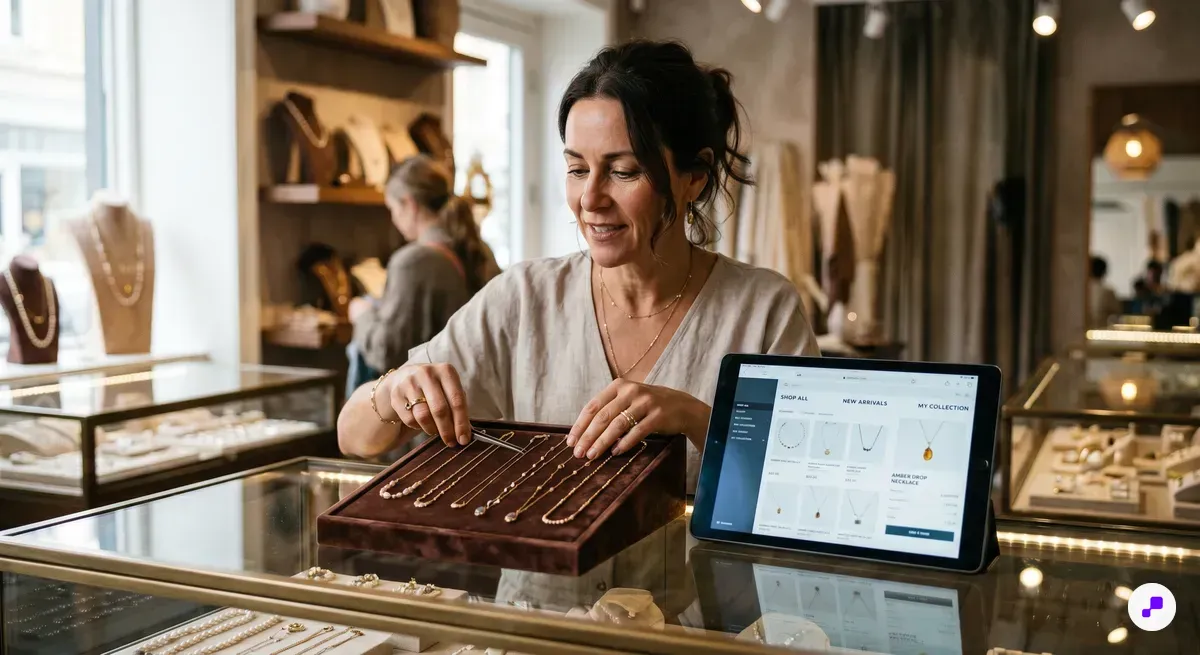
Jewelry has always been omnichannel — long before the term existed. Customers have always wanted to see a piece online, touch it in person, think about it overnight, and buy it when the moment feels right. What's changed is the technology available to track and reward that behavior across every touchpoint.
The jewelry purchase journey is uniquely non-linear. A customer might discover your brand through a friend's recommendation (social), browse your collection on your website (online), visit a trunk show to try pieces on (event), and finally purchase through your online store using a saved favorite (digital). Each of these interactions represents an opportunity to earn loyalty — and if you're only tracking the final purchase, you're ignoring 80% of the engagement that led to it.
Omnichannel loyalty solves three critical problems for jewelry brands. First, it eliminates the "cold start" problem at physical touchpoints. When a customer walks into your boutique and the staff can see her online browsing history, wishlist, and loyalty status, the conversation starts from a place of knowledge, not zero. Second, it creates data continuity — you understand the full customer journey, not just fragments of it. Third, it rewards the behaviors that actually drive jewelry purchases: browsing, wishlisting, trying on, and sharing, not just the final checkout.
The brands winning in jewelry right now are the ones that treat every channel as an extension of one relationship. A customer shouldn't feel like she's dealing with two different companies when she shops online versus in your boutique. Her points, her tier, her preferences, and her history should follow her seamlessly. That consistency is what turns a multi-channel shopper into a loyal customer. For foundational loyalty ideas, see our jewelry loyalty program ideas.
Jewelry's non-linear purchase journey makes omnichannel loyalty essential — customers interact across 3-4 channels before buying.
Map your customer's typical purchase journey across all channels this week — identify every touchpoint where loyalty could be earned or communicated.
Shopify's unified commerce platform connects your online store and POS under one customer profile, giving you the foundation for true omnichannel loyalty.
The foundation of omnichannel loyalty is the unified customer profile — one record that captures everything about a customer regardless of which channel she interacts with. Without this, you're running parallel loyalty programs that happen to share a brand name.
Shopify makes this achievable for jewelry brands of any size. When a customer creates an account on your online store and later makes a purchase at your boutique through Shopify POS, both transactions appear in the same customer profile. Her total spend, loyalty points, tier status, and purchase history are unified automatically. No manual data merging, no separate databases, no integration headaches.
But a true unified profile goes beyond purchase data. You want to capture preferences discovered across channels: metal preferences noted by boutique staff, ring sizes tried on in-store, collections browsed online, and items wishlisted on mobile. Shopify's customer metafields let you store this enriched data so it's accessible everywhere. When a customer walks into your boutique for the second time, your staff can say "Welcome back — I see you were looking at our new gold collection online. Want to try on a few pieces?" That moment is where omnichannel loyalty becomes tangible.
The biggest challenge is identity resolution — connecting the same customer across channels when she might use different email addresses, phone numbers, or even names (maiden vs. married). Wallet passes solve this elegantly. Once a customer adds your loyalty pass to her Apple Wallet or Google Wallet, her identity is tied to that device. Whether she taps at your POS, clicks from a push notification, or scans at a pop-up event, the system knows who she is instantly.
Start by auditing your current customer data. How many customers exist in your Shopify store? How many exist separately in your POS? How much overlap is there? Most jewelry brands find 20-30% of their in-store customers aren't connected to their online profiles — that's revenue data and loyalty history you're losing.
A unified customer profile is the non-negotiable foundation of omnichannel loyalty — Shopify and wallet passes make it achievable without enterprise tools.
Run a customer data audit this week — compare your online customer list with your POS customer list and identify how many records aren't linked.
Shopify POS and online store share the same customer database, automatically merging profiles when email or phone number matches across channels.
Wallet passes solve identity resolution — one tap at POS, one click from a notification, same customer profile every time, no login required.
Your loyalty earning and redemption rules need to work identically across every channel — with some channel-specific bonuses that encourage the behaviors you want in each context. Here's how to structure it.
Base earning should be consistent: the same points-per-dollar rate whether the customer buys online, in your boutique, or at a pop-up. If online purchases earn 2 points per dollar but in-store purchases earn 3, you're creating confusion and potentially resentment. Consistency builds trust in the program.
On top of the base rate, add channel-specific earning bonuses that encourage cross-channel behavior. Award 50 bonus points for a customer's first in-store visit after joining online. Give 100 bonus points for adding the wallet pass (which connects their identity across channels). Offer double points at pop-up events (which drives attendance and creates urgency). These bonuses reward omnichannel behavior without creating earning inequality.
Redemption must be fully cross-channel. Points earned online should be redeemable in-store, and vice versa. A customer who earned 1,000 points from online purchases should be able to redeem a free cleaning service at your boutique. A customer who earned points from in-store purchases should be able to apply a reward at online checkout. Any friction here — "Sorry, those points are only valid online" — instantly destroys trust in the program.
For jewelry specifically, consider channel-specific rewards that play to each channel's strengths. Online rewards: free shipping, early access to digital lookbooks, exclusive online-only pieces. In-store rewards: complimentary cleaning, personal styling session, ring resizing. Pop-up rewards: meet-the-designer experience, limited-edition pieces. This approach uses rewards to drive customers to the channel where you can best serve them. Check our best rewards for jewelry for more inspiration.
Document your earning and redemption rules in a simple one-page guide that both your team and your customers can reference. Complexity kills participation.
Keep base earning rates identical across channels and use bonus points to incentivize cross-channel behavior.
Write your earning and redemption rules on a single page — if you can't explain them simply, your customers won't understand them either.
Shopify POS and online checkout both access the same loyalty balance, enabling seamless cross-channel redemption without manual workarounds.
Digital wallet passes are the single most effective tool for connecting the omnichannel jewelry loyalty experience. They solve the three biggest challenges of cross-channel loyalty: identity, communication, and visibility.
Identity: When a customer taps her wallet pass at your boutique POS, the system instantly knows who she is, her tier status, her points balance, and her purchase history. No asking for email, no looking up phone numbers, no loyalty cards to fumble with. The same pass works at pop-up events, trunk shows, and any other physical touchpoint where you deploy an NFC reader. Online, the pass links directly to her Shopify account, maintaining continuity.
Communication: Wallet passes support push notifications that appear directly on the lock screen — no email to open, no app to check. When you launch a new collection, send a notification to Gold and Platinum members: "Your early access to the Summer Collection starts now — shop before anyone else." These notifications see 85-95% delivery rates, compared to 20-30% for email. For a jewelry brand where you might only communicate with a customer 6-8 times between purchases, every message reaching them matters enormously.
Visibility: The wallet pass displays the customer's current points balance, tier status, and available rewards every time she opens her Apple Wallet or Google Wallet. This persistent visibility keeps your brand present during the long gap between jewelry purchases. When she scrolls past your branded pass while paying for coffee, she's reminded of those 800 points waiting for her. That ambient awareness is something no email campaign can replicate.
Implementation is straightforward. Design your wallet pass template with your brand's visual identity — colors, logo, and tier-specific designs (Silver gets a clean design, Gold gets a warm accent, Platinum gets a premium look). Connect it to your Shopify loyalty system so points and tier status update in real time. Distribute passes via your post-purchase email sequence, your boutique checkout process, and your website sign-up flow.
The result is a customer experience where channel boundaries disappear. She earns online, redeems in-store, gets notified on her phone, and sees her status every day — all through one elegant pass that lives on her phone.
Wallet passes unify identity, communication, and visibility across channels — making them the essential glue for omnichannel jewelry loyalty.
Design a wallet pass template with tier-specific visual treatments this week and test the NFC tap experience at your POS before rolling out to customers.
Wallet passes replace loyalty apps, plastic cards, and email lookups with a single NFC-enabled pass that works seamlessly at every physical and digital touchpoint.
Technology enables omnichannel loyalty, but your boutique staff delivers it. The in-store experience is where jewelry loyalty becomes tangible — a warm greeting by name, a personalized recommendation, a surprise tier upgrade — and your team needs to be equipped to create those moments.
Start with data access. Your boutique staff should be able to see a customer's loyalty profile on the POS screen the moment she checks in or taps her wallet pass. That profile should show: name, tier status, points balance, recent online browsing activity (if consented), purchase history, and any available rewards. Arm your team with this context so they can personalize the interaction from the first hello.
Train staff on specific omnichannel scenarios. When a customer walks in and mentions she was browsing necklaces online, the staff member should be able to pull up those exact products and have them ready to try on. When a customer has enough points for a reward, the staff member should proactively mention it: "By the way, you have 1,200 points — that's enough for a complimentary cleaning and a styling session. Want to use those today?" When a customer is close to the next tier, create a gentle aspiration moment: "You're just $150 away from Platinum status — which comes with exclusive early access to every new collection."
Create a simple staff playbook with the top 10 loyalty scenarios they'll encounter and the ideal response for each. Role-play these scenarios during team meetings until the responses feel natural, not scripted. The goal is for loyalty to feel like genuine care, not a sales tactic.
Incentivize your staff to drive loyalty enrollment and engagement. Track which team members sign up the most new members, which ones mention available rewards, and which ones convert browsing customers into purchasers using loyalty insights. Recognize top performers and share their techniques with the team.
Most importantly, make the technology invisible. Your staff should tap one button to see the customer profile, not navigate through three screens. If the technology is clunky, your team will skip it — and the omnichannel experience dies at the counter. Test the POS loyalty flow yourself and eliminate every unnecessary click. Our jewelry loyalty checklist includes staff training checkpoints.
Train boutique staff to use loyalty data for personalized interactions — the in-store experience is where omnichannel loyalty becomes real.
Create a one-page staff playbook with the top 10 loyalty interaction scenarios and role-play them at your next team meeting.
Shopify POS displays customer profiles with loyalty data at checkout, giving staff instant access to points, tier status, and purchase history.
Pop-up events and trunk shows are high-value loyalty touchpoints that most jewelry brands underutilize. These events create urgency, exclusivity, and face-to-face connection — exactly the ingredients that build lasting jewelry loyalty.
Treat every pop-up as a loyalty activation opportunity. Set up a portable NFC reader connected to your Shopify POS. When attendees tap their wallet pass or sign up on the spot, they're immediately connected to your loyalty ecosystem. Award bonus points for attending (100-200 points), for trying on pieces (50 points — tracked via staff interaction), and of course for purchasing. These event-specific earning opportunities create excitement and give attendees a reason to engage beyond just browsing.
Use events to drive tier upgrades. Send exclusive invitations to your Silver and Gold members: "You're invited to our private trunk show — Platinum members get 30-minute personal styling sessions with the designer." This creates a visible aspiration moment. Silver members see the Platinum perks in action and think "I want that." The event becomes a tier motivation engine.
Capture data at every event touchpoint. When someone tries on a ring, note her size and style preference in the customer profile. When someone admires a necklace but doesn't buy, add it to her wishlist for follow-up. When a couple comes in looking at engagement rings, capture the occasion and timeline. This data feeds your post-event retention campaigns with personalization that generic marketing can't match.
Post-event follow-up is where most brands drop the ball. Within 24 hours, send a wallet pass notification to attendees: "Thanks for joining us — here are the pieces you loved, plus 200 bonus points from today's event." Include direct links to the products they tried on. Within a week, send a personalized email with a "Complete the Look" recommendation based on what caught their eye. This follow-up sequence converts 15-25% of event attendees who didn't purchase on the day.
For maximum impact, make at least two events per year exclusive to loyalty members. "Members-Only Holiday Preview" or "VIP Spring Collection Launch" events create the exclusivity that luxury jewelry customers crave and give them a tangible reason to maintain their loyalty status.
Pop-up events are loyalty goldmines — use NFC check-in, bonus points, and post-event follow-up to convert attendees into repeat customers.
Plan one loyalty-exclusive event this quarter — even a small in-store evening for your top 30 customers with bonus points and early collection access.
Shopify POS works at pop-up events via mobile device, tracking event purchases and loyalty interactions in the same customer profile as your main store.
Attendees tap their wallet pass at event entry for instant check-in, bonus points, and identity — no sign-up forms or manual data entry needed.
Measuring omnichannel loyalty is more complex than single-channel measurement because you need to track both channel-specific performance and the cross-channel behaviors that drive the most value. Here's a framework that works for jewelry brands.
Start with cross-channel customer percentage: what proportion of your loyalty members interact across two or more channels? For jewelry brands with physical and online presence, the target is 30-40%. These cross-channel customers are your most valuable — research consistently shows they spend 30-50% more and retain at 2x the rate of single-channel customers. If this number is below 20%, your channels aren't connected well enough.
Track channel contribution to loyalty engagement. What percentage of points are earned online vs. in-store vs. at events? What percentage of redemptions happen in each channel? If 90% of earning is online but 80% of redemption is in-store, that tells you your in-store earning experience needs attention. Balanced earning across channels indicates a healthy omnichannel program.
Measure the halo effect of loyalty on cross-channel behavior. When a customer joins loyalty online, does her probability of visiting the boutique increase? When she visits the boutique, does her online purchase frequency increase afterward? These halo effects are the true value of omnichannel loyalty and can be measured by comparing behavior before and after loyalty enrollment.
Track wallet pass adoption rate separately. What percentage of loyalty members have the wallet pass installed? What's the notification open rate? How does wallet pass adoption correlate with cross-channel purchasing? Most jewelry brands find that wallet pass holders are 2-3x more likely to shop across channels because the pass makes the transition between channels frictionless. Use our push vs. email ROI calculator to quantify the notification advantage.
Review these metrics monthly and present them to your team. Celebrate wins — "Cross-channel customers grew 5% this month" — and identify gaps. Omnichannel loyalty is a continuous optimization game, not a launch-and-forget initiative.
Cross-channel customer percentage is your top omnichannel metric — these customers spend 30-50% more and churn at half the rate.
Calculate what percentage of your loyalty members have purchased both online and in-store — if it's below 20%, create a cross-channel incentive this month.
Shopify's unified reporting shows customer behavior across online and POS channels, making cross-channel analysis straightforward without third-party tools.
Omnichannel loyalty is the natural fit for jewelry brands where customers browse, try on, and buy across multiple channels. By building a unified customer profile on Shopify, using wallet passes to connect every touchpoint, and training your boutique team to leverage loyalty data, you create a seamless experience that rewards customers wherever they choose to engage. The result is higher spend, deeper loyalty, and a brand that feels personal at every interaction.
JeriCommerce powers omnichannel loyalty for jewelry brands — wallet passes that work at your boutique, online store, and pop-up events, all connected through Shopify with zero app downloads for your customers.
One loyalty pass that works at your boutique, online store, and pop-up events. NFC tap, automatic points, and push notifications across every channel.
Install Free on Shopify