
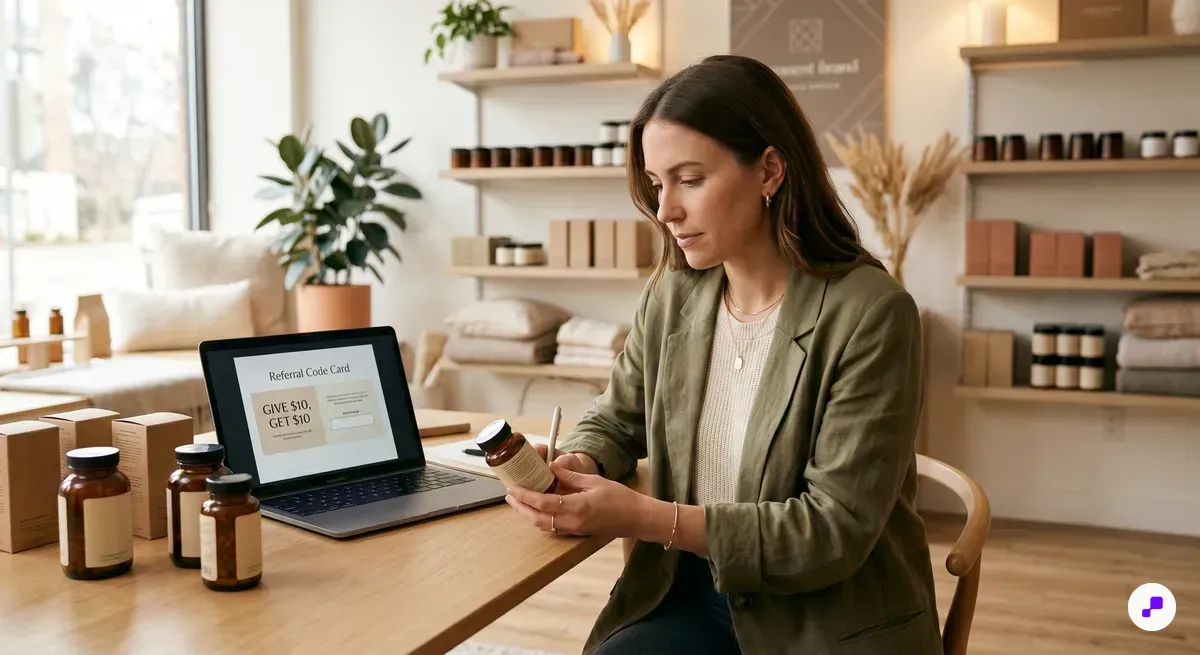
Health community trust makes supplement referrals 4-5x more effective than paid ads — the trust transfer from a friend dramatically reduces purchase hesitation.
Supplement purchases are trust-based decisions. Nobody impulse-buys a $60 monthly probiotic stack — they research, read reviews, and ask friends. This makes referrals the single most powerful acquisition channel for vitamin and supplement brands.
The health and wellness community operates on shared experiences. Fitness enthusiasts compare supplement stacks in gym parking lots. Parents swap children's vitamin recommendations in Facebook groups. Biohackers debate nootropic formulations on Reddit. Every one of these conversations is a referral opportunity.
What makes supplement referrals different from other product categories is the depth of trust required. When someone recommends a t-shirt brand, the stakes are low. When they recommend a supplement, they're staking their health credibility on it. This means successful referrals in supplements carry far more weight — and far more loyalty — than in other categories.
The data backs this up. Referred supplement customers have 37% higher lifetime value than customers acquired through paid ads. They're also 2x more likely to subscribe because the trust transfer from the referrer reduces the perceived risk of committing to a recurring purchase.
For a broader look at referral strategies across industries, explore our ecommerce referral program hub. But the strategies you'll find there need adaptation for the unique trust dynamics of health products.
Identify the top 10 communities (Facebook groups, subreddits, fitness forums) where your customers discuss supplements and monitor the conversations for brand mentions.

Points-based referral rewards feel more authentic than cash-back in health communities. Escalating tiers identify and reward your most valuable advocates.
The referral incentive needs to reward both the advocate and the new customer. For supplement brands, the most effective structure gives the referrer loyalty points and the new customer a first-order discount.
Here's a proven structure for supplement brands: the referrer earns 200 loyalty points (enough for a meaningful reward like free shipping or a product sample), and the referred friend gets 15% off their first order plus 100 bonus loyalty points. This two-sided incentive mirrors the natural dynamic of health recommendations — both people benefit.
Avoid cash-back referral rewards for health products. A $10 cash reward makes the recommendation feel transactional, and health trust is fragile. Points-based referral rewards keep the exchange within the loyalty ecosystem and feel more like a genuine 'thank you' than a sales commission.
Consider tiered referral bonuses that reward volume. The first 3 referrals earn 200 points each. Referrals 4-10 earn 300 points. Referrals 11+ earn 500 points plus a special 'Health Ambassador' badge. This escalating structure identifies and rewards your super-advocates — the customers who'll drive disproportionate growth.
For product-based incentives, offer the referrer a free trial of a new or complementary supplement they haven't tried. This rewards advocacy while driving product discovery. A customer who refers friends to your protein powder might get a free sample of your new creatine blend — expanding their relationship with your brand.
See real-world examples of what works in our referral program examples for supplement brands resource.
Set your referral reward at 200 points for the advocate and 15% off plus 100 points for the friend. Test for 60 days before adjusting.
Shopify's discount code system can generate unique referral codes per customer, allowing you to track attribution automatically and trigger loyalty point awards.
Display the customer's unique referral code directly on their wallet pass with a 'Share and Earn' button — no need to log in or find an email to share their link.
Your top 10-15% of advocates will drive 60-70% of referral revenue. Identify them early, activate them personally, and reward them disproportionately.
Not all customers are equal referrers. Your best advocates are the 10-15% of customers who are genuinely passionate about your products and active in health communities. Finding and activating them is the highest-leverage move in your referral program.
Start by identifying customers with three or more orders in the past six months who have also left a product review. These people have demonstrated both commitment and willingness to share their opinion publicly. They're your referral program seed group.
Send this seed group a personal message — not a mass email. 'You've been part of our community for [X months], and your review of [product] has helped dozens of people make confident health decisions. We're launching our referral program and wanted to give you early access.' Personal outreach converts at 3-4x the rate of mass enrollment emails.
Create a 'Health Ambassador' tier for your top referrers. Ambassadors get early access to new formulations, their name on a community wall, and a quarterly care package. The recognition matters as much as the material rewards — health enthusiasts take pride in being trusted sources of supplement advice.
Leverage content creators within your customer base. Some of your customers already share supplement reviews on Instagram, YouTube, or TikTok. Offer them a custom referral landing page and bonus points for every conversion. This isn't influencer marketing — it's turning genuine customers into structured advocates.
Track referral velocity by customer segment. Which customer cohorts refer the most? Fitness enthusiasts? Parents buying children's vitamins? Wellness professionals? Understanding your referral demographics helps you create segment-specific sharing templates and incentives.
Pull a list of customers with 3+ orders and at least one review. Send them a personal early access invitation to your referral program this week.
Ambassadors get a special wallet pass design with a gold border and 'Health Ambassador' label — a visible badge of status every time they open their wallet.
Direct messaging converts at the highest rate for supplement referrals because health recommendations feel most authentic in personal, one-to-one conversations.
Where your customers share referrals matters as much as the incentive. Supplement brands need to optimize for the channels where health conversations naturally happen.
Direct messaging is the highest-converting referral channel for supplements. When someone texts a friend 'you need to try this — use my code for 15% off,' the personal context makes the recommendation feel like genuine advice, not an ad. Make your referral link short, memorable, and easy to share in a text message.
Social media sharing works best on platforms with health-focused communities. Instagram stories with before-and-after supplement stack photos, Facebook group posts sharing results, and TikTok supplement routine videos. Provide customers with branded sharing templates they can customize — a pre-designed Instagram story graphic with their referral code, for example.
Email referrals are underrated for supplement brands. Many health-conscious consumers share product recommendations in email threads with family members, especially for children's vitamins and family supplements. Include a 'Forward to a Friend' block in your post-purchase email with a pre-written message and unique referral link.
In-person sharing is huge for supplements because health conversations happen at gyms, yoga studios, running clubs, and health food stores. Give customers a physical referral card they can hand to friends — a business card with their unique code and a QR link to your store. For supplement brands with retail pop-up presence, wallet passes make in-person referral tracking seamless.
Don't overlook review platforms. Customers who leave positive reviews on your Shopify store, Google, or Trustpilot are broadcasting their satisfaction publicly. Follow up with a thank-you email that includes their referral link: 'Thanks for the amazing review! Share your link with friends who might benefit too.'
Create three channel-specific sharing assets: a short text message template, an Instagram story graphic with referral code overlay, and a printable referral card for in-person sharing.
Shopify's shareable discount links work across all channels and track attribution back to the original referrer, regardless of where the link is shared.
Referral points that feed into your loyalty program create a unified engine where acquisition and retention reinforce each other.
A referral program and a loyalty program are far more powerful together than separately. When referral rewards feed into your loyalty points system, you create a unified retention and acquisition engine.
The integration is straightforward: referral points are earned the same way as purchase points — they add to the customer's total balance and can be redeemed for the same rewards. This means a customer who refers three friends (earning 600 points) can combine those with their purchase points (say, 200 from orders) to reach an 800-point reward threshold faster.
Create referral-specific loyalty challenges that gamify sharing. 'Refer 3 friends this month and unlock a bonus 500 points' or 'Be the top referrer in March and win a year's supply of our best-selling multivitamin.' These challenges create urgency and tap into the competitive spirit of health enthusiasts.
Track the full referral chain value. When Customer A refers Customer B, and Customer B later refers Customer C, Customer A should get recognition (though not necessarily points) for the chain they started. This attribution helps you identify true network builders — customers whose influence extends beyond their direct circle.
Use referral data to personalize loyalty rewards. A customer who refers primarily parents should see family-oriented rewards and sharing templates. One who refers gym buddies should see fitness-focused incentives. The combination of referral and loyalty data creates a rich customer profile for personalization.
For the complete picture of how loyalty and referrals work together for supplement brands, see our loyalty program guide for supplement brands. The two programs should feel like one seamless experience to your customers.
Set up a monthly referral challenge with a bonus point prize and promote it through your wallet pass notifications and email newsletter.
Most Shopify loyalty apps support referral point crediting through their API, allowing automated point awards when a referred customer completes their first purchase.
Push a wallet notification when a referred friend makes their first purchase: 'Your friend just ordered! You earned 200 points.' Real-time gratification drives more referrals.
Referred supplement customers typically have 37% higher LTV and 40-60% lower acquisition cost than paid-channel customers — the data justifies aggressive investment in referral programs.
Without clear measurement, you can't tell whether your referral program is a growth engine or a cost center. For supplement brands, the metrics that matter go beyond simple referral counts.
Track referral conversion rate — the percentage of people who click a referral link and make a purchase. Industry average for supplements is 8-12%, but well-optimized programs hit 15-18%. If your conversion rate is below 8%, the landing page experience or first-order incentive needs work.
Measure referred customer quality by comparing their 90-day behavior to customers acquired through other channels. Key comparisons: first-to-second order conversion rate, subscription conversion rate, average order value, and 90-day retention. Referred supplement customers should outperform paid acquisition customers on all four metrics.
Calculate referral cost per acquisition (CPA). Add up all referral rewards issued (both points-to-value and discounts) and divide by the number of new customers acquired. Compare this to your paid CPA. Most supplement brands find referral CPA is 40-60% lower than paid social, with higher quality customers.
Monitor advocate engagement over time. Do your referrers stay active after the first month, or does sharing drop off? A declining referral velocity suggests your incentives need refreshing. Introduce seasonal challenges or new reward tiers to re-engage dormant advocates.
Run A/B tests on referral incentive structures quarterly. Test different point amounts, discount percentages, product-based rewards, and sharing templates. Even small improvements in referral conversion compound significantly over time. Use our retention rate calculator to model how referral-driven improvements in retention flow through to revenue.
Set up a monthly referral dashboard tracking: referral conversion rate, referred customer 90-day retention, referral CPA vs. paid CPA, and advocate engagement rate.
Shopify's analytics combined with your referral tracking app can automate monthly reporting on all key referral metrics, comparing referred vs. non-referred customer cohorts.
Referral messaging for supplement brands must lead with personal experience and genuine helpfulness — any whiff of salesiness destroys the trust that makes health referrals work.
The words your customers use to share referrals matter enormously. Health recommendations need to feel authentic and helpful, not salesy. Provide templates that make sharing easy while maintaining the trust that drives conversions.
For text messages, keep it personal and results-focused: 'Hey, I've been taking [brand] [product] for [X months] and it's made a real difference for my [benefit]. Here's 15% off if you want to try it: [link].' This template works because it leads with personal experience, not a promotion.
For social media, create visual templates that customers can personalize. An Instagram story template that says 'My daily supplement stack' with space for the customer to add their photo and referral code. A Facebook post template that says 'Asked me how I [benefit]? Here's what I take — and a discount for you: [link].' The key is making the content feel like the customer's own, not your brand's.
For email sharing, draft a message that sounds like a thoughtful forwarded recommendation: 'Hi [name], I know you've been looking for a good [product type]. I've been using [brand] and really like it — thought you might too. They gave me a code for 15% off your first order: [code].' This works especially well for family supplement recommendations.
For in-person sharing, design a clean referral card — no bigger than a business card — with the customer's unique code, a QR link, and a one-line brand description: '[Brand]: Premium supplements backed by science. Use [code] for 15% off.' Something a customer can hand to a gym buddy without it feeling like a sales pitch.
Avoid any messaging that sounds like multi-level marketing. 'Earn money by sharing our products' is the fastest way to kill trust in health communities. Frame referrals as 'sharing something that works' and rewards as a 'thank you,' not a commission.
Create four sharing templates today (text, social, email, physical card) and A/B test two versions of each over the next 60 days to find the highest-converting copy.
Include a 'Share' button on the wallet pass that opens a pre-populated text message with the customer's referral code and a natural-sounding recommendation template.
Supplement and vitamin brands have a natural referral advantage that most companies in other industries would envy. Health community trust makes personal recommendations incredibly powerful. A structured referral program captures this organic advocacy, makes it trackable, and amplifies it through incentives, easy sharing tools, and integration with your loyalty program. The brands that formalize their referral channel see dramatically lower acquisition costs and higher-quality customers.
Start by identifying your top 20 repeat customers with product reviews — they're your seed advocates. Then set up a two-sided referral incentive and make sharing as frictionless as possible with wallet pass integration.
JeriCommerce's wallet pass loyalty makes referral sharing one tap away. your code, your link, always on your customer's phone.
Install Free on Shopify