Most jewelry brands approach loyalty the same way fashion retailers do — offer 10% off the next order and hope for the best. But jewelry shoppers don't behave like fashion shoppers. The average time between jewelry purchases is 4-8 months, and the average order value sits well above $100. A flat percentage discount doesn't create urgency when the next purchase is months away, and it eats into margins on a category where craftsmanship and perceived value drive pricing.
The real problem is treating jewelry customers like transactional buyers when they're actually emotional buyers. A woman buying a necklace for herself is celebrating a milestone. A man buying an anniversary ring is marking a life moment. These are deeply personal purchases, and the loyalty experience should match that emotional intensity. When you send a generic "You have 200 points" email three months after purchase, you've already lost the emotional thread.
Successful jewelry loyalty programs lean into exclusivity and personalization. Early access to new collections makes members feel like insiders. Birthday rewards timed to arrive a week before the date show you remember. Complimentary cleaning and resizing services turn a one-time purchase into an ongoing relationship. These aren't expensive to provide, but they create the kind of "my jeweler" feeling that luxury brands spend millions trying to manufacture.
The brands that get loyalty right in this category see 30-40% of revenue coming from repeat customers within 18 months. If your repeat purchase rate is below 20%, you don't have a product problem — you have a relationship problem. For inspiration on what works, explore our jewelry loyalty program ideas collection.
Jewelry loyalty must be built around emotional connection and exclusivity, not transactional discounts.
Review your last 100 orders and calculate the percentage from repeat customers — if it's below 20%, prioritize loyalty program launch this quarter.
Shopify's customer profiles track purchase history and lifetime value, giving you the data foundation to identify your most valuable repeat buyers.
The biggest mistake in jewelry loyalty points design is setting earning rates that make sense for a $20 purchase but feel pointless for a $300 one. When a customer spends $300 on a pair of earrings and earns 30 points toward a $5 discount, the program feels insulting. Your earning structure needs to reflect the significance of each purchase.
Start with a generous base rate: 2-3 points per dollar spent. At $300, that customer earns 600-900 points immediately — a meaningful number that feels like progress. Set your first redeemable reward at 500 points so that even a single purchase gets the customer close to a reward. This creates immediate engagement rather than the "I'll never earn enough" feeling that kills participation.
Because jewelry purchases are infrequent, you need non-purchase earning opportunities to keep members engaged between buys. Award 50 points for writing a product review (which also builds social proof). Give 100 points for referring a friend. Add 25 points for following on social media or sharing a wishlist. These micro-interactions keep your brand in the customer's orbit during the long gap between purchases.
Consider bonus point events tied to natural jewelry buying moments. Double points during Valentine's week, Mother's Day, and the holiday season capitalize on when customers are already shopping. A birthday month bonus of 3x points creates a personal connection. Anniversary bonuses — "It's been one year since your first purchase, enjoy 500 bonus points" — acknowledge the relationship timeline. If you want to see the math behind how much these programs return, try our loyalty ROI calculator.
Points should expire after 18 months (longer than typical retail because purchase cycles are longer), with a reminder notification at 90 and 30 days before expiration. This gentle nudge often triggers a purchase.
Set generous earning rates (2-3 points per dollar) so that a single high-AOV purchase feels immediately rewarding.
Calculate the points earned on your average order value and make sure the first redeemable reward is achievable within 1-2 purchases.
Use Shopify Flow to automatically trigger bonus point events during key gifting seasons and customer anniversary dates.
The wallet pass displays the updated points balance after every purchase, keeping the reward progress visible on the customer's phone between visits.
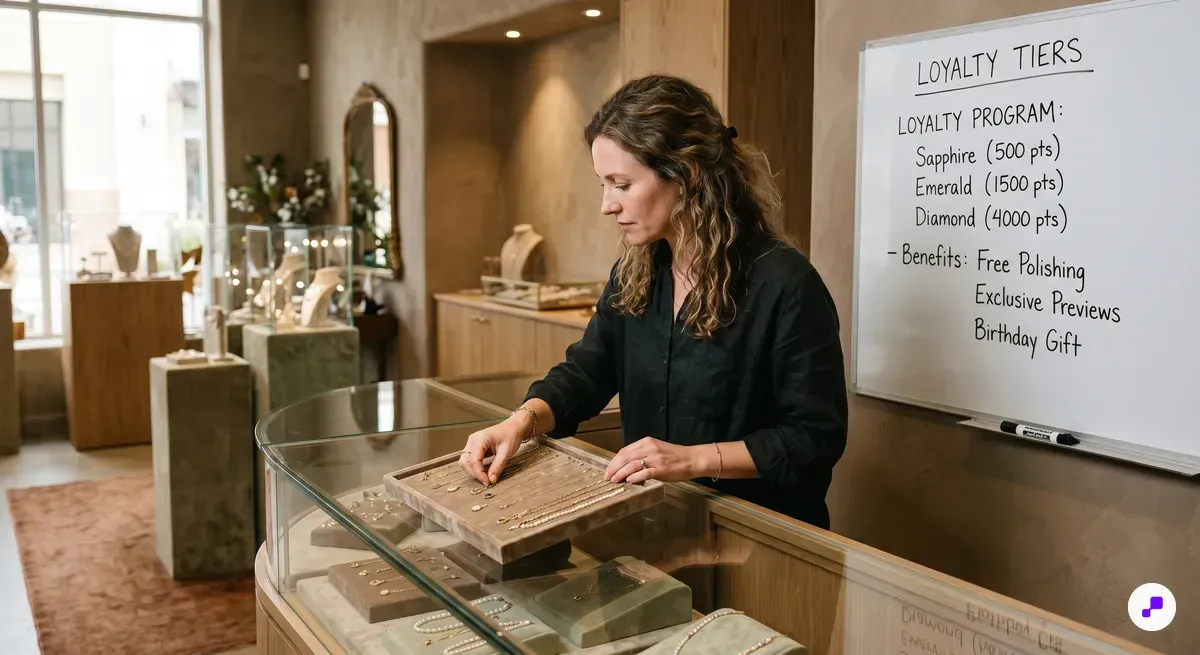
Tiered loyalty programs are especially powerful for jewelry because the category naturally aligns with aspiration and status. Your customers already understand the concept of moving up — from fashion jewelry to fine jewelry, from silver to gold, from gold to platinum. Map your tiers to that same emotional ladder.
A three-tier structure works best for most jewelry brands. The entry tier (Silver, for example) should be automatic upon joining and include meaningful perks: early access to sales, a birthday gift, and free shipping on all orders. The middle tier (Gold) kicks in at a spending threshold that roughly matches two purchases — around $500-$800 in annual spend. Gold perks add exclusive access to new collections before public launch, complimentary gift wrapping, and priority customer service. The top tier (Platinum) requires $1,500+ in annual spend and unlocks the truly special perks: personal styling consultations, invitation-only events, complimentary jewelry cleaning and maintenance, and surprise anniversary gifts.
The key to making tiers work in jewelry is ensuring the benefits feel genuinely exclusive, not just bigger discounts. A "Platinum members get first pick of our limited-edition Valentine's collection" email makes your best customers feel valued in a way that "Platinum members get 20% off" never will. Scarcity and access are the currencies of luxury loyalty.
Communicate tier status visually. When a Gold member's wallet pass shows a gold-colored design and a Platinum member's shows a distinct premium look, the tier becomes part of their identity. They'll show it to friends, which is exactly the kind of organic marketing you want. Our VIP tiers guide for jewelry dives deeper into structuring each level.
Review tier thresholds annually. If fewer than 5% of customers reach your top tier, you've set the bar too high and the exclusivity becomes irrelevance. If more than 25% reach it, the bar is too low and there's no aspiration.
Tier benefits should center on exclusive access and personalized service, not escalating discounts.
Define three tiers today and list the top 3 perks for each — make sure every perk passes the 'would I tell a friend about this?' test.
Shopify's customer tags and segments let you automatically assign tier status based on lifetime spend and trigger tier-specific communications.
Reward selection can make or break your jewelry loyalty program. The wrong rewards (small percentage discounts, free shipping you already offer) make the program feel like an afterthought. The right rewards reinforce why your customers chose your brand in the first place.
Experience-based rewards outperform discounts in jewelry by a wide margin. A complimentary jewelry cleaning session brings customers back into your store or website with zero purchase pressure, but 40% of them buy something while they're there. A personal styling consultation — even a 15-minute video call — creates a VIP experience that deepens the relationship. Early access to a new collection by 48 hours gives loyal customers the first pick, which matters enormously for limited-edition pieces.
Gift-with-purchase rewards work exceptionally well in jewelry. A free pair of studs with a $200+ purchase feels generous and introduces customers to a product category they might not have explored. A complimentary engraving service turns a standard piece into a personalized keepsake. A premium gift box upgrade makes the unboxing experience memorable enough to share on social media — generating free content for your brand.
Consider service-based rewards that extend the product lifecycle. Free resizing within the first year removes purchase hesitation for rings. A lifetime cleaning and polishing service for Platinum members creates a permanent relationship. A trade-in bonus — bring back an older piece and get extra points toward a new one — drives repeat purchases and creates a circular shopping habit.
Avoid percentage-off rewards above 15% — they train customers to wait for discounts and erode the perceived value of your pieces. A $25 reward certificate feels more premium than "10% off" even when the actual value is similar. Frame rewards in terms of what the customer gains, not what you're discounting. Check our best rewards for jewelry stores for more ideas.
Experience and service rewards — styling consultations, free cleaning, early access — outperform discounts in jewelry loyalty.
Add one service-based reward (cleaning, resizing, or engraving) to your loyalty menu this month — it costs almost nothing but has high perceived value.
When a customer earns a reward, a push notification to their wallet pass — 'Your free cleaning service is ready to book' — drives redemption rates above 45%.
Shopify gives jewelry brands a powerful foundation for loyalty because it handles both your online store and in-store POS under one roof. That means a customer who browses online and buys in your showroom has a single loyalty profile — no disconnected experiences, no lost points.
Start by choosing a loyalty app from the Shopify App Store that supports both online and POS earning. You want an app that handles points, tiers, and referrals without requiring customers to create a separate account. JeriCommerce integrates with Shopify to deliver omnichannel loyalty passes that work across both channels — customers earn and redeem whether they're tapping their phone at your boutique counter or checking out online.
Configure your earning rules in the app: points per dollar on purchases, bonus points for reviews, referral rewards, and birthday bonuses. Then set up your reward catalog — the redemption options your customers can choose from. Keep the initial catalog simple (5-7 options) and expand based on what customers actually redeem. If nobody redeems the "free gift wrapping" reward, replace it with something they want.
For in-store experiences, set up a tablet or NFC reader at checkout. When a customer taps their wallet pass, the system identifies them, applies their tier pricing or perks, and awards points — all in one gesture. Train your staff to mention loyalty during the purchase: "You just earned 450 points — you're only 50 away from a free cleaning service." This personal touch is where physical jewelry retail has an advantage over pure online.
Use Shopify Flow to automate the ongoing program management. Set up flows for: welcome series when a customer joins, tier upgrade notifications, points expiration reminders, and win-back campaigns for customers who haven't purchased in 6+ months. Automation ensures your program runs smoothly without demanding daily attention from your team.
Shopify unifies online and in-store loyalty tracking so jewelry customers have one seamless experience across all channels.
Install a Shopify loyalty app this week, configure your points earning rules, and run a test purchase through both online checkout and POS to verify the flow.
Shopify POS and online checkout share the same customer profile, so points earned in-store are immediately available for online redemption and vice versa.
A jewelry loyalty program launch needs to feel as premium as the products you sell. Skip the generic "Join our rewards program" pop-up and create a launch moment that matches your brand's aesthetic and your customers' expectations.
Start with your existing customers — they're the easiest to convert and the most likely to become program advocates. Send a personalized email to your top 50 customers by lifetime value: "As one of our most valued clients, we're inviting you to be among the first to join our new rewards program. You'll start with 500 bonus points — enough for a complimentary cleaning service." This VIP-first approach creates early momentum and generates word-of-mouth from your best customers.
For the public launch, run a two-week enrollment campaign with a sign-up bonus. Make the bonus meaningful relative to your pricing — 500 points (equivalent to a tangible first reward) is more compelling than 100 points that feel like nothing. Feature the program prominently on your homepage, product pages ("Earn 300 points with this purchase"), and checkout flow ("Join now and earn points on today's order").
In-store launch matters equally for jewelry brands with physical locations. Create elegant signage that fits your brand aesthetic — no fluorescent card stock. Train staff with a 30-second enrollment pitch and make the sign-up process take under a minute via wallet pass link. The faster and smoother the enrollment, the higher your conversion rate.
Leverage social media to build awareness. Share the program on Instagram with lifestyle imagery of your jewelry alongside the perks list. Partner with 2-3 micro-influencers who already love your brand to share their enrollment experience. User-generated content showing wallet passes and reward redemptions creates authentic social proof that paid ads can't replicate.
Set a 90-day enrollment target of 40%+ of active customers. Track weekly and adjust your promotion strategy if you're falling behind. If enrollment stalls, the friction is usually in the sign-up process or the perceived value of the rewards. Use our retention rate calculator to benchmark your progress.
Launch to your highest-value customers first with a VIP-exclusive enrollment, then expand with a compelling sign-up bonus.
Email your top 50 customers this week with an exclusive early-access invitation and a generous sign-up bonus to build momentum before the public launch.
Use Shopify's customer segments to identify your top spenders and create a targeted launch email campaign through Shopify Email or your preferred marketing tool.
After launching, the real work begins: tracking whether your loyalty program actually moves the metrics that matter for your jewelry business. Vanity metrics like enrollment count are nice, but they don't pay the bills. Focus on the metrics that tie directly to revenue and retention.
The five key metrics for jewelry loyalty programs are: repeat purchase rate (target 25-35% within 12 months), average time between purchases (target a 15-20% reduction), average order value of loyalty members vs. non-members (loyalty members typically spend 20-30% more), referral conversion rate (what percentage of referred friends actually buy), and program ROI (total incremental revenue from loyalty members minus program costs).
Run a cohort analysis every quarter. Compare customers who joined the loyalty program at the same time and track their purchasing behavior over 3, 6, and 12 months. Compare these cohorts against non-members from the same period. You should see loyalty members purchasing more frequently and spending more per order. If you don't, your rewards aren't compelling enough or your communication cadence is off.
Pay close attention to which rewards get redeemed and which don't. If nobody claims the free gift wrapping but everyone wants early collection access, that tells you exactly what your customers value. Rotate your reward catalog every quarter based on redemption data. Remove anything with less than 10% redemption rate and replace it with new options.
Survey your loyalty members twice a year with three questions: "What's your favorite perk?", "What reward would you love to see added?", and "How would you rate the program overall?" This direct feedback loop prevents the program from going stale and shows customers you value their input. The best jewelry loyalty programs evolve with their customers — what excited them at launch won't necessarily keep them engaged in year two.
Track repeat purchase rate and average time between purchases as your primary success metrics — they tie directly to revenue growth.
Set up a monthly dashboard tracking repeat purchase rate, AOV for members vs. non-members, and reward redemption rates — review it on the first of each month.
Shopify's analytics and customer segments let you compare purchase frequency, AOV, and retention between loyalty members and non-members with just a few clicks.
A jewelry loyalty program built around exclusivity, personalized service, and generous points on high-AOV purchases can double your repeat purchase rate within a year. The key is matching the premium feel of your products with a loyalty experience that rewards emotional connection, not just transactions — and using Shopify to unify every touchpoint into one seamless customer profile.
JeriCommerce makes it simple to launch a omnichannel loyalty program for your jewelry brand — digital passes, Shopify integration, tiered rewards, and push notifications that keep your customers coming back for their next piece.
Launch a premium loyalty program that matches your brand. wallet passes, VIP tiers, and personalized rewards that keep customers coming back for their next piece.
Install Free on Shopify